-
 11th Amendment to the United States Constitution (1795)
 The Eleventh Amendment sets judicial jurisdictions, creating a separation between federal and state court systems. The amendment was passed by Congress March 4, 1794, and ratified February 7, 1795.
-
13th Amendment to the United States Constitution (1865)
The Thirteenth Amendment abolished slavery in the United States except for as punishment for a crime. This exception has become a source of debate and controversy regarding the escalation of incarceration rates and the exploitation of incarcerated people for the benefit of corporate profits. The amendment was passed by Congress January 31, 1865, and ratified December 6, 1865.
-
14th Amendment to the United States Constitution (1868)
The Fourteenth Amendment gave citizenship to all persons born or naturalized in the United States. The Equal Protection clause drastically amended the Constitution and has been used by the Supreme Court to justify expansion of rights. The amendment was passed by Congress June 13, 1866, and ratified July 9, 1868.
-
15th Amendment to the United States Constitution (1870)
The Fifteenth Amendment granted the right to vote to African American men by prohibiting the denial of suffrage based on race, color, or previous condition of servitude. The amendment was passed by Congress February 26, 1869, and ratified February 3, 1870.
-
19th Amendment to the United States Constitution (1920)
The Nineteenth Amendment granted women the right to vote by prohibiting the denial of suffrage based on sex. The amendment was passed by Congress June 4, 1919, and ratified August 18, 1920.
-
24th Amendment to the United States Constitution (1964)
The Twenty-Fourth Amendment prevents the use of poll taxes in elections. It was passed during the 1960s Civil Rights Movement along with the Voting Rights Act of 1965 to actualize voting rights for people of all races guaranteed by the 15th Amendment. The amendment was passed by Congress August 27, 1962, and ratified January 23, 1964.
-
A Bill for Proportioning Crimes and Punishments in Cases Heretofore Capital (1779)
This bill lays out punishments that suit a series of specific crimes. It is part of a series of bills revising Virginia's colonial laws as Virginia transitioned from colony to commonwealth. It limits the use of capital punishment for crimes other than murder and treason.
-
A Very Brief Account of the Destruction of the Indies (1552)
Bartolomé de las Casas' assessment of genocide during the Spanish colonization of the Caribbean is an early reframing of the myth of empire, as well as a foundational reckoning with concepts related to human rights.
-
Abortion deemed manslaughter in the second degree (1830)
This New York state statute regarding abortion reflects the diverse landscape of abortion law in the nineteenth century.
-
Abortion: Sherri's Baby was Deformed (1962)
Sherri Chessen Finkbine caused an international controversy when she wanted to end her pregnancy when she believed she was carrying a deformed baby. Sherri was known for her role on a children's TV show and already had four children at the time of her abortion controversy. She brought questions about the life and health of the mother into the forefront of abortion debates.
-
Academic Freedom Amid Curricular Regulation and Research Restrictions
This teaching module looks at academic freedom amid curricular regulation and research restrictions, featuring a webinar with Eric Berger, professor of law at the University of Nebraska College of Law.
-
Act of Congress
Acts of Congress are statutes enacted by the U.S. Congress. They are published in the U.S. Statutes at Large.
-
Act of Parliament
An Act of Parliament is a law that has been passed by Parliament and is a part of statute law.
-
Act Prohibiting Importation of Slaves (1807)
The Act abolishes the slave trade in the United States but not the slave trade itself. This came at the same time Britain ended the slave trade, although Britain abolished all slavery several decades before the United States. The Constitution of the United States provided that the slave trade had to continue for 20 years past the document’s creation, and the slave trade was ended at the 20 year mark.
-
Acts of the General Assembly of Virginia Colony (1642-1705)
Between 1642 and 1705, Virginia Colony established a series of statutes that increasingly limited the rights of Indigenous and Black residents while expanding the rights of Europeans. These acts reflect the increasing racialization of the colonial legal code.
-
Administration of Justice Act (1774)
One of the Intolerable Acts, the Administration of Justice Act was known as the Murder Act by colonists. The Administration of Justice Act allowed the Governor to remove any acquisition placed on a royal official if the governor did not believe the official would receive a fair trial. Colonists referred to this act as the Murder Act because they believed it would allow royal officials to get away with murder. The Intolerable, or Coercive, Acts were passed as a reaction to the Boston Tea party to reduce the rights of Massachusetts colonists and strengthen royal control over the colony. After this act and the other Intolerable Acts were passed, the First Continental Congress met to formalize a reaction to the perceived overstepping of British parliament.
-
Adoption and Safe Families Act of 1997
This act was intended to help children waiting in foster care move more quickly into safe and permanent homes. However, the timelines set in place to the termination of parental rights has proven to be disproportionately harmful to poor families and families of color.
-
Adoptive Couple v. Baby Girl (2013)
In this case, the Supreme Court ruled that a father who was a member of the Cherokee Nation could not reclaim parental rights of his child under the Indian Child Welfare Act because he never had custody of the child.
-
Affirmative Action's Origins and Legacies
This teaching module provides an in-depth look at affirmative action, delving into its origins and tracing its impact to the present day, featuring a webinar with Nebraska Law faculty Eric Berger, Danielle Jefferis, and Catherine Wilson.
-
African Americans
African Americans refers to people in America who have African ancestry and who are legally, socially, and politically racialized as Black. This includes Afro-Indigenous or Black Natives and their descendants, Black people who were enslaved by the Five Tribes. The term African Americans does not take into account the complexities and diversities of Black identities in the United States over time. African Americans have faced enslavement, racial, social, sexual, and political discrimination throughout U.S. history.
-
Agreement
An agreement refers to a legal contract between two or more parties and documents the agreements that have been decided upon.
-
AHA–OAH Statement on Executive Order "Ending Radical Indoctrination in K–12 Schooling" (2025)
This joint statement from the American Historical Association and the Organization of American Historians calls out the "politicization of history grounded in ahistorical thinking" mandated by Executive Order 14190. More than 30 other organizations have signed on to the statement.
-
Alabama
The land and territory that would become the State of Alabama.
-
Alaska
The land and territory that would become the State of Alaska.
-
Albert Wiley v. Moses Keokuk (1869)
In this case, Moses Keokuk, a chief of the Sac and Fox Nation, successfully used habeas corpus to free himself from the arrest and detention of a U.S. Indian Agent after he left the Sac and Fox reservation without authorization. When a lower court ordered his release, the agent appealed the case to the Kansas Supreme Court. The Supreme Court affirmed the judgment of the lower court, acknowledging the mobility and autonomy of Native Americans.
-
Alien Enemies Act (1798)
This is one of four acts known collectively as the Alien and Sedition Acts. These acts were passed by a Federalist-controlled Congress applied restrictions to immigration and speech in the U.S. They were highly controversial and contributed to the Federalist defeat in the election of 1800. After 1802, only the Alien Enemies Act remained in force, and has continued to be invoked during times of war. In 2025, the President invoked the Alien Enemies Act to expedite the exportation of Venezuelan suspected gang members.
-
Alien Friends Act (1798)
This is one of four acts known collectively as the Alien and Sedition Acts. These acts were passed by a Federalist-controlled Congress applied restrictions to immigration and speech in the U.S. They were highly controversial and contributed to the Federalist defeat in the election of 1800. After 1802, only the Alien Enemies Act remained in force, and has continued to be invoked during times of war.
-
Alien Naturalization Act of 1918
This act incentivized enlistment in the U.S. armed forces to immigrants in exchange for naturalization and citizenship without the declaration of intent or proof of five years' residence requirements.
-
Alien Registration Act (1940)
This act, also known as the Smith Act, required all non-citizens entering and living within the U.S. to register their alien status with the government. It also set criminal penalties for advocating the overthrow of the U.S. government. This law was written to address concerns about subversive activities on the eve of American involvement in World War II.
-
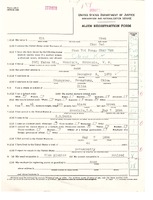 Alien Registration Form for Kit Chun (1940)
 The Alien Registration Act of 1940 required all non-citizens entering and living within the U.S. to register their alien status with the government by completing an Alien Registration Form. The AR-2 form included a questionnaire and a requirement that fingerprints be taken at the time of registration. This act, also known as the Smith Act, was written to address concerns about subversive activities on the eve of American involvement in World War II.
-
Allotment and Assimilation Era
1887-1934. The Allotment and Assimilation Era began with the Dawes Act and was characterized by the forced assimilation of Native Americans. Allotment ended the reservation system and broke up communal tribal lands, granting individual allotments to tribal members. 2/3 of Native land was lost during this period. Assimilation was an inherently violent process that included Native American boarding schools in an attempt to directly colonize the people. This period also saw Native Americans gaining federal citizenship rights as a tool for assimilation.
-
Amending Indian Appropriation Act of 1892
This report from the Committee of Public Lands asserted that dispossessed treaty lands and former military reservations should be closer in price per acre to lands distributed under the Homestead Act.
-
American Indian Religious Freedom Act (1978)
This act protected the right of Native Americans to practice their traditional religions and access to sacred sites, objects, and materials. The act was amended in 1994 to allow for the protected use of peyote as a sacrament in traditional religious ceremonies.
-
American Samoa
The islands of Tutuila, Aunu’u, Ofu, Olosega and Ta’u and the Rose and Swains atolls in the South Pacific.
-
Amicus Brief
An amicus brief is a legal document filed in a case by third parties who have an interest in the case but are not directly involved. For example, the American Historical Association and the Organization of American Historians submitted an amicus brief in Haaland v. Brackeen regarding the history of child removal in tribal communities.
-
An Account of the Slave Trade on the Coast of Africa (1788)
A first-person account of what the slave trade looked like and the conditions on slave ships. The account demonstrates the cognitive dissonance between understanding that enslaved people are humans and the profit-centered ways they were treated.
-
An Act Concerning Slaves and Servants (1813)
This act was one of several passed by the New York State Legislature relating to the gradual abolition of slavery. It details conditions for manumission and reiterates that any child born to an enslaved woman after July 4, 1799 would be born free, and establishes rules for the care of freedmen.
-
An Act for the Abolition of the Slave Trade (1807)
The Act abolishes the slave trade in and among British territories, but not the slave trade itself. This came at the same time the United States ended the slave trade, although Britain abolished all slavery several decades before the United States.
-
An Act for the Gradual Abolition of Slavery (1799)
This act was the first of several passed by the New York State Legislature relating to the gradual abolition of slavery. It declared that any child born to an enslaved woman after July 4, 1799 would be born free, provided that the child serve the enslaver of his or her mother until they reach the age of twenty-eight years and twenty-five years respectively.
-
An Act For the removal of restrictions from part of the lands of allottees of the Five Civilized Tribes, and for other purposes (1908)
This congressional act established Oklahoma county probate courts as the main arbiters of land held by allottees of the Five Tribes. In particular, minors, incompetents, and deceased members of the Five Tribes were targeted for guardian interventions in the probate courts.
-
An Act Further to Protect Personal Liberty (1843)
This Massachusetts personal liberty law aimed to counteract the Fugitive Slave Act of 1793 by forbidding state-level judges and law enforcement officers from arresting or detaining any person "for the reason that he is claimed as a fugitive slave."
-
An Act in Relation to Female Suffrage (1871)
This act in Washington Territory specifically denied women the right to vote. Women were given the right to vote with the passage of the 19th Amendment, nearly 50 years later.
-
An Act making compensation to Messrs. Lewis and Clark, and their companions (1807)
This Congressional act showed government interest in land appropriation. Exploration by white Americans laid foundations for tribal land dispossession.
-
An Act Relating to Woman Suffrage (1897)
This act proposed to amend the Constitution of Washington State to grant women suffrage rights. Washington was one of 12 states to grant women the right to vote prior to the adoption of the 19th Amendment in 1920.
-
An Act Relative to Slaves and Servants (1817)
This act was the last of several passed by the New York State Legislature relating to the gradual abolition of slavery. It set July 4, 1827, as the date of emancipation for enslaved people in the state who had been born before July 4, 1799.
-
An Act respecting slaves, free negroes and mulattoes (1847)
This Missouri law is one of the Black Codes designed to ensure white supremacy prior to the Civil War, limiting literacy and assembly for enslaved people as well as preventing interstate travel for free Black people.
-
An Act Temporarily Providing for Such Persons as Have Been to the Present Time Considered as Slaves (1865)
This law, which did not universally abolish slavery in the Choctaw Nation, regulated the way in which persons who had been previously enslaved in the nation were allowed to remain with their former enslavers. It also legally barred any Black enslaved person who escaped from bondage in the Choctaw Nation from "returning for the purpose of residing in the Nation."
-
An Act to Adopt the Freedmen of the Choctaw Nation (1883)
This act enrolled Choctaw Freedpeople as citizens of the Choctaw Nation, seventeen years after their emancipation.
-
An Act to Adopt the Negroes of the Chickasaw Nation (1873)
This tribal law, which was adopted by the Chickasaw Nation on January 10, 1873, called for the adoption of Chickasaw Freedmen as citizens of the Chickasaw Nation. The law included three primary stipulations for the adoption of Chickasaw Freedmen as tribal citizens: first, that Chickasaw Freedmen be excluded from any financial interests in the $300,000 the tribe would receive and any other tribal invested funds or claims; second, that despite these exclusions from monetary benefits, Chickasaw Freedmen be considered fully subject to the "jurisdiction and laws" of the Chickasaw Nation; and third, that the law would go into effect after being approved "by the proper authority of the United States." The law would not be approved by the U.S. Congress until 1894.
-
An Act to Amend "An Act Relative to Crime and Punishment" (1835)
This Indiana state statute regarding abortion reflects the diverse landscape of abortion law in the nineteenth century. This law punished individuals for helping pregnant women obtain a miscarriage.
-
An Act to Authorize the Sale of Certain Lands to the State of Oklahoma (1953)
This law authorized the state of Oklahoma to buy land once under the control of tribal nations, as the U.S. government resolved to terminate the special trustee relationship tribes held with the United States, further eroding tribal sovereignty.
-
An Act to continue in force and to amend "An Act to establish a Bureau for the Relief of Freedmen and Refugees,'' and for other Purposes (1866)
This act of Congress extended the Freedmen's Bureau until 1868. The Freedmen's Bureau was established during Reconstruction to manage the affairs of the formerly enslaved and refugees from the Civil War. President Andrew Johnson vetoed the bill, but the veto was overridden by Congress.
-
An Act to enable persons held in slavery, to sue for their freedom (1807)
This territorial statute presented an opportunity for enslaved people to sue for their freedom in Louisiana Territory courts. It also specified how petitioners were to be treated by defendants while the freedom suit was being heard.
-
An Act to enable the President of the United States to take possession of the territories ceded by France to the United States (1803)
This federal law allowed the United States to ratify the Louisiana Purchase Treaty, and reflected United States ambitions toward empire, while ignoring critical issues regarding the incorporation of Native nations.
-
An Act to establish a Bureau for the Relief of Freedmen and Refugees (1865)
This act of Congress created the Freedmen's Bureau in order to provide aid and support to the formerly-enslaved people across the South.
-
An Act to Grant to the Women of Wyoming Territory the Right of Suffrage and to Hold Office (1869)
Wyoming was the first state to grant women suffrage rights. This act was the first in the world to grant women the right to vote and access to holding public office. It came 50 years before the 19th Amendment that guaranteed women's suffrage to the entire United States. Wyoming was the first of 15 states to grant women suffrage rights prior to the passage of the 19th Amendment.
-
An Act to Prevent Kidnapping (1820)
This act is Pennsylvania's first personal liberty law. It was written to counteract the Fugitive Slave Act of 1793 and preserve the ability of free Black people to live in Pennsylvania. The act made kidnapping any Black person a felony punishable by large fines and lengthy imprisonment. It also fined any state official that took cognizance of the case of "any fugitive from labor."
-
An Act to Prevent the Immigration of Free Negroes into this State (1853)
This Illinois law was prohibited African Americans from moving into the state. Part of the series of laws known as Black Codes, this law and others like it intended to ensure racial inequality prior to the Civil War. Black people who resided in the state for longer than ten days could face arrest, fines, and sale by auction. Any white citizen who reported their presence was given half of the fine paid by the Black person.
-
An Act to provide for designation by cities and towns of segregation districts for residence of white and colored persons (1912)
Acts passed by the Virginia General Assembly reflected race-neutral language of the legal code after the Civil War. Application of these statutes resulted in entrenched Jim Crow segregation.
-
An Act To provide for the appointment of additional judges of the United States court in the Indian Territory, and for other purposes (1895)
This act reorganized the federal court system in Indian Territory. The establishment of United States courts worked to undermine tribal judicial systems by asserting broad federal authority over regional criminal and civil disputes.
-
An Act To provide for the care and support of insane persons in the Indian Territory (1904)
This act weaponized Western medical diagnoses against tribal citizens in Indian Territory for the purpose of incarceration and confinement. Nearly four hundred Native people, from fifty different nations, were confined to the Canton Asylum during its operation from 1902-1934.
-
An Act to Terminate Certain Federal Restrictions upon Indians (1953)
This act ended federal support for programs on Native reservations, as the U.S. government resolved to terminate the special trustee relationship tribes held with the United States, further eroding tribal sovereignty.
-
Angell Treaty (1880)
The Angell Treaty of 1880 amended the Burlingame Treaty of 1868 and sought to regulate, limit, and suspend the arrival of Chinese laborers to the United States. Article Three of the treaty established a clause stating that Chinese subjects experiencing violence and mistreatment on U.S. soil should be entitled to protection by the U.S. government.
-
Ann v. Henry Hight (1816)
Ann was a Black woman indentured by a man who took her from Maryland to Illinois and finally into Missouri, contrary to an Illinois law that required the consent of the servant if they were taken beyond the state's borders. Upon her employer's death, the executor of his estate, Henry Hight, claimed her as a slave for life. Ann petitioned for her freedom in a Missouri court and won.
-
Ann Williams, Ann Maria Williams, Tobias Williams, & John Williams v. George Miller & George Miller Jr. (1832)
In this successful freedom suit, a mother petitioned for her freedom and that of her three children. While her claim for freedom was not recorded in the documents filed with the court, it was likely on the basis of Maryland's ban on the importation of enslaved people for the purpose of being sold. Ann Williams had been brought into the District of Columbia in 1815 to be sold south to Georgia. In response to the impending sale, 24 year old Ann leapt from the attic of the three-story tavern owned by George Miller. Her arms and back were broken in the fall, and she was purchased by the tavern keeper for $5. The jury in her case rendered a verdict for her freedom and that of her children.
-
Antebellum Period
1820-1860. The Antebellum Period stretches from the Missouri Compromise until the secession of South Carolina. The prominent legal issue during this period was that of slavery and its expansion, as well as the restriction of rights for free Black people in the South. It also marked the beginning of Native American removal policies that displaced Native tribes in order to make way for white settlement.
-
Applegate v. Luke (1927)
After the Phillips County Chancery Court struck down Arkansas' Alien Land Act of 1925 as unconstitutional, Attorney General H. W. Applegate appealed the case to the Arkansas Supreme Court. Justice T. H. Humphreys upheld the lower court's ruling, arguing that the alien land law violated Section 20 of the the Declaration of Rights in the State Constitution.
-
Arch v. Barnabas Harris (1818)
This freedom suit illustrates how enslaved people presented a fundamental issue in the legal system. The central question in Arch's case was a question between personal liberty, enshrined in the Declaration of Independence, versus a right to personal property, also enshrined in the Declaration.
-
Arizona
The land and territory that would become the State of Arizona.
-
Arkansas
The land and territory that would become the State of Arkansas.
-
Arkansas Alien Land Act (1925)
This act was passed by the Arkansas General Assembly in 1925 to restrict the ability of aliens ineligible for citizenship to acquire, possess, enjoy, use, cultivate, occupy, and transfer real property, or any interest therein," unless specified in treaties.
-
Arkansas Declaration of Rights (1874)
This excerpt from the Declaration of Rights in the 1874 (and current) Arkansas State Constitution contains the language prohibiting the distinction between resident aliens and citizens in regard to property.
-
Articles of Confederation (1777)
The first constitution of the United States, the Articles of Confederation, were only in place for eight years due to the limited power granted to the federal government. The Articles of Confederation were replaced by the current constitution in 1789.
-
Articles of Peace and Amity (1666)
This treaty, signed between the English colony of Maryland and twelve Eastern Woodland Native American nations, stipulated the rights of Native peoples and their lands and established regulations for interactions between Native Americans and English colonists. The document reflects an already established relationship between the colonists and Native nations by 1666.
-
Asian Americans
Asian Americans refers to people in America who have Asian ancestry and who may or may not have achieved citizenship due to discriminatory exclusion laws. These laws often defined Asian Americans as "aliens ineligible for citizenship." The term Asian American does not take into account the complexities of Asian identities in the United States. Asian Americans have faced racial, social, sexual, and political discrimination throughout U.S. history.
-
Asian Americans Confront U.S. Law and Policy: A Case Study of the Vietnamese Impact on Defining the "Refugee"
This teaching module looks at the role Vietnamese migrants played in creating the current status of refugees, featuring a webinar with Linda Ho Peché, project director for the Vietnamese in the Diaspora Digital Archive.
-
Asian Immigrants' Fight Against Discriminatory Alien Land Laws
This module examines the history of anti-Asian/Japanese alien land laws in the 1920s United States, focusing on one lawsuit by Chinese immigrant Lum Jung Luke that brought down Arkansas' Alien Land Act.
-
Aspisa v. Hardage Lane (1837)
In this freedom suit, Aspisa sued for her freedom, arguing that her mother's residence in the free Northwest Territory before being taken to St. Louis where Aspisa was born entitled her to her freedom. Aspisa had filed previously against former enslavers including Joseph Rosati, the first Bishop of Saint Louis. A jury decided in favor of Aspisa's freedom in 1839, however, in a subsequent trial, the court determined her status was enslaved.
-
Baker v. Nelson (1972)
Baker v. Nelson was first same-sex marriage case to be reviewed by the Supreme Court. The Supreme Court dismissed the appeal from the Minnesota Supreme Court, stating that the case did not bring forward "a substantial federal question." This case reflects the lack of thought given to LGBTQ+ rights in 1972.
-
Balzac v. Porto Rico (1922)
Balzac v. Porto Rico is one of a series of cases decided by the Supreme Court addressing the status of U.S. territories known as the Insular Cases. The court in Balzac ruled that residents of Puerto Rico were not guaranteed a trial by jury. In Dorr v. United States, the Supreme Court ruled the same way for residents of the Philippines.
-
Bill of Rights (1791)
The first 10 amendments to the Constitution guarantee certain personal rights and limit the power of the federal government. These amendments are continuously considered by the Supreme Court in their rulings.
-
Borderlands
Borderlands are the often-contested spaces where different nations, ethnic groups, or societies interact with one another. The border may refer to either a physical border or an ideological one.
-
Boston Port Act (1774)
One of the Intolerable or Coercive Acts, the Boston Port Act closed Boston harbor to all commerce until the city paid for the tea destroyed during the Boston Tea Party. The Boston Port Act attempted to subdue Boston’s revolutionary residents. After this act and the other Intolerable Acts were passed, the First Continental Congress met to formalize a reaction to the perceived overstepping of British parliament.
-
Bowers v. Hardwick (1986)
Later overturned by Lawrence v. Texas, this Supreme Court case ruled that the 14th Amendment did not prevent states from prohibiting sexual relations between same-sex couples.
-
Brief of Amici Curiae American Historical Association and Organization of American Historians In Support of Federal and Tribal Parties (2022)
The amicus brief for Haaland v. Brackeen, submitted by the American Historical Association and the Organization of American Historians in support of federal and tribal parties, outlines key historical issues of child removal in tribal communities.
-
Brief of Historians of Marriage and the American Historical Association as Amici Curiae in Support of Petitioners (2015)
This amicus brief for Obergefell v. Hodges was submitted by historians affiliated with the American Historical Society in support of same sex marriage.
-
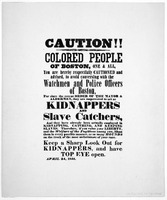 Broadside Reacting to the Fugitive Slave Act (1851)
 This broadside was distributed in Boston following the passage of the Fugitive Slave Act of 1850.
-
Brown v. Board of Education (1954)
The Supreme Court found in Brown v. Board of Education that educational segregation violated the Equal Protection Clause of the Fourteenth Amendment. This landmark case overturned the precedent created by the decision in Plessy v. Ferguson, and ended the Jim Crow era.
-
Buck v. Bell (1927)
In this case, the Supreme Court legitimized eugenic sterilization laws. Justice Oliver Wendell Holmes Jr. ruled that a Virginia statute permitting the forced sterilization of institutionalized people found to be "afflicted with an hereditary form of insanity or imbecility" was within the power of the State under the Fourteenth Amendment and did not violate the Constitution. Regarding Carrie Buck and her family, Justice Holmes declared, "Three generations of imbeciles are enough."
-
Burke Act (1906)
The Burke Act amended Section 6 of the Dawes Act to explicitly add competency as a legal marker for allottees, tying settler-colonial judgements of social and cultural behavior to land holding.
-
Burlingame-Seward Treaty (1886)
In the wake of the Second Opium War (1865-60), United States Secretary of State William Seward and the U.S. Minister to China Anson Burlingame negotiated what became known as the Burlingame Treaty of 1868. The treaty established trade ports for the U.S. in China, opened Chinese consuls in the U.S., and permitted the free immigration and travel of Chinese immigrants to the United States under the "the most-favored nation principle."
-
Cable Act (1922)
The Cable Act was a federal law that repealed the Expatriation Act, restoring United States citizenship to American women married to foreigners. The act reflected early goals from newly-won women's suffrage.
-
California
The land and territory that would become the State of California.
-
California Proposition 6 (2024)
A proposed amendment to the California that would have banned involuntary servitude as a punishment for a crime. This measure failed in the 2024 election, meaning the State of California remains one of 16 states that still allows forced labor. A similar ballot measure also failed in 2022.
-
Chain Gang Blues (1925)
Chain Gang Blues was a song recorded by blues singer Ma Rainey in 1925 that reflects the experience of Black Americans in the Jim Crow South. In the song, the protagonist has been sent on the chain gang for reasons that she thinks are unjust.
-
Charles Mahoney v. John Ashton (1791)
This freedom suit was based on the claim that the petitioner was descended from a free Black woman who was an indentured servant when she arrived in colonial Maryland from England. Mahoney's attorneys invoked the Somerset principle, 18th century British case law, and even the Declaration of Independence to secure his freedom, but after three jury trials, Mahoney remained enslaved.
-
Charlotte Dupee, Charles, & Mary Ann v. Henry Clay (1829)
In this freedom suit, Charlotte Dupee sought to claim freedom for herself and her children from Henry Clay, the outgoing Secretary of State and leading Whig Senator from Kentucky. While the courts did find in her favor, Charlotte continued to resist her enslavement until she and her daughter Mary Ann were ultimately manumitted 1840.
-
Charter
A charter is the legal document granting colonial governments the right to create a colony. It outlines the rights, privileges, and responsibilities given to colonists by the sovereign.
-
Charter of Delaware (1701)
The charter for the colony of Delaware guarantees the residents of the colony "freedom of their consciences" as well as religious freedom, stating that if these are abridged no man can be truly happy. It also sets up the rules and values of the colony's government. Colonial charters outline the boundaries of their colony and set up a government for the colony. These documents provide insight into the values of the colonies' founders. The Delaware charter also provides limits on the governor's powers including setting up the terms for impeachment.
-
Charter of Georgia (1732)
The charter of Georgia sets up the rules and values of the colony’s government. Georgia was founded as a place to relocate debtors of London to give them a chance to make a living and pay back their debts. The colony’s location buffered profitable South Carolina from the Spanish Colonies and Native Americans in Florida and beyond. Colonial charters outline the boundaries of their colony and set up a government for the colony. Colonial charters provide insight into the values of the colonies’ founders. The Charter of Georgia limited the amount of land individuals could own because of its goals to relocate the poor.