 Statement of Facts in Dred Scott v. Sanford (1854) Statement of Facts in Dred Scott v. Sanford (1854) |
|
The parties in Dred Scott v. Sandford agreed to a "Statement of Facts" about the timeline of events in Scott's life that were relevant to his freedom suit. This agreed upon evidence downplayed Dred Scott's active role in putting his case before the court.
|
| Statement of the Chickasaw Freedmen, Setting Forth Their Wrongs, Grievances, Claims and Needs (1894) |
|
This statement prepared by members of the Committee of Chickasaw Freedmen's Association recounts how the Chickasaw Nation had not met its treaty obligations to Chickasaw Freedpeople.
|
| Stenberg v. Carhart (2000) |
|
In this case, the Supreme Court found that a Nebraska state ban on partial-birth abortion was unconstitutional, as it failed to include a health exception and imposed an "undue burden" on people seeking abortions.
|
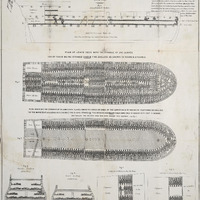 Stowage of the British slave ship "Brookes" under the Regulated Slave Trade Act (1788) Stowage of the British slave ship "Brookes" under the Regulated Slave Trade Act (1788) |
|
This image was used by English abolitionists to demonstrate the terrible conditions aboard slave ships.
|
| Students for Fair Admission v. Harvard (2023) |
|
This Supreme Court case considered whether Harvard's admissions process violated Title VI of the Civil Rights Act. The Court decided that the race-based admissions system did not meet the strict scrutiny required to allow a race-based system, and held as unconstitutional the consideration of an applicant’s race as a factor in making an admissions decision that benefits diversity.
|
| Studying the Missing and Murdered Indian Crisis Act of 2019 |
|
This bill was introduced to authorize the Government Accountability Office to collect data and study the crisis of missing and murdered Native Americans. It did not pass into law, but was a part of a broader legislative effort to bring awareness to murdered and missing Indigenous People.
|
| Sugar Act (1764) |
|
The Sugar Act of 1764 imposed duties on sugar, molasses, wine, and other goods imported to United States colonies. The act also includes expectations of stricter adherence to trade regulations and steeper penalties for violations. It even includes a provision to defend those enforcing the act. It was part of a series of bills imposing unequal tariffs on North American colonies and those in England. These policies aided in the popularity of independence movements in North America.
|
| Sworn Affidavit of Alexander Harlin Regarding His Continued Enslavement Until the 1866 Treaty as Part of His Application for Enrollment as a Choctaw (1896) |
|
In this sworn affidavit, Alexander Harlin attested that he, as a "Choctaw Freedman, of African Blood," was enslaved by a Choctaw woman Sarah Harlin until the Treaty of 1866 was signed. The statement was made in support of his application for enrollment in the Choctaw Nation under the Act of June 10, 1896 which authorized the Dawes Commission to add names to existing tribal rolls.
|
| Sworn Affidavit of Jeff Franklin Regarding His Enslavement and Emancipation in the Chickasaw Nation as Part of His Application for Enrollment as a Chickasaw (1896) |
|
In this sworn affidavit, Jeff Franklin attested that he was a colored man and was enslaved by Easter Colber, a Chickasaw man until April 28th, 1866, when the Treaty of 1866 was signed. The statement was made in support of his application for enrollment in the Chickasaw Nation under the Act of June 10, 1896 which authorized the Dawes Commission to add names to existing tribal rolls. The affidavit also includes information about his continued residency in the Chickasaw Nation until the time of his application in 1896.
|
| Sworn Statement of W. L. Cochran as to the Enslavement of Margaret Clark in 1866 in Support of Her Application for Enrollment as a Choctaw (1896) |
|
In this sworn statement, W. L. Cochran attested that Margaret Clark, "an African woman," was enslaved by R. L. Cochran in the Choctaw Nation until the Treaty of 1866 was signed. The statement was made in support of Margaret Clark's application for enrollment in the Choctaw Nation under the Act of June 10, 1896 which authorized the Dawes Commission to add names to existing tribal rolls.
|
| Tea Act (1773) |
|
The Tea Act created a monopoly on the tea trade for the East India Company. It ultimately lowered tea prices in Britain but forced colonists to pay the Townshend tax on tea. Reactions to the Act sparked the Boston Tea Party. Prior to the Tea Act, the East India Company was required to sell tea directly to London and then other merchants would sell tea to the colonies. The Tea Act eliminated third party merchants and forced colonists to buy taxed tea.
|
| Terry v. Ohio (1968) |
|
Terry v. Ohio is the landmark Supreme Court case that established the basis for stop and frisk policies. These policies disproportionately affect Black people and lead to the disproportionate incarceration of Black Americans.
|
| Texas Poll Tax (1901) |
|
This poll tax law in Texas was voted on in a referendum in the 1902 election as a proposed amendment to the state constitution.
|
| The Bull Inter Caetera (1493) |
|
The Bull Inter Caetera legitimized European land claims in the Western Hemisphere by decree of the Catholic Church. Establishing the Doctrine of Discovery, this papal decree became the legal basis for land claims in the region.
|
| The Cherokee Removal Through the Eyes of a Private Soldier (1890) |
|
A former Army soldier presents a first-hand account of Cherokee removal.
|
| The Five Civilized Tribes Act (1906) |
|
This act legislated the end of tribal enrollment in the Five Tribes, as well as the dissolution of their tribal government. However, section 28 extended tribal sovereignty for the Five Tribes for a truncated 30 days per year.
|
| The Great Law of Peace of the Iroquois Confederacy (1142) |
|
The Constitution of the Haudenosaunee (Iroquois), also known as the Six Nations, dates back to as early as 1142. The political system this oral constitution established was greatly admired by the Founding Fathers, who incorporated many of its democratic principles into the U.S. Constitution.
|
| The Letters of Amerigo Vespucci, the First Voyage (1503) |
|
The account of Amerigo Vespucci's first voyage to the Americas features depictions of Indigenous people that created negative stereotypes.
|
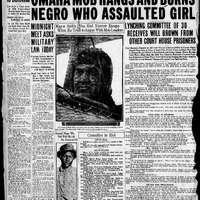 The Lynching of Will Brown (1919) The Lynching of Will Brown (1919) |
|
The day after the lynching of Will Brown, the Omaha Bee devoted the first two pages of its edition to the racial terror violence enacted by a mob of white Omahans. The articles on these pages provide different perspective of the race riot, from the crowds cheering at the destruction of government buildings, to the alleged assault victim's shock at the incident. The newspaper also featured a list of victims of the mob.
|
| The Slave, Grace (1827) |
|
In this freedom suit, an enslaved woman who had spent time in England was re-enslaved once she voluntarily returned to her home in Antigua. The court found that while she became free once she set foot on English soil, her status reverted to that of enslaved once she returned to Antigua.
|
| The True Facts in the Case of Felix Quander (1879) |
|
In August 1879, Felix Quander was shot and injured by law enforcement officers while evading arrest. In a letter to the Editor of the National Republican newspaper in D.C., Quander's attorney describes the event, as well as previous incidents that lead up to the shooting and capture of Quander. Related newspaper coverage of the ordeal and subsequent court case follows. While the National Republican and Evening Star tend to display varying degrees of sympathy for Quander, the Alexandria Gazette is harsh in its judgment of the man and his reputation.
|
| The Woman Suffrage Movement and Frederick Douglass (1908) |
|
In this speech given on the 60th Anniversary of the Seneca Falls Convention, Black women's rights advocate Mary Church Terrell reflects on the role of Frederick Douglass in the women's suffrage movement.
|
| Tinker v. Des Moines School District (1969) |
|
The Supreme Court's decision in this case recognized the First Amendment right to freedom of speech or expression in U.S. public schools.
|
| Townshend Revenue Act (1767) |
|
The Townshend Acts were a series of taxes and regulations imposed on the American colonies by the British Parliament. The Townshend Revenue Act levied taxes on glass, lead, tea, and paper, replacing the Stamp Act, which was repealed the year before.
|
| Treaty of Amity, Commerce and Navigation (1794) |
|
Unpopular with the American public, this treaty between the United States and Britain attempted to resolve outstanding issues from American independence. This treaty, also known as John Jay’s Treaty, made trade between the two countries more even and reduced British military presence in the U.S.
|