 Perez v. Sharp (1948) Perez v. Sharp (1948) |
|
In this case, a 4-3 majority of the Supreme Court of California ruled that the state's ban on interracial marriage violated the 14th Amendment. It was the first of any state to strike down an anti-miscegenation law in the U.S, preceding Loving v. Virginia by almost 20 years.
|
| Peter and others v. Susanna Elliott and Rachell Elliott (1787) |
|
This freedom suit was brought forth by 22 enslaved people who were freed by a deed of manumission that was then contested by the executrixes of the former enslaver upon his death. The court found in favor of the re-enslavement of Peter and the other 21 freedmen.
|
| Planned Parenthood v. Casey (1992) |
|
In the Supreme Court case of Planned Parenthood v. Casey, the ruling in Roe v. Wade was upheld, but changed the scrutiny standard from "strict scrutiny" to an "undue burden" standard.
|
| Platt Amendment (1903) |
|
The Platt Amendment was a part of the Army Appropriations Act of 1901 and stipulated conditions of Cuban independence following the Spanish-American war. It laid the foundation of Cuban-U.S. relations for the next several decades.
|
| Plessy v. Ferguson (1896) |
|
In Plessy v. Ferguson, the Supreme Court found that racial discrimination did not violate constitutional equal protection. This case established the principle of "separate but equal" which was overturned in 1965 by the decision in Brown v. Board of Education.
|
| Plymouth, Massachusetts, Colonial Court Cases (1646-1675) |
|
These excerpts from the Records of the Colony of New Plymouth in New England document Native Peoples' engagement with the law after a 1641 code grants due process.
|
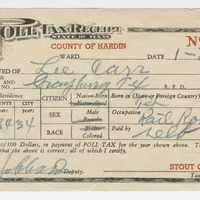 Poll Tax Receipt for Lee Carr (1955) Poll Tax Receipt for Lee Carr (1955) |
|
An image of a poll tax receipt from Texas. Poll taxes were a tool to prevent Black people and poor people from voting, since the poll tax was often a significant percentage of someone's weekly income.
|
| President Johnson's Commencement Address at Howard University: "To Fulfill These Rights" (1965) |
|
In this speech given to Howard University's 1965 graduating class, President Lyndon B. Johnson talks about the Civil Rights and Voting Rights Acts being passed as a result of the Civil Rights Movement and the long-lasting impacts of systemic racism.
|
| President Thomas Jefferson's Confidential Message to Congress (1803) |
|
Jefferson's statement showed government interest in tribal removal, land appropriation, and eventual dispossession.
|
| Prigg v. Pennsylvania (1842) |
|
The case of Prigg v. Pennsylvania evaluated the legality of Pennsylvania's personal liberty laws. Margaret Morgan moved from Maryland to Pennsylvania after being granted her freedom. When relatives of her previous enslaver wanted to reclaim her, they sent Edward Prigg to Pennsylvania to find her. Pennsylvania courts found Prigg guilty of violating the state's personal liberty laws, but the Supreme Court ruled that the federal fugitive slave laws overrule state laws.
|
| Proclamation 10903 - Invocation of the Alien Enemies Act Regarding the Invasion of the United States by Tren de Aragua (2025) |
|
This proclamation issued by President Donald Trump invoked the Alien Enemies Act of 1798 to apprehend and remove suspected members of Tren de Aragua from within the U.S. The proclamation calls for the apprehension, restraint, and removal of Venezuelan citizens who are at least 14 years of age, within the U.S., and who are not U.S. citizens or lawful permanent residents.
|
| Proclamation 10948 - Enhancing National Security By Addressing Risks At Harvard University (2025) |
|
This presidential proclamation claims that because of an increase of criminal activity at Harvard University, and a failure of the University to comply with federal directives, international student visas will be revoked.
|
| Proclamation 10949 - Restricting the Entry of Foreign Nationals to Protect the United States from Foreign Terrorists and Other National Security and Public Safety Threats (2025) |
|
A presidential proclamation that reinstates the muslim travel ban from Donald Trump's first presidency.
|
| Proclamation 4417 - An American Promise (1976) |
|
This proclamation issued by President Gerald Ford confirmed the termination of Executive Order 9066, which had authorized the internment of Japanese-Americans during World War II.
|
| Proclamation of King Ferdinand of Spain (1514) |
|
This proclamation to the Taino and Arawak peoples of the New World informs them of new rule by Spain and the Catholic Church.
|
| Public Law 280 (1953) |
|
This law gave California, Minnesota, Nebraska, Oregon, and Wisconsin criminal and civil jurisdiction on Indian reservations, as the U.S. government resolved to terminate the special trustee relationship tribes held with the United States, eroding tribal sovereignty.
|
| Quartering Act (1765) |
|
A part of the American Mutiny Act, the Quartering Act required American colonists to house and board British soldiers. The Act placed financial burden of quartering soldiers on the colonies. It specified the supplies soldiers of different ranks were expected to be furnished with by the colonies, and the costs associated with failure to comply. This act is the reason the Third Amendment was included in the Constitution of the United States. Like the Stamp and Sugar Acts, the Quartering Act forced colonists into extra financial responsibilities without any representation in Parliament.
|
| Quartering Act (1774) |
|
One of the Intolerable or Coercive Acts, the Quartering Act of 1774 expanded the Quartering Act of 1765 to allow soldiers to be housed in private homes. While the other Intolerable Acts applied directly to Massachusetts, the Quartering Act applied to all of colonial North America. After this act and the other Intolerable Acts were passed, the First Continental Congress met to formalize a reaction to the perceived overstepping of British parliament.
|
| Queen Anne's Speech in Parliament (1712) |
|
In a speech by Queen Anne before Parliament, she described a contract granted to England by Spain for slave trading rights and emphasized peace with France, as England received the contract from Spain.
|
| Re: DEI Programs Are Lawful Under Federal Civil Rights Laws and Supreme Court Precedent (2025) |
|
This memorandum from law professors across the United States explains how diversity, equity, and inclusion initiatives are legally defensible, in spite of the January 21, 2025, Executive Order titled "Ending Illegal Discrimination and Restoring Merit-Based Opportunity."
|
| Re: February 14, 2025 Dear Colleague Letter issued by the United States Department of Education, Office of Civil Rights (2025) |
|
In this letter from the Montana University System, the Chief Legal Counsel responds to the Dear Colleague letter, describing its compliance with the guidance from the Dear Colleague Letter. It calls attention to Montana's work with tribal governments to increase the recruitment and retention of tribal students, noting that the Supreme Court has recognized distinctions based on tribal enrollment as political not racial classification.
|
| Reauthorization of the Violence Against Women Act Fact Sheet (2022) |
|
This statement from the White House outlines critical elements in the reauthorized Violence Against Women Act signed by President Joe Biden as part of the Consolidated Appropriations Act of 2022.
|
| Refugee Act (1980) |
|
This act provided a permanent and systematic procedure for the admission of refugees of special humanitarian concern to the United States as well as comprehensive and uniform provisions for the effective resettlement and absorption of the refugees who are admitted.
|
| Regents of the University of California v. Bakke (1978) |
|
Overturned by the Harvard and UNC v. Students for Fair Admissions decision, the Supreme Court in University of California v. Bakke ruled that college admissions were allowed to take race into account.
|
| Regulated Slave Trade Act (1788) |
|
This act, also known as Dolben's Act, placed limits and regulations on the slave trade, and illustrates the attempts to regulate the numbers of children in the slave trade.
|