 Terry v. Ohio (1968) Terry v. Ohio (1968) |
|
Terry v. Ohio is the landmark Supreme Court case that established the basis for stop and frisk policies. These policies disproportionately affect Black people and lead to the disproportionate incarceration of Black Americans.
|
| Texas Poll Tax (1901) |
|
This poll tax law in Texas was voted on in a referendum in the 1902 election as a proposed amendment to the state constitution.
|
| The Five Civilized Tribes Act (1906) |
|
This act legislated the end of tribal enrollment in the Five Tribes, as well as the dissolution of their tribal government. However, section 28 extended tribal sovereignty for the Five Tribes for a truncated 30 days per year.
|
| The Insular Cases and Contested Citizenship |
|
This teaching module discusses the intersection of U.S. colonial power and migration, featuring a webinar with Robert McGreevey, author of the 2018 book, Borderline Citizens: The United States, Puerto Rico, and the Politics of Colonial Migration.
|
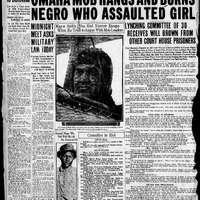 The Lynching of Will Brown (1919) The Lynching of Will Brown (1919) |
|
The day after the lynching of Will Brown, the Omaha Bee devoted the first two pages of its edition to the racial terror violence enacted by a mob of white Omahans. The articles on these pages provide different perspective of the race riot, from the crowds cheering at the destruction of government buildings, to the alleged assault victim's shock at the incident. The newspaper also featured a list of victims of the mob.
|
| The Treaty of 1866 and the Long Fight for Black Belonging in the Choctaw and Chickasaw Nations |
|
This module reframes histories of the Civil War, emancipation, and Reconstruction by analyzing how enslaved and freed Black people in the Choctaw and Chickasaw Nations struggled to actualize their freedoms amid contested tribal and federal jurisdictions. Ultimately, the module elucidates how Black enslaved and Freedpeople in the Chickasaw and Choctaw Nations developed unique methods of resistance and visions of freedom shaped by the legal paradigms forged in the Treaty of 1866.
|
| The Woman Suffrage Movement and Frederick Douglass (1908) |
|
In this speech given on the 60th Anniversary of the Seneca Falls Convention, Black women's rights advocate Mary Church Terrell reflects on the role of Frederick Douglass in the women's suffrage movement.
|
| Tydings–McDuffie Act (1934) |
|
This act established the process for the independence of the Philippine Islands, then a U.S. territory, after a ten-year transition period. The act reclassified Filipinos them from U.S. nationals to aliens and limited the number of immigrants from the Philippines to 50 per year.
|
| Undesirable Aliens Act (1929) |
|
This act made unlawfully entering the U.S. a crime for the first time. Immigrants who did not cross the border through an official point of entry, where they had to pay a fee and submit to tests, could be charged with a misdemeanor crime, facing fines and up to a year's imprisonment. Returning to the U.S. after deportation was made a felony, punishable by $1,000 in fines and up to two years imprisonment. This law applied to all immigrants entering the U.S., but was intended to restrict immigration from Mexico.
|
| United Nations Universal Declaration of Rights (1948) |
|
This document, drafted by a committee of the United Nations chaired by Eleanor Roosevelt, details the "basic rights and fundamental freedoms" due all peoples regardless of "race, colour, sex, language, religion, political or other opinion, national or social origin, property, birth or other status."
|
| United States v. Cartozian (1925) |
|
In this case, the District Court of Oregon debated whether an Armenian immigrant was white enough to be naturalized. Just two years after the Supreme Court ruled that Ozawa, a Japanese man, and Thind, a South Asian man, were not white enough for naturalization, the Oregon court ruled that people from Asia Minor were close enough to European descent to be naturalized.
|
| United States v. Sandoval (1913) |
|
In this case, the Supreme Court ruled that the Pueblo people were Indians, repudiating the earlier United States v. Joseph decision which had held that they were not. The title to Pueblo lands was now seen as held by tribes instead of in fee simple, meaning that Congressional approval was needed in order to make land sales. This undermined the legitimacy of non-Indian land titles across New Mexico.
|
| United States v. Thind (1923) |
|
The Supreme Court found in U.S. v. Thind that Indian immigrants were not eligible for naturalization, based on a contested category of whiteness. Contradicting their 1922 ruling in Ozawa naming caucasian identity as a requirement for naturalization, as a South Asian immigrant, Thind was deemed ineligible for citizenship because, despite being racially caucasian, he did not appear white.
|
| United States v. Wong Kim Ark (1898) |
|
In United States v. Wong Kim Ark, the Supreme Court solidified the principle of birthright citizenship, affirming that anyone born in the U.S., regardless of their parents' citizenship, is a U.S. citizen.
|
| Vanguard: Black Women and the Right to Vote |
|
This teaching module discusses how Black women fought against both racism and sexism during their fight for women's suffrage, featuring a webinar with Martha S. Jones, author of the 2020 book, Vanguard: How Black Women Broke Barriers, Won the Vote, and Insisted on Equality for All.
|
| Voting Rights Act (1965) |
|
The Voting Rights Act of 1965 prohibits racial discrimination in voting, enforcing the voting rights protected by the Fourteenth and Fifteenth Amendments. Its intent was to outlaw the discriminatory voting practices adopted by many southern states against African Americans. Its power was severely reduced by the 2013 Supreme Court Decision in Shelby County v. Holder.
|
| War Brides Act (1945) |
|
The War Brides Act was a federal law that allowed for the naturalization of foreign women married to United States servicemen.
|
| Webinar - Affirmative Action's Origins and Legacies (2023) |
|
In this webinar, UNL Law Faculty Eric Berger, Danielle Jefferis, and Catherine Wilson provide an in-depth look at affirmative action, delving into its origins and tracing its impact to the present day.
|
| Webinar - Before the Movement: The Hidden History of Black Civil Rights (2026) |
|
In this webinar, Professor Dylan C. Penningroth of the University of California, Berkeley, discusses his award-winning 2023 book, Before the Movement: The Hidden History of Black Civil Rights, examining how Black people used the law in their everyday lives prior to the civil rights movement.
|
| Webinar - From Back Alley to the Border: Criminal Abortion in the 20th Century U.S. (2024) |
|
In this webinar, Dr. Alicia Gutierrez-Romine of California State University, San Bernardino, discusses U.S. constitutionalism and criminal abortion in the 20th century with Dr. William Thomas and his American Constitutional History class.
|
| Webinar - Latina/os and Criminal and Immigration Law Enforcement (2025) |
|
In this webinar, Professor Kevin R. Johnson of the University of California, Davis, discusses the history of criminal and immigration law enforcement of Latina/os in the U.S with Dr. Donna D. Anderson and her And Justice For All class.
|
| Webinar - The Insular Cases and Contested Citizenship (2024) |
|
In this webinar, Professor Robert McGreevey of the College of New Jersey discusses the intersection of U.S. colonial power and migration with Dr. Jeannette Eileen Jones and her And Justice For All class.
|
| Webinar - Vanguard: Black Women and the Right to Vote (2024) |
|
In this webinar, Professor Martha S. Jones of Johns Hopkins University discusses Black women and the right to vote with Dr. William Thomas and his American Constitutional History class.
|
| Williams v. Walker-Thomas Furniture Co. (1965) |
|
In this case, a U.S. Court of Appeals decided that a lower court could rule a contract unconscionable and therefore not enforceable. Ora Lee Williams, a resident of an underprivileged Black neighborhood in Washington, D.C., had signed an installment sales contract containing a clause that gave the seller the right to repossess all prior goods purchased under the contract upon missing a payment on the most recent purchase, even if she had already paid enough to cover what was owed. Justice Wright remanded the case back to the lower court with a new definition of unconscionability. This case is an example of abusive credit practices targeting those in poverty in the U.S.
|
| Yasui v. United States (1943) |
|
In this case, the Supreme Court held that curfews against minority groups were constitutional at a time of war against the country that group's ancestors originated from. After the Executive Order 9066 was issued in the wake of the attack on Pearl Harbor, Japanese Americans were subject to curfews and other restrictions in addition to being removed to internment camps. Minoru Yasui was convicted of violating the curfew. This was a companion case to Hirabayashi v. United States, decided on the same day.
|