 The Carceral State: Legal Histories of American Unfreedom The Carceral State: Legal Histories of American Unfreedom |
|
This teaching module discusses race, the carceral state, and the criminalization of Blackness, featuring a webinar with legal historian Taja-Nia Henderson.
|
| The Five Civilized Tribes Act (1906) |
|
This act legislated the end of tribal enrollment in the Five Tribes, as well as the dissolution of their tribal government. However, section 28 extended tribal sovereignty for the Five Tribes for a truncated 30 days per year.
|
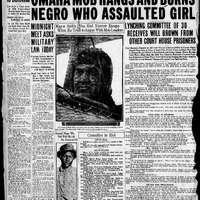 The Lynching of Will Brown (1919) The Lynching of Will Brown (1919) |
|
The day after the lynching of Will Brown, the Omaha Bee devoted the first two pages of its edition to the racial terror violence enacted by a mob of white Omahans. The articles on these pages provide different perspective of the race riot, from the crowds cheering at the destruction of government buildings, to the alleged assault victim's shock at the incident. The newspaper also featured a list of victims of the mob.
|
| The Slave, Grace (1827) |
|
In this freedom suit, an enslaved woman who had spent time in England was re-enslaved once she voluntarily returned to her home in Antigua. The court found that while she became free once she set foot on English soil, her status reverted to that of enslaved once she returned to Antigua.
|
| The Timing of Queen v. Hepburn: An exploration of African American Networks in the Early Republic (2015) |
|
This essay explores the phenomenon of multigenerational networks of freedom-making through the petition for freedom cases of the Queen family in Washington, D.C.
|
| The Treaty of 1866 and the Long Fight for Black Belonging in the Choctaw and Chickasaw Nations |
|
This module reframes histories of the Civil War, emancipation, and Reconstruction by analyzing how enslaved and freed Black people in the Choctaw and Chickasaw Nations struggled to actualize their freedoms amid contested tribal and federal jurisdictions. Ultimately, the module elucidates how Black enslaved and Freedpeople in the Chickasaw and Choctaw Nations developed unique methods of resistance and visions of freedom shaped by the legal paradigms forged in the Treaty of 1866.
|
| The True Facts in the Case of Felix Quander (1879) |
|
In August 1879, Felix Quander was shot and injured by law enforcement officers while evading arrest. In a letter to the Editor of the National Republican newspaper in D.C., Quander's attorney describes the event, as well as previous incidents that lead up to the shooting and capture of Quander. Related newspaper coverage of the ordeal and subsequent court case follows. While the National Republican and Evening Star tend to display varying degrees of sympathy for Quander, the Alexandria Gazette is harsh in its judgment of the man and his reputation.
|
| The Woman Suffrage Movement and Frederick Douglass (1908) |
|
In this speech given on the 60th Anniversary of the Seneca Falls Convention, Black women's rights advocate Mary Church Terrell reflects on the role of Frederick Douglass in the women's suffrage movement.
|
| Treaty with the Choctaw and Chickasaw (1866) |
|
The 1866 Treaty with the Choctaw and Chickasaw was one of a series of treaties between the United States government and each of the "Five Civilized Tribes" (the Cherokee, Chickasaw, Choctaw, Muscogee Creek, and Seminole Nations) at the end of the Civil War. The treaty details the stipulations for the Choctaw and Chickasaw Nations to re-establish their allegiance with the U.S. after allying with the Confederate States of America during the Civil War. Among other provisions, the Choctaw and Chickasaw Treaty of 1866 included articles that outlawed slavery within both nations (except as a punishment for crime), provided a pathway for citizenship and civil rights for the Freedmen of both nations, and ceded lands to the United States.
|
| Trouble in Fairfax: The Quander Case (1879) |
|
In February 1879, Felix Quander and his family were the victims of violence at the hands of county officials. In a letter to the Editor of the National Republican newspaper in D.C., Quander, or someone writing on his behalf, describes the attack upon his family. Related newspaper coverage of events follow.
|
| U.S. Freedman's Bank Records, Registers of Signatures of Depositors, New York (1870) |
|
Freedman's Bank records show both strivings toward stability as well as racialization and colorism post-emancipation due to the specific color-related information listed with deposits.
|
| Unis et al. v. Charlton's Administrator et al. (1855) |
|
In this freedom suit, the descendants of a Black woman named Flora claimed their freedom on the grounds that Flora was free before being abducted and sold into slavery in Virginia. Between 1826-1855, a series of cases bounced around county and appellate courts in Virginia before finally being decided against freedom for Flora's descendants.
|
| United States v. The Amistad (1841) |
|
This freedom suit originated after 53 Africans revolted and took control of the Spanish slave ship that intended to enslave them in Cuba. The ship was eventually seized by the U.S. Navy off the coast of Long Island and the Africans were taken into custody and charged with mutiny and murder. After a series of court appearances, the Supreme Court ruled that the Africans were "free negroes" who had been "unlawfully kidnapped, and forcibly and wrongfully carried on board" the Amistad. They were ordered to be released. After obtaining their freedom, missionary groups helped the surviving Africans return to Sierra Leone.
|
| Vanguard: Black Women and the Right to Vote |
|
This teaching module discusses how Black women fought against both racism and sexism during their fight for women's suffrage, featuring a webinar with Martha S. Jones, author of the 2020 book, Vanguard: How Black Women Broke Barriers, Won the Vote, and Insisted on Equality for All.
|
| Voting Rights Act (1965) |
|
The Voting Rights Act of 1965 prohibits racial discrimination in voting, enforcing the voting rights protected by the Fourteenth and Fifteenth Amendments. Its intent was to outlaw the discriminatory voting practices adopted by many southern states against African Americans. Its power was severely reduced by the 2013 Supreme Court Decision in Shelby County v. Holder.
|
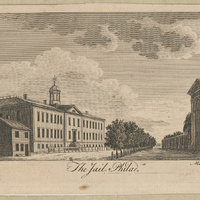 Walnut Street Prison (1789) Walnut Street Prison (1789) |
|
An etching of the Walnut Street Prison in Philadelphia. Established as a city jail in 1773, it was expanded in 1790 to become the first state penitentiary in the new country. This prison was among the first to feature individual cells and was built to accommodate work details. The penitentiary was noted to have a larger percentage of Black inmates than white, noting the racialization of incarceration in the United States. The prison was in operation until 1838.
|
| Webinar - Affirmative Action's Origins and Legacies (2023) |
|
In this webinar, UNL Law Faculty Eric Berger, Danielle Jefferis, and Catherine Wilson provide an in-depth look at affirmative action, delving into its origins and tracing its impact to the present day.
|
| Webinar - Asian Americans Confront U.S. Law and Policy: A Case Study of the Vietnamese Impact on Defining the "Refugee" (2024) |
|
In this webinar, Drs. Linda Ho Peché and Donna D. Anderson discuss the role Vietnamese migrants played in creating the current status of refugees with our And Justice For All class.
|
| Webinar - Before the Movement: The Hidden History of Black Civil Rights (2026) |
|
In this webinar, Professor Dylan C. Penningroth of the University of California, Berkeley, discusses his award-winning 2023 book, Before the Movement: The Hidden History of Black Civil Rights, examining how Black people used the law in their everyday lives prior to the civil rights movement.
|
| Webinar - Color-Evasive Love and Freedom from Violence in (Neo)Liberal Adoption Laws (2025) |
|
In this webinar, Professor Kit Myers of the University of California, Merced, discusses race, adoption, and family in the United States with Dr. Donna D. Anderson and her And Justice For All class.
|
| Webinar - D.C. Divided: Segregation in the Nation's Capital (2025) |
|
This webinar discusses the racially restrictive covenants used by early 20th century developers and white citizens to prevent Black residents and other groups from buying or leasing property in Washington, D.C. This community conversation hosted by the Institute of Politics, Policy & History features a panel of historians, legal scholars, and descendants who reveal the history of the enduring impact of racial covenants in D.C. and how residents fought back.
|
| Webinar - Equal Protection, Reconstruction, and the Meaning of the 14th Amendment (2023) |
|
In this webinar, Dr. Kate Masur of Northwestern University discusses the 14th Amendment and the implications of equal protection under the law with Dr. Sharlene Sinegal-DeCuir of Xavier University and Dr. William Thomas and his American Constitutional History class.
|
| Webinar - More Than a Snapshot: Will Brown's Lynching and the Violence of History (2025) |
|
In this webinar, Professor Ashley Howard of the University of Iowa discusses racial violence in the Midwest with Dr. Katrina Jagodinsky and her Rights & Wrongs in American Legal History class.
|
| Webinar - The Carceral State: Legal Histories of American Unfreedom (2024) |
|
In this webinar, Professor Taja-Nia Henderson of Rutgers Law School discusses race, the carceral state, and the criminalization of Blackness with Professor Danielle Jefferis of the University of Nebraska College of Law and our And Justice For All class.
|
| Webinar - Vanguard: Black Women and the Right to Vote (2024) |
|
In this webinar, Professor Martha S. Jones of Johns Hopkins University discusses Black women and the right to vote with Dr. William Thomas and his American Constitutional History class.
|