In the Matter of the Petition of Timoteo Andrade to be Admitted a Citizen of the U.S.A. (1936)
United States of America
Petition for Citizenship
No. 24049
To the Honorable the US District Court of Western Dist of NY at Buffalo NY
The petition of Timoteo Andrade, hereby filed, respectfully shows:
(1) My place of residence is 207 Georgia St, Buffalo NY.
(2) My occupation is waiter.
(3) I was born in Lagos, Mexico, on January 24, 1898. My race is Mexican.
(4) I declared my intention to become a citizen of the United States on December 27, 1929, in the Supreme Court of New York, at Buffalo, NY.
(5) I am married. The name of my wife or husband is Sara; we were married on November 18, 1918, at El Paso, Texas; She was born at El Paso, Texas, on August 15, 1915, for permanent residence therein, and now resides at Buffalo, NY. I have 3 children, and the name, date, and place of birth, and place of residence of each of said children are as follows: Michael, born 9/20/21 at Galesburg, Illinois; Maria, born 1/20/24; and Timoteo Jr, born 11/3/27 at Buffalo N.Y. All reside at Buffalo NY.
(6) My last foreign residence was Torreon, Mexico. I emigrated to the United States of America from Torreon, Mexico. My lawful entry for permanent residence in the United States was at El Paso, Texas, under the name of Timoteo Andrade on June 15, 1915, on the vessel Bridge as shown by the certificate of my arrival attached hereto.
(7) I am not a disbeliever in or opposed to organized government or a member of or affiliated with an organization or body of persons teaching disbelief in or opposed to organized government. I am not a polygamist nor a believer in the practice of polygamy. I am attached to the principles of the Constitution of the United States and well disposed to the good order and happiness of the United States. It is my intention to become a citizen of the United States and to renounce absolutely and forever all allegiance and fidelity to any foreign prince, potentate, state, or sovereignty, and particularly to The United States of Mexico of whom (which) at this time I am subject (or citizen), and it is my intention to reside permanently in the United States.
(8) I am able to speak the English language.
(9) I have resided continuously in the United States of America for the term of five years at least immediately preceding the date of this petition, to wit, since June 15, 1915, and in the County of Erie, this State, continuously next preceding the date of this petition, since November 17, 1920, being a residence within said county of at least six months next preceding the date of this petition.
(10) I have not heretofore made petition for citizenship. . . .
Attached hereto and made a part of this, my petition for citizenship, are my declaration of intention to become a citizen of the United States, certificate from the Department of Labor of my said arrival, and the affidavits of the two verifying witnesses required by law.
Wherefore, I, your petitioner, pray that I may be admitted a citizen of the United States of America, and that my name be changed to ——
I, your aforesaid petitioner being duly sworn, depose and say that I have read/heard read this petition and know the contents thereof; that the same is true of my own knowledge except as to matters herein stated to be alleged upon information and belief, and that as to those matters I believe it to be true; and that this petition is signed by me with my full, true name.
Timoteo Andrade
Affidavits of Witnesses
Bernard Malvern, occupation salesman, residing at 550 Shirley Ave, Buffalo NY, and Thomas Harding, occupation salesman, residing at 347 Riley St, Buffalo NY, each being severally, duly, and respectively sworn, deposes and says that he is a citizen of the United States of America; that he has personally known and has bene acquainted in the United States with Timoteo Andrade, the petitioner above mentioned, since March 1, 1930, and that to his personal knowledge the petitioner has resided in the United States continuously preceding the date of filing this petition, of which this affidavit is a part, to wit, since the date last mentioned, and at Buffalo, in the County of Erie, this State, in which the above-entitled petition is made, continuously since March 1, 1930, and that he has personal knowledge that the petitioner is and during all such periods has been a person of good moral character, attached to the principles of the Constitution of the United States, and well disposed to the good order and happiness of the United States, and that in his opinion the petitioner is in every way qualified to be admitted a citizen of the United States.
Bernard Malvern
Thomas Harding
Subscribed and sworn to before me by the above-named petitioner and witnesses in the office of the Clerk of said Court at Buffalo, NY, this 12th day of March, Anno Domini 1935. I hereby certify that certificate of arrival No. 5-4 from the Department of Labor, showing the lawful entry for permanent residence of the petitioner above named, together with declaration of intention No. 48281 of such petitioner, has been by me filed with, attached to, and made a part of this petition on this date.
May C. Sickmon, Clerk.
By Margaret [Unclear], Deputy Clerk
Oath of Allegiance
I hereby declare, on oath, that I absolutely and entirely renounce and abjure all allegiance and fidelity to any foreign prince, potentate, state, or sovereignty, and the particularly to The United States of Mexico of whom (which) I have heretofore been a subject (or citizen); that I will support and defend the Constitution and laws of the United States of America against all enemies, foreign and domestic; that I will bear true faith and allegiance to the same; and that I take this obligation freely without any mental reservation or purpose of evasion; So help me God. In acknowledgment whereof I have hereunto affixed my signature.
Timoteo Andrade
Sworn to in open court, this 1st day of June, A. D. 1936
May C. Sickmon, Clerk
By Roland E. Logel, Deputy Clerk.
Petition granted: Line No. 1 of List No. 462 and Certificate No. 4038215 issued.
Petition denied: List No.
Petition continued from Oct 5, 1935 to List 398
Petition continued from May 7, 1936 to List 456
Dec. 5, 1935. See attached opinion & separate file.
U.S. Department of Labor
Bureau of Naturalization
No. 54
Certificate of Arrival
I hereby certify that the Immigration records of the Department of Labor show that the alien named below arrived at the port, on the date and in the manner shown, and was lawfully admitted to the United States of America for permanent residence.
Port of entry: El Paso, Texas
Name: Timoteo Andrade
Date: June 15, 1915
Manner of arrival: Bridge
I further certify that this certificate of arrival is issued under authority of, and in conformity with, the provisions of the Act of June 29, 1906, as amended, solely for the use of the alien herein named and only for naturalization purposes.
In Witness Whereof, this Certificate of Arrival is issued Nov. 30, 1929
By direction of the Secretary of Labor.
Raymond F. Crist
Commissioner of Naturalization
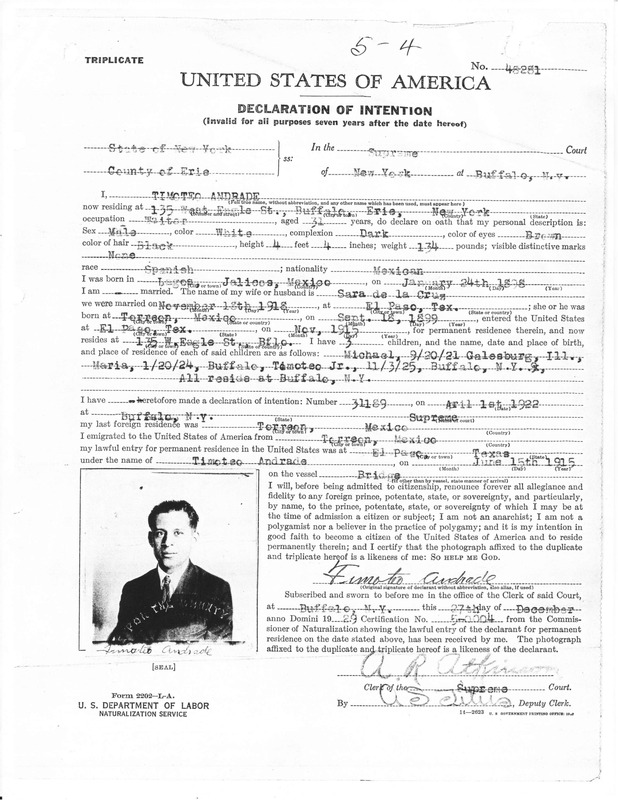
No. 48281
United States of America
Declaration of Intention
(Invalid for all purposes seven years after the date hereof)
State of New York
County of Erie ss:
In the Supreme Court of New York at Buffalo, N.Y.
I, Timoteo Andrade, now residing at 135 West Eagle St. Buffalo, Erie, New York, occupation waiter, aged 31 years, do declare on oath that my personal description is: sex male, color white, complexion dark, color of eyes brown, color of hair black, height 4 feet 4 inches; weight 134 pounds; visible distinctive marks none; race Spanish; nationality Mexican. I was born in Lagos, Jalicos, Mexico, on January 24th 1898.
I am married. The name of my wife or husband is Sara de la Cruz; we were married on November 18th 1918, at El Paso, Tex.; she or he was born at Torreon, Mexico, on Sept. 18, 1899, entered the United States at El Paso, Tex., on Nov. 1915, for permanent residence therein, and now resides at 135 W. Eagle St. Bflo. I have 3 children, and the name, date and place of birth, and place of residence of each of said children are as follows: Michael, 9/20/21 Galesburg, Ill., Maria, 1/20/24, Buffalo, Timoteo Jr., 11/3/25, Buffalo, N.Y. All reside at Buffalo, N.Y.
I have heretofore made a declaration of intention: Number 31189, on April 1st 1922 at Buffalo, N.Y. Supreme Court; my last foreign residence was Torreon, Mexico. I emigrated to the United States from Torreon, Mexico; my lawful entry for permanent residence in the United States was at El Paso, Texas, under the name of Timoteo Andrade, on June 15th 1915 on the vessel Bridge.
I will, before being admitted to citizenship, renounce forever all allegiance and fidelity to any foreign prince, potentate, state, or sovereignty, and particularly, by name, to the prince, potentate, state, or sovereignty of which I may be at the time of admission a citizen or subject; I am not an anarchist; I am not a polygamist nor a believer in the practice of polygamy; and it is my intention in good faith to become a citizen of the United States of America and the reside permanently therein; and I certify that the photograph affixed to the duplicate and triplicate hereof is a likeness of me: So help me God.
Timoteo Andrade
Subscribed and sworn to before me in the office of the Clerk of said Court, at Buffalo, N.Y. this 27th day of December anno Domini 1929 Certification No. 5-0004 from the Commissioner of Naturalization showing the lawful entry of the declarant for permanent residence on the date stated above, has been received by me. The photograph affixed to the duplicate and triplicate hereof is a likeness of the declarant.
A. R. Atkinson
Clerk of the Supreme Court
By A. S. Titus, Deputy Clerk.
United States District Court: Western District of New York
In the Matter of the Petition of Timoteo Andrade to be admitted a Citizen of the United States of America
Petition No. 2272-P-24049
Appearances: Arthur J. Karnuth, District Director of Immigration and Naturalization, by John L. Murff, Acting Naturalization Examiner.
Knight, District Judge: Timoteo Andrade, now a citizen of Mexico, has petitioned for admission to citizenship in the United States. The District Director of Immigration and Naturalization moves to dismiss the petition on the sole ground that petitioner is ineligible by race to citizenship. An affidavit of petitioner is presented setting forth that he is of Indian and Spanish blood in equal proportions.
Section 359, Title 8, of the United States Code, provides that the laws relating to naturalization shall apply to aliens being free white persons, and to aliens of African nativity and to persons of African descent. Petitioner is admittedly not of African nativity or descent. It is the contention of the Director that the petitioner is not a free white person.
In a note appended to its opinion in Morrison v. California, 291 U.S. 82, it is stated: "There is a strain of Indian blood in many of the inhabitants of Mexico as well as in the peoples of Central and South America. Whether the persons of such descent may be naturalized in the United States is still an unsettled question." The question is now raised as to an alien of one-half Indian blood.
In Ozawa v. United States, 260 U.S. 178, the rule is asserted that "the words 'white person' were meant to indicate only a person of what is popularly known as the Caucasian race." The term excludes the Chinese, Japanese, Hindus, the American Indians and the Filipinos. Morrison v. California, 291 U.S. 82; United States v. Thind, 261 U.S. 204.
The Supreme Court further states in Morrison v. California, supra, that "men are not white if the strain of colored blood in them is a half or a quarter, or, not improbably, even less, the governing test always (United States v. Thind, 261 U.S. 204) being that of common understanding." Applicants of one-half Japanese, one-half Chinese, and one-half Japanese-Chinese blood respectively, have been held ineligible to naturalization, In re Knight, 171 F. 299; Ex parte Hing, 22 F. (2d) 554; In re Young, 195 F. 645. In re Alverto, 198 F. 688, held an applicant of three-quarters Filipino blood ineligible. The nearest approach to a decision on similar facts is found In re Camille, 6 F. 257, wherein a person of one-half Indian blood, the mother having been an Indian woman of British Columbia, was denied naturalization. It is my opinion that the rule of these cases applies equally to the petitioner and renders him ineligible to citizenship in the United States.
In re Rodriguez, 81 F. 337, is not consistent with the later decisions of the Supreme Court.
The petition is denied.
December 11, 1935.
John Knight
United States District Judge
In the Matter of the Petition for citizenship of Timoteo Andrade
Petition 24049
Pursuant to stipulation signed February 28, 1936, in the case of Timoteo Andrade, by William H. Marshall, Acting District Director of Immigration and Naturalization for District #7 and Frederick T. Devlin, Attorney for Petitioner, further testimony was introduced by the Attorney for the Petitioner on March 11, 1936, and April 13, 1936, copies of which are hereto attached.
It is believed that the above testimony conclusively shows that the petitioner was in error when he stated, at the time of his preliminary examination on March 12, 1935, that he was fifty per cent Indian blood.
Since the only objection the Government had to the naturalization of the said Timoteo Andrade, the Government now withdraws its objection and your designated examiner recommends that his petition for citizenship be granted.
Ralph L. White
Designated Examiner.
In the Matter of the Petition for citizenship of Timoteo Andrade
Petition 24049. Preliminary Hearing Reopened by Stipulation. Dated February 28, 1936.
The petitioner was duly sworn.
By Mr. Frederick T. Devlin, Attorney for the Petitioner.
Q. What is your full name?
A. Timoteo Andrade.
Q. Where do you live now?
A. 207 Georgia St., Buffalo
Q. What is your business or occupation now?
A. I am a waiter.
Q. You are the petitioner in this application for citizenship?
A. Yes.
Q. There came a time, Mr. Andrade, when you stated in effect, in a certain paper or affidavit, or application, that you had been told, or that you understood that you were about seventy-five percent of Indian blood and about twenty-five percent Spanish blood. There came a further time when in some affidavit, you stated, in effect, that you had been told that you were about fifty percent Indian blood and about fifty percent of Spanish blood. Will you now explain first of all why you made the claim to a large percentage of Indian blood?
A. It happened this way. In Mexico, even if we have full Spanish blood, we say that we have Indian blood, because in Mexico we are all Mexicans. There is no distinction, no matter in what part of the Country we are born, and I thought that it would put me in a better position.
Q. Is the having of Indian blood something that is to be boasted of? Is it something to be proud of?
A. We are proud that we are Mexicans and we don't like to be told that we have Spanish or French blood.
Q. Was that true as of the time you left Mexico?
A. Yes.
Q. Do you know whether it was a common practice for Spaniards, who had no Indian blood, to boast of having Indian blood in their veins?
A. Yes.
Q. Do you know whether it was considered good business or good politics for a Spaniard to do so?
A. Yes, it was.
Q. Will you explain the circumstances under which you changed your statement concerning the percentage of Indian blood and the percentage of Spanish blood to fifty percent Indian?
A. I was asked how much Indian blood I had in me. I said, 'Maybe I have seventy-five percent; maybe fifty'.
Q. To whom did you state that?
A. To the Immigration Inspector in this office.
Mr. Devlin: I state for the record that the above was stated in answer to Examiner White's question.
By Examiner White.
Q. I understood him to say that he thought it would be to his advantage to state he had fifty percent Indian blood. Is that correct?
A. In Mexico, we hold (the Mexicans), even if we have not Indian blood, we are proud that we descended from Indians.
Q. That was all right when you were in Mexico, but now you are up here you have no reason to feel that way.
A. Since asking my mother, I think I have not two percent.
Q. What made you think, when you were in here, that you had fifty percent?
A. The real Mexican has part Indian blood and I figured this way, as I was Mexican.
By Mr. Devlin.
Q. When you were in here, did you know whether you had Indian blood or not?
A. No.
Maria Bera Andrade was duly sworn, as was Mr. Leon Lancaster, Mexican Consul, who acted as interpreter.
Q. What is your full name?
A. Maria Bera Andrade.
Q. Where do you reside?
A. In Georgia Street, 209.
Q. Are you related to Timoteo Andrade, the petitioner?
A. He is my son. . . .
Q. Before going further, Mrs. Andrade, have you any authentic papers, books, or other documents, showing your ancestry?
A. I have nothing at all. Everything was destroyed in Mexico during the revolution in 1915 against the Carranza government.
Q. Was that the uprising that involved Pancho Villa?
A. Yes.
Q. Did you have such papers prior to that time?
A. Before the revolution, I had all such papers.
Q. How did you lose them?
A. The Government Troops came in, destroyed the houses and a fire ruined everything. . . .
Q. Before we go into your husband's side of the picture, Mrs. Andrade, of what blood do you understand yourself to be?
A. Mexican.
Q. Of what race do you consider yourself to be, Spanish, French, or what?
A. Spanish. . . .
Q. Will you describe the appearance of your father?
A. He had dark complexion, dark eyes and the appearance of his face was like mine.
Q. What was his name?
A. Isidoro Bera.
Q. Just to refresh your recollection, I call attention to a charge which was a one time made under your supervision, in which you attributed blue eyes to your father and I ask whether your statement is correct or whether the chart is correct.
A. Timoteo made a mistake in writing it. It was my mother who had blue eyes.
Q. Will you describe her complexion, color of eyes and hair?
A. She had blue eyes, hair light brown and white complexion.
Q. Do you know of what race your father and your mother were?
A. My mother came of Spanish blood and my father of Mexican blood.
Q. When you speak of your father coming of Mexican blood, will you state what of that was Spanish blood, if any?
A. My father was part Spanish and part Mexican.
Q. Do you understand that when you speak of Mexican blood that designation is not a designation of blood which is accepted for the purposes of indicating ancestry and racial stock?
A. Yes. I understand it does not mean what kind of blood.
Q. Having that in mind then, and bearing in mind that the only thing we are trying to learn is of what kind of racial blood your father was, and having in mind that you have stated that he was part Spanish and part Mexican, can you help us any more by stating what blood he did have? What does Mexican blood mean to you?
A. To me, Mexican blood is the blood of the people living in Mexico. It might be Spanish, it might be mixed with Indian. . . .
Q. Taking your mother's side of your grandparents, and taking your mother's father, do you know of what racial blood he was?
A. He was of Spanish blood, so called Mexican.
Q. Do you know his name?
A. Miguel Hernandez.
Q. Will you describe him as to complexion, eyes, etc?
A. He had a white complexion and blue eyes.
Q. When you speak of his being of Spanish and Mexican blood, do you know, from your observation of him, or from family tradition, talk in the family through the years, whether he was predominantly Spanish or predominantly Mexican?
A. In appearance, Spanish. . . .
Q. What is the difference, in your mind, between Spanish and Mexican blood?
A. All I can say is that our blood is mixed with Mexican, the people who lived in Mexico, and with Spaniards. I have heard that we were mixed with Indian blood. A Spaniard and a Mexican, I think they are about the same as to blood. We all speak Spanish.
Q. What do you understand a Mexican to be as distinguished from a pure blooded Indian from the back country?
A. In the district from where my people have been for a number of years, when the Indians come from the neighboring towns, the people say, 'Here come the little Indians'; they never say, 'Here come the little Mexicans'.
Q. Is the State of Jalisco, and particularly the City of Lagos and its neighboring district made up of the earliest known Spanish settlers and their descendants?
A. Yes, they are.
Q. Can you tell us whether the descendants there now, or when you lived there, are they predominantly of Spanish or white complexions, as distinguished from the Indians who come out form the back woods?
A. They appear white.
Q. Is it not a fact that the State of Jalisco, next to the State which contains Mexico City, is the State to which the early Spanish and other white people came to settle?
A. Yes.
Q. Among your father and mother, and all of your grandparents that you ever knew, and including your husband's parents, did you ever see or hear, or know of any one of them that was an Indian?
A. No. . .
Q. Now, you have described the complexion and appearance of your mother's father. Will you describe the same characteristics of your mother's mother?
A. She was very short, had a white complexion and brown hair and blue eyes.
Q. Going over to your father's side, will you describe the same characteristics of your father's father?
A. He was dark.
Q. What color eyes?
A. Dark.
Q. As to your father's mother?
A. About the same appearance as I, brown eyes, dark complexion.
Q. Will you describe your husband?
A. Clear complexion, like Timoteo. . . .
Q. Did your husband ever tell you of what blood his father and mother were?
A. One of my daughters, when she went to school, studied French from her father and found out that her grandfather was French and that her grandmother was Spanish. . . .
Q. Do you understand that in Mexico it is considered an honor to have Indian blood?
A. For Mexicans in Mexico, yes.
Q. Is that true of the section of the Country where you came from?
A. Yes.
Q. Did you ever hear your father or either of your grandfathers claim to be Indian because of that feeling?
A. No. I never heard them speak about it. . . .
Q. Of all the parents of yourself and your husband and the grandparents of your husband, did you ever hear them use any Indian language or words?
A. No.
(Hearing held open.)
Certified true and correct transcript.
Grace Armstrong Handley
Clerk.
United States District Court: Western District of New York
In the Matter of The Petition of Timoteo Andrade to be admitted a Citizen of the United States of America.
Petition No. 2272-P-24049
Appearances: Arthur J. Karnuth, District Director of Immigration and Naturalization, by Ralph L. White, Designated Examiner; Frederick T. Devlin, for Petitioner.
Knight, District Judge: Heretofore this court denied the petition for citizenship of Timoteo Andrade. An affidavit of petitioner was then presented by petitioner setting forth that he is of Indian and Spanish blood in equal proportions. After the denial of the petition aforesaid, a re-hearing was had before the designated examiner and additional proofs are now submitted to this court upon an application for a rehearing on the petition for naturalization. As stated in my prior opinion, quoting from Morrison v. California, 291 U.S. 82: "men are not white if the strain of colored blood in them is a half or a quarter, or, not improbably, even less, the governing test always being that of common understanding." Other authorities quoted in such opinion fully sustain the conclusion that where one is half Indian and half Spanish blood he is not entitled to naturalization under the provisions of Section 359, Title 8, of the U.S. Code.
A different state of facts is now presented. The father of petitioner has long since died. The mother, Maria Bera Andrade, testified upon the re-hearing before the examiner. While her testimony is somewhat obscure, I think the construction that may be placed upon it is that this petitioner is of little Indian blood; that is about two percent. The petitioner, also, on the second examination, in effect, denied the statements made in the first proceeding that he was 50 to 75 percent of Indian blood. He claimed he was in mistake in this and offers explanation for such mistake. It appears by his statement now made that he has small percent, if any, of Indian blood in him. The examiner makes report to the court: "It is believed that testimony conclusively shows that the petitioner was in error when he stated, at the time of his preliminary examination on March 12, 1935, that he was fifty percent Indian blood." The government has withdrawn its objections herein and recommended that citizenship be granted.
It is my opinion under the facts as they are now disclosed the motion should be granted.
June 1, 1936.
John Knight
United States District Judge
- Title
- In the Matter of the Petition of Timoteo Andrade to be Admitted a Citizen of the U.S.A. (1936)
- Description
-
Timoteo Andrade was an immigrant from Mexico who arrived in the United States in 1915. In 1922, he began the naturalization process to become as a citizen as xenophobic tensions surrounding Mexican immigration in the U.S. flared. On his declaration of intention to naturalize, Andrade identified his race as Spanish and nationality as Mexican, while on his petition for citizenship, he listed his race as Mexican. During his naturalization interview, he stated that he was "fifty per cent Indian blood," which resulted in his naturalization being denied in 1935. The Mexican Consulate formally appealed the judge's decision in Andrade's case and two others'. Andrade's mother was interviewed and provided testimony regarding the lack of "Indian blood" in her son's ancestry, and in 1936, he was granted citizenship.
Timoteo Andrade's case is a significant example of how Mexican Americans were not readily accepted by the U.S. majority, and how immigrants continued to question the U.S. government's definition of "whiteness." The Andrades' answers to questions about their race demonstrate a difficulty in separating race and nation as they attempt to conform to the racial ideology in the U.S. at the time. - Excerpted
- Yes
- Date
- 1936-06-01
- Temporal Coverage
- Exclusion Era
- Great Depression and the New Deal
- Interwar Period
- Jim Crow Era
- Long Civil Rights Movement
- Prohibition Era
- World War I
- Allotment and Assimilation Era
- Related Documents
-
 Ozawa v. United States (1922)
-
United States v. Thind (1923)
-
Morrison v. California (1934)
- Document Category
- Primary Source
- Archival Source
- Citizenship Petition of Timoteo Andrade, Box 24, Petition #24049, Petitions for Naturalization, U.S. District Court for the Western District of New York, Record Group 21: Records of the U.S .District Courts of the United States, National Archives and Records Administration, Northeast Region, New York, NY.
- Item sets
- Naturalization
- Title
- In the Matter of the Petition of Timoteo Andrade to be Admitted a Citizen of the U.S.A. (1936)
- Description
-
Timoteo Andrade was an immigrant from Mexico who arrived in the United States in 1915. In 1922, he began the naturalization process to become as a citizen as xenophobic tensions surrounding Mexican immigration in the U.S. flared. On his declaration of intention to naturalize, Andrade identified his race as Spanish and nationality as Mexican, while on his petition for citizenship, he listed his race as Mexican. During his naturalization interview, he stated that he was "fifty per cent Indian blood," which resulted in his naturalization being denied in 1935. The Mexican Consulate formally appealed the judge's decision in Andrade's case and two others'. Andrade's mother was interviewed and provided testimony regarding the lack of "Indian blood" in her son's ancestry, and in 1936, he was granted citizenship.
Timoteo Andrade's case is a significant example of how Mexican Americans were not readily accepted by the U.S. majority, and how immigrants continued to question the U.S. government's definition of "whiteness." The Andrades' answers to questions about their race demonstrate a difficulty in separating race and nation as they attempt to conform to the racial ideology in the U.S. at the time. - Excerpted
- Yes
- Date
- 1936-06-01
- Temporal Coverage
- Exclusion Era
- Great Depression and the New Deal
- Interwar Period
- Jim Crow Era
- Long Civil Rights Movement
- Prohibition Era
- World War I
- Allotment and Assimilation Era
- Related Documents
-
Ozawa v. United States (1922)
-
United States v. Thind (1923)
-
Morrison v. California (1934)
- Document Category
- Primary Source
- Archival Source
- Citizenship Petition of Timoteo Andrade, Box 24, Petition #24049, Petitions for Naturalization, U.S. District Court for the Western District of New York, Record Group 21: Records of the U.S .District Courts of the United States, National Archives and Records Administration, Northeast Region, New York, NY.
- Item sets
- Naturalization