Illinois Women Participants in Suffrage Parade (1913)
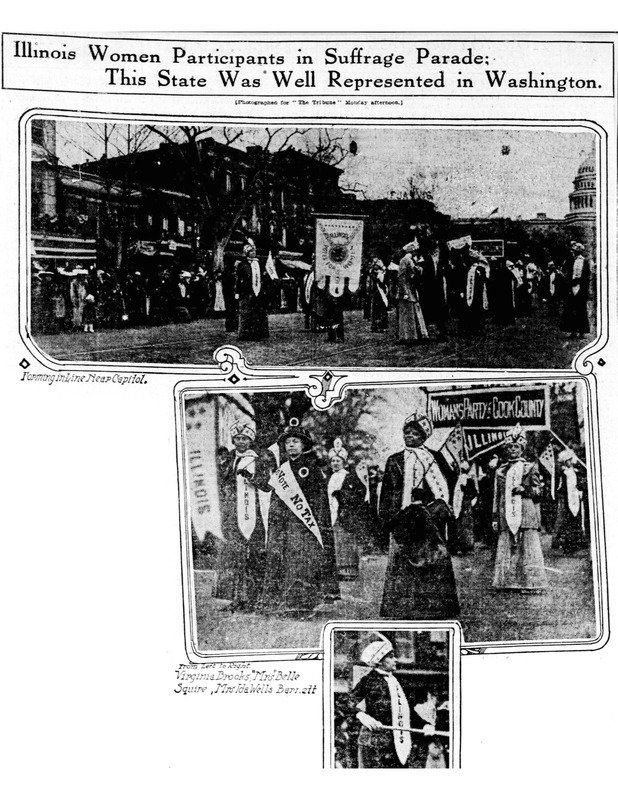
Illinois Women Feature Parade
Delegation from This State Wins High Praise by Order in Marching.
Cheered by Big Crowd.
Question of Color Line threatens for While to Make Trouble in Ranks.
Washington, D.C., March 3.—The Illinois delegation today won the place of first rank in the suffrage parade in the opinion of the spectators along the line of march.
The women, in their trig stoles of white, with jaunty turbans set at a military angle, marched with the precision of veteran soldiers and brought forth much praise from the men who lined the sidewalks of Pennsylvania avenue.
"Look at the Illinois suffragists. They sure do keep step," shouted one excited boy scout as the delegation passed his stand.
Mrs. George Welles [Clara Barck Welles], chairman of the Illinois parade committee and major of the state delegation, walked at the head of the marchers, giving the signal to stand at "attention," "forward, march," and "turn," with a large brass baton which was presented to her a few days ago by a veteran who had carried it at the battle of Gettysburg. The way she kept her troops in marching order during the long waits of half an hour or more would have done credit to a "regular" army officer.
Delegation Numbers Sixty-five.
The Illinois delegation numbered sixty-two marchers at the start and finished with sixty-five, a number double that of many of the western delegations. The state band, the money for which was donated by the north side branch of the Illinois Equal Suffrage association, was one of the largest and best in the entire parade. . . .
One Hitch in Program.
Preceding Mrs. Charlotte Rhodus, with the banner of her organization, the Woman's Party of Cook county, was a row containing only three suffragists whose interpretation of Democratic principles almost resulted in the disruption of the Illinois delegation at the drill this morning. As a result, they did not join the marchers until they had passed half way down the line of march on Pennsylvania avenue.
In the center of the row was Mrs. Ida Wells Barnett, a member of the Chicago Woman's club and president of the Alpha club, a suffrage organization of colored women. Flanking her on both sides were her two champions, Miss Virginia Brooks, the "Joan of Arc" of West Hammond, and Mrs. Belle Squire, president of the No Vote, No Tax league.
The first hint that there was to be any discrimination against the colored women came with Mrs. Welles was putting the Illinois suffragists through their practice in the drill hall on the second floor of the suffrage parade headquarters. Mrs. Trout, who had been missing from the room for some minutes, came in hurriedly, held a short conference with Mrs. Welles, and then announced to the waiting women that it was a question whether Mrs. Barnett would march with her delegation. A murmur of excitement passed round the room and those standing near the colored woman kept an embarrassed silence.
Mrs. Trout Voices Protest
"Many of the eastern and southern women have greatly resented the fact that there are to be colored women in the delegations," announced Mrs. Trout. "Some have even gone so far as to say they will not march if negro women are allowed to take part. Mrs. [Genevieve] Stone of the National Suffrage association and the woman in charge of the entire parade1 has advised us to keep our delegation entirely white. So far as Illinois is concerned, we should like to have Mrs. Barnett march in the delegation, but if the national association has decided it is unwise to include the colored women, I think we should abide by its decision." She looked around for approval.
"You are right; it will prejudice southern people against suffrage if we take the colored women into our ranks," said Mrs. Schuyler Coe Brandt [Salie Eunice Wilbur] of Oak Park, a Georgia woman and a sympathizer with the southern suffragists.
"But it is entirely undemocratic," interrupted Miss Brooks. "We have come down here to march for equal rights. It would be autocratic to exclude men or women of any color. I think that we should allow Mrs. Barnett to walk in our delegation. If the women of other states lack moral courage, we should show them that we are not afraid of public opinion. We should stand by our principles. If we do not the parade will be a farce."
Plea by Mrs. Barnett.
Mrs. Barnett's voice trembled with emotion and two large tears coursed their way part way down her cheeks before she could raise her veil and wipe them away. "The southern women have tried to evade the question time and again by giving some excuse or other every time it has been brought up," she said. "If the Illinois women do not take a stand now in this great democratic parade then the colored women are lost."
"It is time for Illinois to recognize the colored woman as a political equal," replied Mrs. Trout, "and you shall march with the delegation."
But the matter was not settled. Someone drew Mrs. Trout aside, whispered a few words in her ear, and then, to everyone's surprise, the Illinois delegate announced that she should have to see Mrs. Stone before any final decision could be made.
Each woman of the Illinois delegation had a decided opinion of the matter and did not hesitate to express it.
Mrs. Squire is Peacemaker.
"It will be undemocratic if we do not let Mrs. Barnett march with us," declared Miss Marion Drake. "But we should not go against the law of the national association. We are only a small part in the great line of march, and we must not cause any confusion by disobeying orders."
In the meantime, Mrs. Barnett, looking much disappointed, took a seat quietly beside Mrs. Belle Squire, who has been ill since she reached Washington yesterday afternoon. "It will be all right, I'm sure," said Mrs. Squire, patting Mrs. Barnett's hand reassuringly.
"I am afraid that we shall not be able to have you march with us," announced Mrs. Trout, reappearing in the room, followed by Mrs. Welles. "Personally I should like nothing more than to have you represent our Illinois suffrage organization. But I feel that we are responsible to the national association and cannot do as we choose."
"After talking again with Mrs. Stone, I shall have to ask you to march with the colored delegation. I am sorry, but I feel that it is the right thing to do."2
Ultimatum by Mrs. Barnett.
"I shall not march at all unless I can march under the Illinois banner," indignantly replied Mrs. Barnett. "When I was asked to come down here I was asked to march with the other women of our state, and I intend to do so or not take part in the parade at all."
"If I were a colored woman, I should be willing to march with the other women of my race," argued Mrs. Welles.
"There is a difference, Mrs. Welles, which you probably do not see," replied Mrs. Barnett. "I shall not march with the colored women. Either I go with you or not at all. I am not taking this stand because I personally wish for recognition. I am doing it for the future benefit of my whole race." Her face set in lines of grim determination, but her voice trembled and several tears glistened in her eyes.
"If you will walk in the colored delegation, Mrs. Barnett, I shall walk by your side," said Mrs. Squire.
"I shall join Mrs. Barnett and Mrs. Squire," announced Miss Brooks. "I think it would be a disgrace for Illinois women to let Mrs. Barnett march alone when the parade is intended to show woman's demand for the great principles of Democracy."
Mrs. Barnett Accepts Plan.
Mrs. Barnett consented to march with the women of her race when the two suffragists promised to join her. For a time it looked as if many in the delegation would swing over to her support. In time to avoid further defections in the ranks, Mrs. Trout announced the meeting adjourned until the afternoon.
At 2 o'clock the three suffragists were missing from the Illinois delegation, which had drawn into line on New Jersey avenue in advance of the parade. Half an hour later, Miss Brooks walked up and inquired if Mrs. Squire and Mrs Barnett had been seen.
Hearing that Mrs. Squire was not likely to take her place with any of the marchers on account of illness, Miss Brooks announced she was willing to march alone with Mrs. Barnett.
"They have said you are going to do it because you want publicity," someone warned her.
"Let anyone say anything they please," she replied. "I cannot prevent that, but I can prevent having one of our delegation left to march alone, almost as if she were in disgrace. I shall go and find Mrs. Barnett."
Later, Mrs. Squire appeared, asked for Mrs. Barnett, and set off on a search for the stray delegate.
All Return to Fold.
A little further down the line, Miss Brooks joined the delegation. She joined Mrs. Squire. The sympathy for Mrs. Barnett changed to alarm. It was feared she had taken her dismissal from the ranks as a personal matter and had decided to stay away.
Suddenly, from the crowd on the sidewalk, Mrs. Barnett walked calmly out to the delegation and assumed her place at the side of Mrs. Squire. There was no question raised of her eligibility and she finished the parade. . . .
Mrs. W. H. Stuart, a member of the Chicago Political Equality league and a fine horsewoman, rode beside Illinois' women on a spirited horse. Several times she helped out the mounted police force which was inadequate to handle the crowds. . . .
1. This is incorrect. According to the official program for the Woman Suffrage Procession, Genevieve Stone was chairman of the committee that had supervision of the delegations of marchers from non-suffrage states. The chairman of the Joint Suffrage Procession Committee in charge of the parade was Alice Paul.
2. There is nothing in the historical record to indicate that there was a separate delegation specifically for Black women. Black women who participated in the procession marched with their state, occupational, and organizational delegations. This confusion is illustrative of the unclear instructions passed down by parade committee leaders who were unwilling to alienate racist white women participants by standing up for Black women who wanted to march.