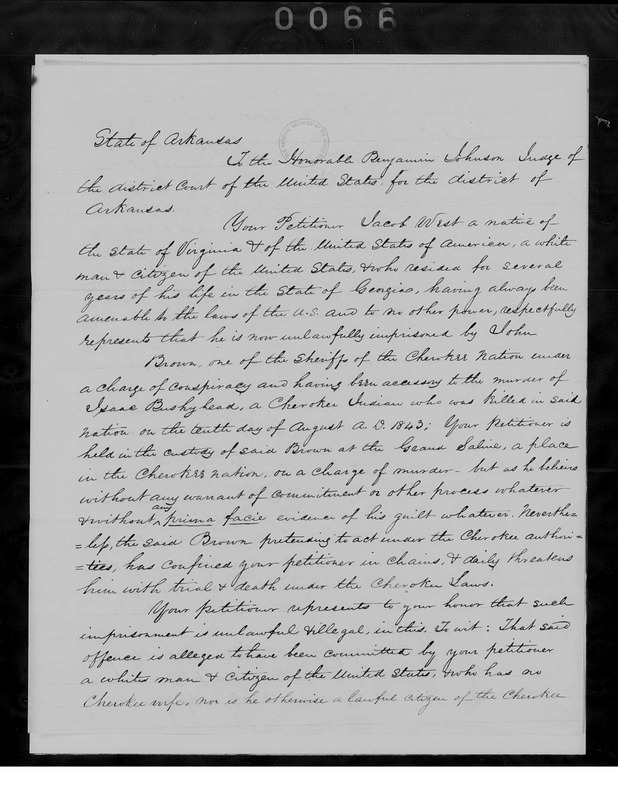
In the Matter of the Application of Jacob West for a Writ of Habeas Corpus (1843)
State of Arkansas
To the Honorable Benjamin Johnson Judge of the district court of the United States for the district of Arkansas.
Your Petitioner Jacob West a native of the state of Virginia & of the United States of American, a white man & citizens of the United States, & who resided for several years of his life in the State of Georgia, having always been amenable to the laws of the U.S. and to no other power, respectfully represents that he is not unlawfully imprisoned by John Brown, one of the Sheriffs of the Cherokee Nation under a charge of conspiracy and having been accessory to the murder of Isaac Bushyhead, a Cherokee Indian who was killed in said nation on the tenth day of August A. D. 1843; Your Petitioner is held in the custody of said Brown at the Grand Saline, a place in the Cherokee Nation, on a charge of murder, but as he believes without any warrant of commitment or other process whatever & without any prima facie evidence of his guilt whatever. Nevertheless, the said Brown pretending to act under the Cherokee authorities, has confined your petitioner in chains, & daily threatens him with trial & death under the Cherokee Laws.
Your Petitioner represents to your honor that such imprisonment is unlawful & illegal, in this. To wit: That said offence is alleged to have been committed by your petitioner a white man & citizen of the United States, & who has no Cherokee wife, nor is he otherwise a lawful citizen of the Cherokee Nation, in any wise subject to their laws or jurisdiction. But that if he is guilty of the crime with which he is charged, he is amenable to the laws of the U.S. by virtue of an act of Congress approved June 30th 1834 entitled "An Act to regulate trade and intercourse with the Indian tribes, and to preserve peace on the Frontiers." By virtue of which law and by the act of 1st March 1837 entitled "An Act to extend the Jurisdiction of the District Court of the United States for the District of Arkansas" exclusive jurisdiction of offences by whites upon Indians and the Indians upon whites, is given to the District Court of the United States; To which jurisdiction of the Courts of the United States your petitioner is ready to submit, and now offers to submit, praying that by it an impartial trial may be had.
Your Petitioner further shews that the Cherokees are by treaty with the United States of 29th December 1835 expressly bound by these laws; because it is expressly provided in the 5th Article of that treaty "that their laws shall not be inconsistent with the Constitution of the United States, and such acts of Congress as have been or may be passed regulating trade and intercourse with the Indians; and also that they shall not be considered as extending to such citizen & army of the United States as may travel or reside in the Indian Country, but permission according to the laws and regulations of the Government of the same."
Nevertheless your Petitioner respectfully represents that the Cherokee authorities unlawfully claim jurisdiction of said alleged offence, and will unless your Honor promptly interpose, proceed to his trial therefor in their courts.
Your Petitioner therefore humbly prays your Honor to grant for him a writ of Habeas Corpus to be directed to the District Marshal for the District of Arkansas, commanding him to take your Petitioner into custody, and commanding the said John Brown to bring your Petitioner together with the cause of his caption and detention, before your honor, in order that he may be examined and your Petitioner farther dealt with as the law directs.
(signed) Jacob West
(signed) Geo W. Paschal
Attorney for Petitioner
State of Arkansas.
Before me Benjamin Johnson, Judge of the United States District Court for the District of Arkansas personally appeared Bluford West, and being duly sworn, on oath says that the facts set forth in the foregoing petition are true to the best of his knowledge & belief.
Sworn to and subscribed this day of September A.D. 1843.
(Copy of the Writ prayed)
State of Arkansas.
The United States of America to John Brown of the Cherokee Nation, and to the district Marshal of the United States for the district of Arkansas, Greeting:
Whereas, Jacob West has exhibited to the undersigned District Judge of the United States for the District of Arkansas, his petition, wherein he sets forth that he is a white man, a citizen of the United States, a native of Virginia, subject only to the laws of the United States, and that he is now held by John Brown one of the Cherokee Sheriffs, on the alleged crime of having been accessory to the murder of Isaac Bushyhead a Cherokee Indian, a prisoner at the Grand Saline in the Cherokee Nation, threatened with a prosecution under and by virtue of the Cherokee laws, and the petitioner claiming the right to be tried by the laws of the United States within the District of Arkansas, according to the laws and treaties of the United States, and the petitioner having prayed a writ of Habeas Corpus in order that the premises may be examined and him farther dealt with as the law directs.
These are therefore to command you the said John Brown to bring forthwith before me (at the City of Little Rock in the State of Arkansas) Judge of the District Court as aforesaid, the said Jacob West, together with the cause of his caption and detention, and you the District Marshal of the United States for said District or any of his lawful deputies are hereby commanded to take charge of said Jacob West and him securely keep and bring before me, in order that he may be farther dealt with as the law directs. This neither of you will omit under the penalties of fine and imprisonment, and have you with said West, this writ, together with your actings & doings &c
Given under my hand at Little Rock this day of September A.D. 1843.
Jacob West Ex parte
Argument of Geo. W. Paschal
I beg leave to call attention to the following points:
The District Judge in vacation has power to grant the Writ by virtue of the 14th section of the Judiciary Act, approved September 24th 1789, Sec Story's Laws 1789, Chapter 20, Sec. 14. This writ may be issued in all cases where it may be necessary to carry out the jurisdiction of the United States Court, and is governed "according to the usages & principles of law."
That the U.S. district Court have jurisdiction there can be no doubt. It is expressly given by the several statutes and treaties quoted in the petition. The petition is verified by affidavit, & shews the petitioner to be a white man, and the offence to have been committed within the Indian Country.
According to the principles and usages of the English Law this writ of Habeas Corpus might run anywhere within the jurisdiction of the Courts of the Kingdom, even upon the high seas. See Secs. 11 & 12 of 31st Charles 2nd passed A.D. 1678 and the writ shall not be denied by a Judge under a penalty. See ibid: Sec. 10.
The right to grant the writ by a Judge in vacation existed even before the Judiciary Act already referred to. The question of the right of a Judge to grant the writ in vacation was settled by the 12 Judges of England in 1757 in answer to the questions propounded to them. See Prince's Digest. Appendix p. 921, 2nd Edition.
That the Prisoner is confined by the Cherokee authorities can make no difference. Their power as an independent nation was expressly denied in the case of Cherokee Nation vs George, 6 Peters Rep. Admit this right to try any citizen whom they may find in their country, and we at once subject citizens of the United States travelling in the Indian Country to the greatest dangers.
They have jurisdiction of their own citizens; But the jurisdiction of the United States extends to "offences by whites upon Indians and of Indians upon whites" "or whites upon whites." An offender cannot be subject to two jurisdictions.
As to the right of the Marshal to execute the writ, it is derived from the Judiciary Act, which makes his jurisdiction coextensive with the power of the Court.
Your power to detain the prisoner until he is tried in your Court will of course not be questioned.
The application is made with the confident belief that by granting it the most serious consequences will be averted to the Cherokees and conflict with the United States prevented.
Most respectfully submitted
(signed) Geo. W. Paschal
Hon. Benjamin Johnson
District Judge U.S.
Little Rock, Arkansas
Little Rock, September 25th 1843.
Dear Sir
I have received the application of Jacob West, for a writ of Habeas Corpus and have duly considered the same. From the testimony of his son Bluford West, it appears that Jacob West has for more than thirty years, lived with the Cherokee tribe of Indians, has had an Indian wife, who is now deceased, and that he has resided with said tribe up to the present time. Under these circumstances I am of opinion that he is amenable to the laws of the Cherokee tribe of Indians and subject to their jurisdiction as fully as a native Indian. He has made himself one of them and is to be regarded as an Indian.
This question I have heretofore determined upon solemn argument, and I entertain no doubt of its correctness. I am therefore constrained to overrule the application for the writ.
With great respect
Your obedient servant
(signed) B. Johnson
District Judge
Judge Geo W. Paschal