Dred Scott is easily among the most important plaintiffs in U.S. history, yet Americans know almost nothing about the man. Indeed, "Dred Scott" has become an abstraction. The case stands as a reference point for the failure to end slavery, the epitome of misguided legalisms by the U.S. Supreme Court, and at its core a symbol of the tragedy of American racism. Dred Scott's lawsuit in the 1850s sharpened the constitutional crisis over slavery in the United States, but it did not start out that way. One newspaper writer who interviewed Dred shortly after the court ruled against him noted that he spoke "with the ease of a veteran litigant." In many ways, in his day and since, Scott has become the archetype of a litigant in American history, a name without a story, a man without a background.
Why do we know so little about Dred Scott, the person? One reason is certainly that the stunning decision by the U.S. Supreme Court in Scott v. Sandford (1857) overshadowed everything else about him. Chief Justice Roger B. Taney's notorious majority opinion denied U.S. citizenship to free Black people, declared enslaved people to be property with no rights, and helped set the stage that led to the American Civil War. It was, up to that point in the young nation's history, the first Supreme Court case to overturn an act of Congress. Taney proclaimed a national dictum of pure white supremacy—that when the U.S. Constitution was ratified, Black Americans were "regarded as beings of an inferior order," who could be "justly and lawfully" enslaved, because they were "altogether unfit to associate with the white race." Taney, infamously, went even further, declaring that Black people "had no rights which the white man was bound to respect." He concluded that the words "all men are created equal" in the Declaration of Independence simply did not apply to Black Americans. Taney's blunt racism offended many then, as it offends now, but it was Taney's distorted and inaccurate interpretation of American legal history that assumed racial privilege, that tore the nation apart in the deadliest, bloodiest, and most traumatic war in U.S. history, and that continues to do so much damage today.
Black Americans and the Law
Most Americans remain unaware that Dred Scott and thousands of other Black Americans turned to the law in large numbers in the Early American Republic, sued for their freedom in colonial and U.S. courts, and won thousands of these freedom suits over two centuries. Taney gave no acknowledgement of the long record of the freedom suits in American history. Their individual cases reveal a larger story about litigants like Dred Scott, one that is as unfamiliar as it is significant—many enslaved men and women and free Black and Native peoples studied the law, and knew how to use it and what it could achieve. They understood law's cultural authority in America and searched within it for the means to protect themselves, their families, and their communities. Sometimes their civil actions took place over several generations. And in case after case, including those that made it before the U.S. Supreme Court, these litigants stood before the law and asserted that the rule of law mattered. Although they did not always succeed, their lawsuits laid down the rule of law as the basis for challenging injustices within the American legal order. In principle at least, no one, not even the most powerful slaveholder, was above the law.
Take, for instance, the case of Dorinda, "a free woman of color." On April 1, 1827, she wrote her attorney Hamilton R. Gamble in St. Louis telling him that the man she sued for her freedom "is trying his best to keep me a slave." The fact that Dorinda wrote her attorney a handwritten letter was itself remarkable, attesting that she was literate. The fact that her letter survived was equally so. It may be one of the only pieces of correspondence we have in the archival record of the U.S. from an enslaved person to their attorney. What she told him was even more significant. Dorinda knew that the St. Louis court had ordered the man who enslaved her, a Missourian named Phelps, not to remove her from the court's jurisdiction. "You know that he was ordered by the court not to fetch me out of the county where the court sits," she pointedly observed. Then she told Gamble that Phelps not only violated the court's order but also "says that he will keep me out of your reach if possible." Dorinda noted that Phelps would not appear in court "unless he is made to do so." Her letter to Gamble apparently went unanswered. On the back of it he wrote "received after suit was dismissed."
We don't know what happened to Dorinda, whether she managed to secure her freedom or whether Phelps managed to keep her enslaved. But twenty-five years later, her attorney Hamilton R. Gamble was elected to the Missouri Supreme Court and issued a lone dissent in favor of Dred Scott's freedom. When Scott's case was eventually appealed to the U.S. Supreme Court, it was Phelps' lawyer, Henry S. Geyer, who defended John F. A. Sanford and introduced for the first time in the proceedings the stunning arguments that Black litigants could not be citizens and that the Missouri Compromise was unconstitutional. Fitting together these disparate records like a jigsaw puzzle reveals what is otherwise impossible to see: how ordinary Americans like Dorinda and Dred Scott knew so much about the law, how seemingly local lawsuits affected the entire course of American constitutionalism, and how, cumulatively, individual legal actions influenced the momentous case brought by Dred Scott.
Historians and constitutional scholars have repeatedly underestimated the awareness and sophistication about the law shown by people in the Early Republic, perhaps especially Dred Scott. One leading constitutional scholar has blamed Dred, of all things, for not suing for his freedom earlier, asserting that he "failed" to sue because he was an "illiterate slave" who "simply did not know that under Illinois law he has a right to his liberty." As recently as 2018, in a history of the Supreme Court and its jurisprudence on slavery, this scholar speculated that Scott did not sue in the territory "perhaps because he did not know he had a legal claim to freedom or perhaps because he saw little value in gaining his freedom in these remote frontier outposts."
Interpretive stances like these have become conventional wisdom, but they are far from historical truth. Evidence from Scott's case and thousands of others indicates that men and women like Scott studied the law closely, observed its many sources of authority, and wielded it with considerable dexterity to achieve more than a modicum of justice in their lives.
The Missing Pieces of Scott v. Sandford
The parties in Scott v. Sandford agreed to a "Statement of Facts" about the sequence of events in Scott's life that were relevant to the legal issues, but a careful review of the Statement alongside other evidence not submitted to the court reveals just how much official legal records downplayed Dred Scott's decisive role as a litigant. Three contemporaneous documents, in particular, supplement what we know from the Statement, and taken together, these sources provide the essential missing pieces of the story showing how Dred Scott put together a case for his family's freedom.
Dred Scott spent the first eighteen years of his life on an 860-acre plantation in Southampton County, Virginia, the same county where Nat Turner would stage the largest, bloodiest revolt in the history of American slavery. Scott was enslaved by Peter Blow and his wife Elizabeth Taylor Blow. The Blow family had extensive plantations across southeastern Virginia, including "Tower Hill" on the Nottoway River straddling Sussex and Southampton Counties and the "Olde Place" in Southampton County. In 1818, Peter and Elizabeth moved to a cotton plantation near Huntsville, Alabama, and then two years later to Florence, Alabama, where they managed a small hotel. In 1830, they relocated again to Saint Louis, Missouri, and opened the Jefferson Hotel. Elizabeth died in 1831 after a long illness, and Peter Blow died the following year, when Dred Scott was sold to Dr. John Emerson, an irascible physician in the U.S. Army then stationed at Jefferson Barracks.
The Statement of Facts laid out a timeline of events for the court, establishing when Dred Scott and his soon to be wife Harriet were taken to the Northwest Territory, the Louisiana Purchase territory, and back to Missouri. Emerson was transferred to Fort Armstrong in Illinois in 1834 and then to Fort Snelling on the Upper Mississippi River. Dred Scott went to both outposts.
Harriet Robinson also came from Virginia. She was born on a plantation called Whitehall in King George County near Fredericksburg and enslaved by the Taliaferro (pronounced "Tolliver") family, another politically powerful slaveholding clan in the state. Harriet's enslaver, Lawrence Taliaferro, served as a young officer in the War of 1812, suffered from persistent war-related ailments, and relocated to Bedford Springs, Pennsylvania, for health reasons. In 1819 he gained an appointment from the War Department as the U.S. Indian Agent for the Upper Mississippi near Fort Snelling. The Statement of Facts asserted that Taliaferro brought Harriet from Virginia to Fort Snelling in 1835. There, at the northwesternmost edge of the United States, Dred Scott and Harriet Robinson met and married in 1836.
Dred & Harriet's Marriage
First, the Statement of Facts asserted that Taliaferro "sold and delivered" Harriet "as a slave" to Dr. Emerson when she married Dred Scott, but Lawrence Taliaferro served as the justice of the peace in the territory and went to the trouble of officiating a civil service for the Scotts' marriage, an act that, at the very least, acknowledged their legal status as, if not exactly free, then at least rights-bearing persons under the law. Later in his autobiography, Taliaferro wrote that he officiated a civil marriage and "gave" Harriet to Dred Scott, implying that Dred was no longer enslaved. In a third-hand newspaper account, Taliaferro clarified his actions in unambiguous terms as "marrying the two and giving the girl her freedom."1
Dred and Harriet Scott knew what their civil marriage in the Wisconsin Territory could mean. White lawmakers policed marriage closely for many reasons, not least because when white women married, they transferred their legal rights and their legal personhood from their father to their husband under the doctrine of coverture. White women like Scott's enslaver Irene Emerson could not sue or be sued other than through their husbands, fathers, brothers, or trustees. It was one of the defining features of slavery in the United States that slave marriages had no legal force. They simply went unrecognized and unacknowledged in American law. This is why Northern states, beginning with New York in 1809, legalized slave marriages as a first step toward gradual emancipation. For Dred and Harriet Scott, their civil marriage in a free territory, however loosely documented, could provide the essential basis in the law for their eventual freedom.
Dred's First Freedom Suit
Second, Dred Scott filed a freedom suit that went entirely unmentioned in the Statement of Facts. John Emerson, the peripatetic army doctor who purchased Dred from the Blow family, constantly pleaded for a transfer out of the Upper Mississippi region. When the Army finally granted him a transfer, he left Dred at Fort Snelling and set off for Fort Jessup in Louisiana, where he had a whirlwind courtship with Irene Sanford from St. Louis, the seventeen-year-old Virginia-born daughter of Alexander Sanford, a failed iron manufacturer from Winchester who moved to St. Louis to escape his debts. She was visiting her sister whose husband Capt. Henry Bainbridge was stationed at the fort. Irene's brother, John F. A., rose to substantial wealth in St. Louis as a partner in Pierre Chouteau's preeminent fur-trading business. Chouteau was the wealthiest person in the city and among the largest slaveholders in Missouri. When John Sanford married Chouteau's daughter, Emilie, the bond between the families deepened. The newly betrothed Emersons brought the Scotts from Fort Snelling back to St. Louis, where a half-dozen enslaved families were suing the powerful Chouteau family for freedom. There, the Scotts were expecting their first child.
This was the moment, in the summer of 1838, that Dred Scott chose to launch his first freedom suit against Dr. John Emerson. A case that was not included in the "Statement of Facts," it has been lost in the court records and was only documented in contemporaneous letters by Emerson himself. Emerson was at his most vulnerable. Sick, incapacitated for weeks, he faced mounting legal bills defending a 640-acre land claim he had staked in Davenport, Iowa. Begging for another transfer, he complained to his superiors that "even one of my negroes in Saint Louis has sued me for his freedom." This referred to Dred Scott, the only enslaved person Emerson ever owned, but the freedom suit apparently never went to trial. Why the suit was withdrawn remains one of the central mysteries of the case. The "Statement of Facts" and the historical record are silent.
Scott and Emerson may have reached an understanding, perhaps that he and Harriet would be considered free once they were back at Fort Snelling where Emerson had been reassigned. The record shows clearly, however, that in October 1838, on a steamboat on the Mississippi River north of the Missouri state line, Harriet gave birth to a daughter they named Eliza. She was born in an ostensibly free territory. Under Missouri's slave law, like Virginia's and other Southern states', the status of a child followed the mother (partus sequitur ventrem). Eliza's future would hinge almost entirely on whether Harriet was in fact free or not.
Harriet's Manumission
The third missing piece from the Statement of Facts comes from Taliaferro's personal records. As the Scotts arrived with their newborn back at Fort Snelling, Taliaferro and the U.S. military commanders were negotiating a series of treaties with the Ojibwe, Ho-Chunk, and Dakota. As the fur trade collapsed, U.S. officials and traders stoked the conflict with alcohol and fraudulent annuities. Taliaferro left the agency for good in 1839, exhausted from violence, fraud, and lawsuits over the flagrant violations of U.S. law by licensed traders for the American Fur Company. Later, recovering in Bedford Springs, Pennsylvania, Taliaferro scribbled out a handwritten list of twenty-one people he had "freed from slavery" beginning in 1839. Harriet's name was on the list. It seems clear that Harriet was freed by Taliaferro at Fort Snelling, but the legal force of her marriage in a free territory and her manumission were nowhere recorded in a U.S. court of law.
Appealing to the Law
The Emersons left Fort Snelling in 1840, and the Scotts went with them back to St. Louis. We do not know whether Dred and Harriet negotiated an agreement with John Emerson that if they returned to St. Louis, he would manumit Dred, and they would both be free, or whether because of Dred and Harriet's civil marriage or Harriet's tenuous claim to freedom, they expected to gradually assert their status as a free Black family. But after John Emerson's unexpected death in 1843, his widow Irene Emerson stood to inherit the Scotts, and she tightened her grip on them by hiring them out and separating them from one another. Her brother-in-law, Captain Henry Bainbridge, took Dred to Fort Jessup, Louisiana, in 1844, and to Corpus Christi, Texas, in 1845 with the Army of the Observation as the war with Mexico began. Irene hired Harriet out in St. Louis.
When Dred Scott finally returned from Texas nearly two years later in the spring of 1846, the Scotts immediately filed their freedom suits against Irene Emerson in the Circuit Court of St. Louis. They would have known that many other Black men and women had won similar cases in prior decades. Repeatedly in the 1820s and 1830s, Missouri courts ruled in favor of enslaved people who had been taken to free states or territories. Although the disposition of the Missouri courts became less hospitable in the 1840s, the Scotts had a strong case by virtue of their civil marriage, Harriet's apparent emancipation, and their long residence in the Northwest Territory. That they won their case in Missouri's courts vindicates their claim and confidence in the law.
Dred and Harriet Scott and thousands of other men and women like them understood the power of American law, what it could accomplish and what it could not, its promise and its peril for their lives. They acted in American law on their own clear-eyed understanding of complex constitutional ideas, and they followed their gut convictions about the rule of law and the meaning of justice. They appealed to "the law" even when it was tilted decidedly against them, and, most of all, they understood their rights as rooted in their daily, lived experiences. In this way, the story we tell about American legal history is often upside down. It features judges and lawyers in complicated, esoteric debates before the highest courts in the land. But it is the people themselves we should follow, litigants like Dred and Harriet Scott, who pursued justice in causes often lonely and long.
Suggested Reading
Erlich, Walter. They Have No Rights: Dred Scott’s Struggle for Freedom. Applewood Books, 1979.
______. "Was the Dred Scott Case Valid?" The Journal of American History Vol. 55, No. 2 (September 1968): 256-265.
Fehrenbacher, Don E. The Dred Scott Case: Its Significance in American Law and Politics. Oxford University Press, 1978.
Finkleman, Paul. "Scott v. Sandford: The Court's Most Dreadful Case and How It Changed History," in "Symposium: 150th Anniversary of the Dred Scott Decision," Chicago-Kent Law Review 97 (2007): 2-48.
______. Supreme Injustice: Slavery in the Nation’s Highest Court. Harvard University Press, 2018.
Kennington, Kelly M. In the Shadow of Dred Scott: St. Louis Freedom Suits and the Legal Culture of Slavery in Antebellum America. University of Georgia Press, 2017.
Konig, David Thomas. "The Long Road to Dred Scott: Personhood and the Rule of Law in the Trial Court Records of St. Louis Freedom Suits," UMKC Law Review 75, 1 (Fall 2006): 54-79.
Twitty, Anne S. Before Dred Scott: Slavery and Legal Culture in the American Confluence, 1787–1857. Cambridge University Press, 2016.
______. "Roger Taney. Memory Entrepreneur" (manuscript in possession of the author, 2025).
VanderVelde, Lea. Mrs. Dred Scott: A Life on Slavery’s Frontier. Oxford University Press, 2009.
Welch, Kimberly M. Black Litigants in the Antebellum American South. University of North Carolina Press, 2018.
1. Lawrence Taliaferro, Auto-biography of Major Lawrence Taliaferro (1864); "Interesting Reminiscences," Brookville Republican, May 4, 1861, Page 2.
 Dred Scott v. Sandford (1857)
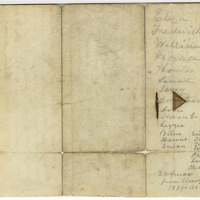 List of Enslaved People Freed by Lawrence Taliaferro