-
 More Than a Snapshot: Will Brown's Lynching and the Violence of History (2025)
 This teaching module discusses the history of racial violence in the Midwest, featuring a webinar with Ashley Howard, author of the 2025 book, Midwest Unrest: 1960s Urban Rebellions and the Black Freedom Movement.
-
Lynching Record for 1919 (1920)
In April 1919, the National Association for the Advancement of Colored People published a pamphlet documenting lynchings committed in the U.S. between the years 1889-1918, calling them "the common shame of all Americans." After its publication, the NAACP continued to publish supplements for each year until 1939.
This supplement for the year 1919 reported 83 known lynchings, 77 of which were committed against Black men and women. Of this number, 10 were U.S. soldiers returning from service after World War I. The patriotic service of Black men provoked racist white people in their communities, worsening existing labor tensions between white and Black workers. The perceived threat of communist-inspired revolution during this post-war era (the First Red Scare) coupled with Black American's challenge to the social order in advocating for racial equality led to widespread incidents of racialized violence in a period referred to as the Red Summer. Of the 83 lynchings in 1919, 50 took place between the riot in Jenkins County, Georgia, in April and the massacre in Elaine, Arkansas, in October.
This document contains graphic descriptions of racial violence.
-
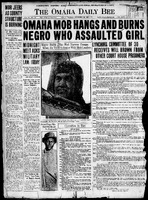 The Lynching of Will Brown (1919)
 The day after the lynching of Will Brown, the Omaha Bee devoted the first two pages of its edition to the racial terror violence enacted by a mob of white Omahans. The articles on these pages provide different perspectives of the race riot, from the crowds cheering at the destruction of government buildings, to the alleged assault victim's shock at the incident. The newspaper also featured a list of victims of the mob.
Most historians believe that the allegations against Will Brown were false and an attempt by corrupt and racist political leaders to stir up social unrest in a racially divisive city.
-
Nebraska Alien Land Law (1921)
This law barred noncitizens (aliens) from owning land in the state of Nebraska by putting a five-year limitation on holding all leases, titles, or comparable documents. It was a direct attack on Japanese immigrants with businesses or farms as a result of growing anti-Asian sentiment. Family members of aliens who had acquired land prior to 1889 were only allowed to hold the land for ten years. Any businesses working within the state, not just those originating from it, were required to have a board of directors or trustees of which a majority were citizens.
-
Meyer v. Nebraska (1923)
In this case, the Supreme Court determined that a Nebraska law prohibiting the teaching of minority languages in schools violated the Due Process Clause of the Fourteenth Amendment. The Nebraska law had been passed in 1919 after the First World War during a time of anti-immigration nativist sentiment in the U.S. and specified that no language other than English may be taught in Nebraska schools. The Supreme Court found that the Due Process Clause protected "the calling of modern language teachers" and "the opportunities of pupils to acquire knowledge."
-
Labor Management Relations Act (1947)
Also known as the Taft-Hartley Labor Act, this act amended the National Labor Relations Act of 1935 (Wagner Act) to limit the power of labor unions following the post-war strike wave of 1945-1946.
-
Interim Report on Employment of Homosexuals and Other Sex Perverts in Government (1950)
This report by a senate subcommittee summarized the people they deemed unsuited to work for the federal government due to their sexuality. As a result, thousands of LGBTQ+ employees were fired or forced to resign from government roles. Following World War II, there was a surge in growth of gay culture as young people began moving into cities, using the anonymity they found there to practice their sexuality. The backlash against the increasingly prevalent gay culture was known as the Lavender Scare. Tied to McCarthyism and the Second Red Scare, it was argued by reports such as this one that LGBTQ+ employees were "easy prey" for blackmailers, thus making them a security risk. This report provided no examples of U.S. government employees succumbing to blackmail over their sexual orientation.
-
Dennis v. United States (1951)
In this case, the Supreme Court affirmed the convictions of a group of Communist Party organizers, upholding the Smith Act (1940), which criminalized advocating for the overthrow of the U.S. government. The court again examined the Smith Act in Yates v. United States (1957) before it overturned the ruling in the Dennis case with Brandenburg v. Ohio (1969). In Brandenburg, the court ruled that public speech advocating for unlawful acts was protected by the First and Fourteenth Amendments, so long as it did not or was unlikely to incite "imminent lawless action."
-
Executive Order 10450 - Security Requirements for Government Employment (1953)
This executive order by President Dwight D. Eisenhower required the heads of federal agencies to investigate federal employees to evaluate if they posed potential security risks. The order specifically listed "sexual perversion" (homosexuality) as being inconsistent with the interests of the national security and grounds for termination. Part of the Red and Lavender Scares, this executive order banned members of the LGBTQ+ community from being employed by the federal government. As a result, thousands of gay employees were fired or forced to resign from government roles.
-
Yates v. United States (1957)
In this case, the Supreme Court limited the scope of the Smith Act by holding that radical and reactionary speech was protected under the First Amendment, drawing a distinction between advocacy of forcible overthrow as an abstract principle and an effort to instigate action to that end. Unlike the decision in the earlier Dennis v. United States (1951) case, the court reversed the convictions of the Communist Party leaders.
-
National Defense Education Act of 1958
Passed in the midst of the Cold War, this act provided funding for the expansion and improvement of educational programs to meet "critical national needs" and strengthen the national defense." In the year prior, the Soviet Union launched Sputnik, Earth's first human-made satellite, fueling fears that the U.S. was falling behind of the USSR in technological advancements. The NDEA provided funding and support for education in mathematics, science, and modern foreign languages.
-
Kameny v. Brucker - Petition for a Writ of Certiorari (1961)
In 1957, Army veteran Franklin E. Kameny was fired from his job as an astronomer with the U.S. Army Map Service under federal policy initiated by Executive Order 10450 (1953), which barred LGBTQ+ employees from federal employment. Kameny appealed his dismissal and the declaration of the Civil Service Commission that he was "unsuitable and ineligible for Federal employment on grounds of immoral conduct," but the Commission upheld its decision.
In 1959, Kameny turned to the courts, arguing that the actions by the government were unsubstantiated by facts and that he had not received the procedural rights due him by statute and regulation. The court disagreed, and his appeal was rejected. Kameny, representing himself, petitioned the Supreme Court to have his case heard, arguing equal citizenship for the LGBTQ+ community. While the court denied his petition, Kameny's case became the first civil rights claim based on sexual orientation to be brought before the Supreme Court.