-
 The Progress of Colored Women (1898)
 In this speech before the National American Women's Suffrage Association, civil rights activist Mary Church Terrell discusses the achievements of Black women since emancipation and calls for the end of racial injustice. She ends her speech with words of hope for the future: "And so, lifting as we climb, onward and upward we go, struggling and striving, . . . we knock at the bar of justice, asking an equal chance."
-
Letter from Nellie M. Quander to Alice Paul (1913)
Nellie M. Quander, president of the newly-incorporated Alpha Kappa Alpha sorority at Howard University, wrote a letter to women's suffrage activist Alice Paul inquiring about the upcoming Woman Suffrage Procession. After her first letter went unanswered, Quander wrote again to ask if the Howard University students would be welcome in the march, or if they would be met with "discrimination on account of race affiliation," highlighting the racial discrimination Black women faced in the suffrage movement. It is unclear whether Quander received a reply to her second letter or if any members of Alpha Kappa Alpha participated in the march. One account of the march noted the presence of a "group of twenty-five girls in caps and gowns" from Howard University.
-
Illinois Women Participants in Suffrage Parade (1913)
On March 3, 1913, the day before President Woodrow Wilson's first inauguration, as many as 10,000 women participated in the Woman Suffrage Procession down Pennsylvania Avenue. The parade was the first large-scale civil rights march in the nation's capital. The participation of African American women was a point of contention for racist members of the various delegations, however, Black women marched in the procession unsegregated.
The Chicago Daily Tribune reported on the parade, giving special attention to an incident where Black activist Ida B. Wells-Barnett was very nearly prohibited from marching with the rest of the Illinois delegate. Instead of giving in to attempts to segregate her, Wells-Barnett boldly marched alongside the white women of Illinois as planned. The next edition of the newspaper printed a picture of Wells-Barnett and her fellow marchers.
-
Suffrage Paraders (1913)
On March 3, 1913, the day before President Woodrow Wilson's first inauguration, as many as 10,000 women participated in the Woman Suffrage Procession down Pennsylvania Avenue. The parade was the first large-scale civil rights march in the nation's capital. The participation of African American women was a point of contention for racist members of the various delegations, however, Black women marched in the procession unsegregated. The official magazine of the National Association for the Advancement of Colored People, The Crisis, published an account of the parade and the Black women who participated in it.
-
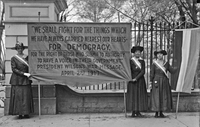 For Democracy (1917)
 In this photo, three suffragists stand in front of the White House holding a banner with a quote from President Woodrow Wilson's address before Congress, calling for a declaration of war against Germany: "We shall fight for things which we have always carried nearest our hearts—for democracy, for the right of those who submit to authority to have a voice in their government."
One tactic adopted by suffragists was to use the president's own words to highlight the hypocrisy of fighting for democracy abroad while denying it at home. Today, we can see an additional layer of hypocrisy in the deep racial divide that permeated the women's suffrage movement and the ways in which restrictive voting laws prevented Black men from exercising their right to vote under the 15th Amendment.
-
19th Amendment to the United States Constitution (1920)
The Nineteenth Amendment granted women the right to vote by prohibiting the denial of suffrage based on sex. The amendment was passed by Congress on June 4, 1919, and ratified August 18, 1920. The 19th Amendment effectively only guaranteed voting rights for white women. Women of color remained disenfranchised for years after. Poll taxes, literacy and property tests, violence and intimidation were all used to keep women of color from exercising their right to vote. It was not until the Voting Rights Act of 1965 that the 19th Amendment became a reality for all women.
-
Kameny v. Brucker - Petition for a Writ of Certiorari (1961)
In 1957, Army veteran Franklin E. Kameny was fired from his job as an astronomer with the U.S. Army Map Service under federal policy initiated by Executive Order 10450 (1953), which barred LGBTQ+ employees from federal employment. Kameny appealed his dismissal and the declaration of the Civil Service Commission that he was "unsuitable and ineligible for Federal employment on grounds of immoral conduct," but the Commission upheld its decision.
In 1959, Kameny turned to the courts, arguing that the actions by the government were unsubstantiated by facts and that he had not received the procedural rights due him by statute and regulation. The court disagreed, and his appeal was rejected. Kameny, representing himself, petitioned the Supreme Court to have his case heard, arguing equal citizenship for the LGBTQ+ community. While the court denied his petition, Kameny's case became the first civil rights claim based on sexual orientation to be brought before the Supreme Court.
-
Civil Rights Act of 1964
The Civil Rights Act of 1964 ended segregation in public places and banned discrimination in employment. The act reflected over a century of political and legal activism and the Jim Crow era. Following the Civil Rights Act, protections for voting rights were passed in 1965, and affirmative action was used to combat the legacies of segregation to continue the work started under this law.
-
Voting Rights Act (1965)
The Voting Rights Act of 1965 prohibited racial discrimination in voting, enforcing the voting rights protected by the Fourteenth and Fifteenth Amendments. Its intent was to outlaw the discriminatory voting practices adopted by many southern states against African Americans.
The Voting Rights Act's power was severely reduced by the 2013 Supreme Court Decision in Shelby County v. Holder and again in 2026 by Louisiana v. Callais. Mere days after the decision in Callais, Tennessee passed a new redistricting map that will divide the only majority-Black district in the state. Several other southern states have also taken steps toward redistricting areas with a Black majority.
-
Roe v. Wade (1973)
Roe v. Wade is the landmark Supreme Court decision that extended the right to privacy to the ability for women to obtain abortion care. The decision was overturned in the 2022 decision of Dobbs v. Jackson Women's Health Organization, returning legislation on abortion care to the states.
-
Americans with Disabilities Act (1990)
The Americans with Disabilities Act was the first federal law prohibiting discrimination against disabled individuals. It prohibited employment discrimination and mandated various accessibility accommodations in jobs, public transportation, public buildings, and in media. The act was amended in 2008 to expand the definition of "disability," making it easier to prove what qualifies for accommodations.
-
Obergefell v. Hodges (2015)
In the landmark decision in Obergefell v. Hodges, the Supreme Court found that same-sex marriage was protected under the equal protection clause of the 14th Amendment.