 Meriam Report: General Summary of Findings and Recommendations (1928) Meriam Report: General Summary of Findings and Recommendations (1928) |
|
The Meriam Report highlighted the failures of allotment while advocating for reform.
|
| Mexican "Wetbacks" Wait Deportation in Crowded Camps (1956) |
|
Operation Wetback is the racially offensive name given to a publicized 1954 summer campaign by the U.S. Border Patrol designed to apprehend and deport Mexican nationals who were in the U.S. illegally. Although it is often reported that over one million people were apprehended under the program, that number is actually from the previous fiscal year. During the fiscal year of which Operation Wetback was a part of, approximately 250,000 deportations were reported. The operation was a part of a policy of removal of Mexicans and Mexican-Americans begun during the Great Depression. This newspaper article describes the deplorable conditions of the deportation camps and ships.
|
| Meyer v. Nebraska (1923) |
|
In this case, the Supreme Court found that a Nebraska law prohibiting the teaching of minority languages in schools violated the Due Process Clause of the Fourteenth Amendment.
|
| Miranda v. Arizona (1966) |
|
In this case, the Supreme Court ruled that criminal suspects must be advised of their constitutional rights before being interrogated. Now known as Miranda Rights, a Miranda Warning is given to suspects in police custody advising them informing them of their Fifth Amendment right against compelled self-incrimination and their Sixth Amendment right to counsel.
|
| Muller v. Oregon (1908) |
|
In this case, the Supreme Court ruled that an Oregon statute restricting the number of hours women were permitted to work in a factory or laundry was not unconstitutional, as limitations placed upon contractual powers fall within the police power of the State. According to the court, "the fact that woman's "physical structure and the performance of maternal functions place her at a disadvantage which justifies a difference in legislation in regard to some of the burdens which rest upon her."
|
| Native American Citizenship and Competency During the Allotment and Assimilationist Era (2025) |
|
This teaching module explores how citizenship featured in Native American policy during the Allotment and Assimilation Era. It highlights the first formal naturalization process for individuals on a national scale. Focusing on competency commissions from 1915 to 1920, this unit guides students in analyzing how legal assessments of "competency" in the context of citizenship were shaped by race, gender, and settler values. Using primary documents— including applications, inspection reports, and naturalization rituals—this module examines how federal policies enforced whiteness and domestic norms as criteria for inclusion. The module also encourages discussion about the dual role of citizenship as both a tool of assimilation and a potential resource for Native resistance and legal agency.
|
| Naturalization Act of 1906 |
|
This act created the Bureau of Immigration and Naturalization and provided specific guidance for the naturalization process, including standardizing documentation. This act also required knowledge of the English language.
|
| Nebraska Abortion Statute (1929) |
|
This Nebraska state statute regarding abortion reflects the diverse landscape of abortion law before Roe v. Wade. This law punished individuals for helping pregnant women obtain a miscarriage.
|
| Nebraska Alien Land Law (1921) |
|
This law barred noncitizens (aliens) from owning land in the state of Nebraska by putting a five-year limitation on holding all leases, titles, or comparable documents. It was a direct attack on Japanese immigrants with businesses or farms as a result of growing anti-Asian sentiment. Family members of aliens who had acquired land prior to 1889 were only allowed to hold the land for ten years. Any businesses working within the state, not just those originating from it, were required to have a board of directors or trustees of which a majority were citizens.
|
| Nebraska Civil Rights Law (1885) |
|
This law states that every person in the state of Nebraska should be granted equal ability to enjoy public spaces. Those who deny someone their ability to enjoy a public space will be charged with a misdemeanor and fined between $25 and $100.
|
| Nebraska Vagrancy Law (1929) |
|
Vagrancy acts passed by the Nebraska state legislature reflected race-neutral legal language that was used to target the poor, people of color, and women.
|
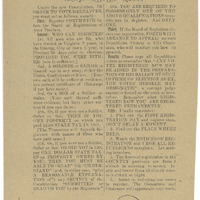 Notice to Republican Voters of the 9th Congressional District of Virginia (1902) Notice to Republican Voters of the 9th Congressional District of Virginia (1902) |
|
This broadside publicized information about new voting laws and poll taxes in Virginia.
|
| Oklahoma Statute on Railroad Segregation (1907) |
|
This act racially segregated railroad compartments and waiting rooms under the justification of increasing rider satisfaction. This was the first bill passed and put into effect by the new Oklahoma State Legislature.
|
| Oklahoma's Poor Rich Indians: An Orgy of Graft and Exploitation of the Five Civilized Tribes, Legalized Robbery (1924) |
|
The introduction of Zitkala-Ša's groundbreaking report opened the scene on fraud facilitated by guardians, lawmakers, and county clerks at the expense of minors, heirs, and incompetents during early Oklahoma statehood, and focused on probate courts as a site of legal exploitation.
|
| Omaha Grapples with its Ugly Past (2019) |
|
This article looks at the legacy of the lynching of Will Brown, featuring interviews with prominent, Black Omaha community members Preston Love and Ernie Chambers, as well as University of Nebraska-Omaha Urban studies professor, Barbara Hewins-Maroney.
|
| Ozawa v. United States (1922) |
|
The Supreme Court found in Ozawa v. United States that Japanese immigrants were not eligible for naturalization, based on a contested category of whiteness. The case considered the meaning of "free white persons" from the 1906 Naturalization Act and whether factors like assimilability should be considered. While the court determined in Ozawa that the words "white person" were meant to indicate a person of the "caucasian race," the decision in U.S. v. Thind just months later stated that the word "caucasian" was meant to refer to the "common understanding" of race and not a scientific one.
|
| Pensionado Act (1903) |
|
This act, passed in the aftermath of the Philippine–American War, established a scholarship program for Filipino people to receive an education in the U.S.
|
| People v. Buffum (1953) |
|
One of California's pre-Roe v. Wade abortion cases, the decision in Buffum attempted to regulate abortion tourism to Mexico. This case determined that California could not legislate medical practices in Mexico, causing an increase in abortion clinics across the border in Tijuana.
|
| Perez v. Sharp (1948) |
|
In this case, a 4-3 majority of the Supreme Court of California ruled that the state's ban on interracial marriage violated the 14th Amendment. It was the first of any state to strike down an anti-miscegenation law in the U.S, preceding Loving v. Virginia by almost 20 years.
|
| Platt Amendment (1903) |
|
The Platt Amendment was a part of the Army Appropriations Act of 1901 and stipulated conditions of Cuban independence following the Spanish-American war. It laid the foundation of Cuban-U.S. relations for the next several decades.
|
| Plessy v. Ferguson (1896) |
|
In Plessy v. Ferguson, the Supreme Court found that racial discrimination did not violate constitutional equal protection. This case established the principle of "separate but equal" which was overturned in 1965 by the decision in Brown v. Board of Education.
|
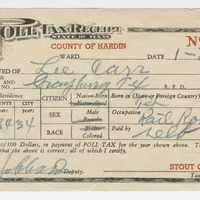 Poll Tax Receipt for Lee Carr (1955) Poll Tax Receipt for Lee Carr (1955) |
|
An image of a poll tax receipt from Texas. Poll taxes were a tool to prevent Black people and poor people from voting, since the poll tax was often a significant percentage of someone's weekly income.
|
| President Johnson's Commencement Address at Howard University: "To Fulfill These Rights" (1965) |
|
In this speech given to Howard University's 1965 graduating class, President Lyndon B. Johnson talks about the Civil Rights and Voting Rights Acts being passed as a result of the Civil Rights Movement and the long-lasting impacts of systemic racism.
|
| Public Law 280 (1953) |
|
This law gave California, Minnesota, Nebraska, Oregon, and Wisconsin criminal and civil jurisdiction on Indian reservations, as the U.S. government resolved to terminate the special trustee relationship tribes held with the United States, eroding tribal sovereignty.
|
| Remembering a Dark Past, Renewing Resolve for the Future (2019) |
|
This article from the Omaha World Herald describes Omaha's official observance of the 100-year anniversary of the lynching of Will Brown. Omaha Mayor, Jean Stothert, spoke at the commemoration calling Will Brown's lynching one of the darkest days in our history.
|
| Roberto Alvarez, et al. v. E. L. Owen, et al. (1931) |
|
This case was the first successful school desegregation case in the United States, decided fifteen years before Brown v. Board of Education. When the school board in Lemon Grove, California, attempted to build a separate school for students of Mexican origin, the court ruled that the segregation violated state laws which considered people of Mexican descent to be white.
|
| Selective Service Act (1917) |
|
This act authorized the U.S. government to raise a national army through compulsory enlistment via a draft. The military was segregated at the time of World War I, and Black soldiers were mostly relegated to labor roles.
|
| Selective Training and Service Act (1940) |
|
This act authorized the U.S. government to raise a national army through compulsory enlistment via a draft. While the act prohibited discrimination based on race, the military was still segregated at the time of World War II, and Black soldiers were mostly relegated to labor roles.
|
| Separate schools for white and colored (1904) |
|
Acts passed by the Virginia General Assembly reflected race-neutral language of the legal code after the Civil War. Application of these statutes resulted in entrenched Jim Crow segregation.
|
| Shelley v. Kraemer (1948) |
|
In this case, the Supreme Court ruled that the Equal Protection Clause of the Fourteenth Amendment prohibited the enforcement of restrictive covenants banning the purchase or occupation of property based on race. Shelley v. Kraemer was decided alongside Hurd v. Hodge, which held that the Civil Rights Act of 1866 prohibits judicial enforcement by D.C. courts of such restrictive covenants.
|
| State of Iowa v. Katz (1949) |
|
In this case, the Iowa Supreme Court upheld a lower court's jury verdict that Katz Drug Store violated the civil rights of three Black patrons when workers refused to serve them at the store's soda fountain.
|
| State of Nebraska, ex rel. Daniel Freeman, v. John Scheve et al. (1902) |
|
In this case, Daniel Freeman, recognized as the first homesteader under the 1862 Homestead Act, made a public grievance over the use of the Bible in a public school near Beatrice. When the teacher refused to cease using the Bible, offering prayers, and singing hymns in her classroom, Freeman took his case to the school board, who defended the teacher. He then took his case to the courts. The lower court also sided with the teacher, and he appealed the case to the Nebraska Supreme Court. The higher court found that the actions of the teacher and the school board violated the provisions in Nebraska's constitution regarding the separation of church and state. The U.S. Supreme Court did not make a similar ruling until 1962 in Engel v. Vitale.
|
| Suffrage Paraders (1913) |
|
On March 3, 1913, the day before President Woodrow Wilson's first inauguration, as many as 10,000 women participated in the Woman Suffrage Procession down Pennsylvania Avenue. The parade was the first large-scale civil rights march in the nation's capital. The participation of African American women was a point of contention for racist members of the various delegations, however, Black women marched in the procession unsegregated. The official magazine of the National Association for the Advancement of Colored People, The Crisis, published an account of the parade and the Black women who participated in it.
|
| Sweatt v. Painter (1950) |
|
In this case, the Supreme Court held that separate Black law schools in Texas were not equal in quality to white-only law schools. Sweatt v. Painter set important precedent for the decision in Brown v. Board of Education four years later.
|
| Sworn Affidavit of Alexander Harlin Regarding His Continued Enslavement Until the 1866 Treaty as Part of His Application for Enrollment as a Choctaw (1896) |
|
In this sworn affidavit, Alexander Harlin attested that he, as a "Choctaw Freedman, of African Blood," was enslaved by a Choctaw woman Sarah Harlin until the Treaty of 1866 was signed. The statement was made in support of his application for enrollment in the Choctaw Nation under the Act of June 10, 1896 which authorized the Dawes Commission to add names to existing tribal rolls.
|
| Sworn Affidavit of Jeff Franklin Regarding His Enslavement and Emancipation in the Chickasaw Nation as Part of His Application for Enrollment as a Chickasaw (1896) |
|
In this sworn affidavit, Jeff Franklin attested that he was a colored man and was enslaved by Easter Colber, a Chickasaw man until April 28th, 1866, when the Treaty of 1866 was signed. The statement was made in support of his application for enrollment in the Chickasaw Nation under the Act of June 10, 1896 which authorized the Dawes Commission to add names to existing tribal rolls. The affidavit also includes information about his continued residency in the Chickasaw Nation until the time of his application in 1896.
|
| Sworn Statement of W. L. Cochran as to the Enslavement of Margaret Clark in 1866 in Support of Her Application for Enrollment as a Choctaw (1896) |
|
In this sworn statement, W. L. Cochran attested that Margaret Clark, "an African woman," was enslaved by R. L. Cochran in the Choctaw Nation until the Treaty of 1866 was signed. The statement was made in support of Margaret Clark's application for enrollment in the Choctaw Nation under the Act of June 10, 1896 which authorized the Dawes Commission to add names to existing tribal rolls.
|
| Terry v. Ohio (1968) |
|
Terry v. Ohio is the landmark Supreme Court case that established the basis for stop and frisk policies. These policies disproportionately affect Black people and lead to the disproportionate incarceration of Black Americans.
|
| Texas Poll Tax (1901) |
|
This poll tax law in Texas was voted on in a referendum in the 1902 election as a proposed amendment to the state constitution.
|
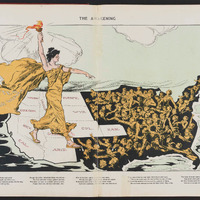 The Awakening (1915) The Awakening (1915) |
|
This political cartoon was the centerfold of a special suffrage issue of Puck Magazine. The cartoon depicts Lady Liberty marching eastward on a map of the United States following suffrage wins in the western states of Washington, Oregon, Nevada, California, Idaho, Utah, Arizona, Montana, Wyoming, Colorado, and Kansas. Women in the east reach toward the light of Liberty's torch of freedom. Below the image is a poem by Alice Duer Miller.
|
| The Insular Cases and Contested Citizenship (2024) |
|
This teaching module discusses the intersection of U.S. colonial power and migration, featuring a webinar with Robert McGreevey, author of the 2018 book, Borderline Citizens: The United States, Puerto Rico, and the Politics of Colonial Migration.
|
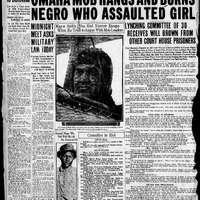 The Lynching of Will Brown (1919) The Lynching of Will Brown (1919) |
|
The day after the lynching of Will Brown, the Omaha Bee devoted the first two pages of its edition to the racial terror violence enacted by a mob of white Omahans. The articles on these pages provide different perspective of the race riot, from the crowds cheering at the destruction of government buildings, to the alleged assault victim's shock at the incident. The newspaper also featured a list of victims of the mob.
|
| The Treaty of 1866 and the Long Fight for Black Belonging in the Choctaw and Chickasaw Nations (2025) |
|
This module reframes histories of the Civil War, emancipation, and Reconstruction by analyzing how enslaved and freed Black people in the Choctaw and Chickasaw Nations struggled to actualize their freedoms amid contested tribal and federal jurisdictions. Ultimately, the module elucidates how Black enslaved and Freedpeople in the Chickasaw and Choctaw Nations developed unique methods of resistance and visions of freedom shaped by the legal paradigms forged in the Treaty of 1866.
|
| The Woman Suffrage Movement and Frederick Douglass (1908) |
|
In this speech given on the 60th Anniversary of the Seneca Falls Convention, Black women's rights advocate Mary Church Terrell reflects on the role of Frederick Douglass in the women's suffrage movement.
|
| Tydings–McDuffie Act (1934) |
|
This act established the process for the independence of the Philippine Islands, then a U.S. territory, after a ten-year transition period. The act reclassified Filipinos them from U.S. nationals to aliens and limited the number of immigrants from the Philippines to 50 per year.
|
| Undesirable Aliens Act (1929) |
|
This act made unlawfully entering the U.S. a crime for the first time. Immigrants who did not cross the border through an official point of entry, where they had to pay a fee and submit to tests, could be charged with a misdemeanor crime, facing fines and up to a year's imprisonment. Returning to the U.S. after deportation was made a felony, punishable by $1,000 in fines and up to two years imprisonment. This law applied to all immigrants entering the U.S., but was intended to restrict immigration from Mexico.
|
| Union Labor Injunctions (1903) |
|
This California act states that workers who agree to work together during a trade dispute between employees and employers are not eligible to be criminally charged for conspiracy. Courts cannot issue injunctions against a group of workers for organizing together if the actions they take as a group is an action a single person could do legally. This law was passed in 1903 to protect workers' right to organize and take collective action and to prevent employers from using conspiracy laws to crack down on union activity.
|
| United Nations Universal Declaration of Rights (1948) |
|
This document, drafted by a committee of the United Nations chaired by Eleanor Roosevelt, details the "basic rights and fundamental freedoms" due all peoples regardless of "race, colour, sex, language, religion, political or other opinion, national or social origin, property, birth or other status."
|
| United States v. Cartozian (1925) |
|
In this case, the District Court of Oregon debated whether an Armenian immigrant was white enough to be naturalized. Just two years after the Supreme Court ruled that Ozawa, a Japanese man, and Thind, a South Asian man, were not white enough for naturalization, the Oregon court ruled that people from Asia Minor were close enough to European descent to be naturalized.
|
| United States v. Sandoval (1913) |
|
In this case, the Supreme Court ruled that the Pueblo people were Indians, repudiating the earlier United States v. Joseph decision which had held that they were not. The title to Pueblo lands was now seen as held by tribes instead of in fee simple, meaning that Congressional approval was needed in order to make land sales. This undermined the legitimacy of non-Indian land titles across New Mexico.
|
| United States v. Thind (1923) |
|
The Supreme Court found in U.S. v. Thind that Indian immigrants were not eligible for naturalization, based on a contested category of whiteness. Contradicting their 1922 ruling in Ozawa naming caucasian identity as a requirement for naturalization, as a South Asian immigrant, Thind was deemed ineligible for citizenship because, despite being racially caucasian, he did not appear white.
|
| United States v. Wong Kim Ark (1898) |
|
In United States v. Wong Kim Ark, the Supreme Court solidified the principle of birthright citizenship, affirming that anyone born in the U.S., regardless of their parents' citizenship, is a U.S. citizen.
|
| Vanguard: Black Women and the Right to Vote (2024) |
|
This teaching module discusses how Black women fought against both racism and sexism during their fight for women's suffrage, featuring a webinar with Martha S. Jones, author of the 2020 book, Vanguard: How Black Women Broke Barriers, Won the Vote, and Insisted on Equality for All.
|
| Voting Rights Act (1965) |
|
The Voting Rights Act of 1965 prohibits racial discrimination in voting, enforcing the voting rights protected by the Fourteenth and Fifteenth Amendments. Its intent was to outlaw the discriminatory voting practices adopted by many southern states against African Americans. Its power was severely reduced by the 2013 Supreme Court Decision in Shelby County v. Holder and again by Louisiana v. Callais in 2026. Mere days after the decision in Callais, Tennessee passed a new redistricting map that will divide the only majority-Black district in the state. Several other southern states have also taken steps toward redistricting areas with a Black majority.
|
| War Brides Act (1945) |
|
The War Brides Act was a federal law that allowed for the admission of foreign women married to United States servicemen. Alien spouses and their minor children were exempted from the quota systems implemented by the Immigration Act of 1924. The Act enabled more than 100,000 foreign-born wives and children of American soldiers to immigrate to the United States, from 1945 until its expiration in 1948.
|
| Washington Law Against Discrimination in Employment (1949) |
|
Originally passed in 1949, the Law Against Discrimination in Employment prohibits employers from discriminating against employees because of race, creed, color, national origin, as well as age (1961), sex (1971), marital status (1973), disability (1973, 1993, 1997), sexual orientation (2006), honorably discharged veteran or military status (2007), and citizenship or immigration status (2020). The many changes made to this law since its post-war origin reflects the progression of the civil rights movements over the years.
|
| Webinar - Affirmative Action's Origins and Legacies (2023) |
|
In this webinar, UNL Law Faculty Eric Berger, Danielle Jefferis, and Catherine Wilson provide an in-depth look at affirmative action, delving into its origins and tracing its impact to the present day.
|
| Webinar - Before the Movement: The Hidden History of Black Civil Rights (2026) |
|
In this webinar, Professor Dylan C. Penningroth of the University of California, Berkeley, discusses his award-winning 2023 book, Before the Movement: The Hidden History of Black Civil Rights, examining how Black people used the law in their everyday lives prior to the civil rights movement.
|
| Webinar - From Back Alley to the Border: Criminal Abortion in the 20th Century U.S. (2024) |
|
In this webinar, Dr. Alicia Gutierrez-Romine of California State University, San Bernardino, discusses U.S. constitutionalism and criminal abortion in the 20th century with Dr. William Thomas and his American Constitutional History class.
|
| Webinar - Latina/os and Criminal and Immigration Law Enforcement (2025) |
|
In this webinar, Professor Kevin R. Johnson of the University of California, Davis, discusses the history of criminal and immigration law enforcement of Latina/os in the U.S with Dr. Donna D. Anderson and her And Justice For All class.
|
| Webinar - The Insular Cases and Contested Citizenship (2024) |
|
In this webinar, Professor Robert McGreevey of the College of New Jersey discusses the intersection of U.S. colonial power and migration with Dr. Jeannette Eileen Jones and her And Justice For All class.
|
| Webinar - Vanguard: Black Women and the Right to Vote (2024) |
|
In this webinar, Professor Martha S. Jones of Johns Hopkins University discusses Black women and the right to vote with Dr. William Thomas and his American Constitutional History class.
|
| Wetbacks Force Ship Into Port (1956) |
|
Operation Wetback is the racially offensive name given to a publicized 1954 summer campaign by the U.S. Border Patrol designed to apprehend and deport Mexican nationals who were in the U.S. illegally. Although it is often reported that over one million people were apprehended under the program, that number is actually from the previous fiscal year. During the fiscal year of which Operation Wetback was a part of, approximately 250,000 deportations were reported. The operation was a part of a policy of removal of Mexicans and Mexican-Americans begun during the Great Depression. This newspaper article describes a mutiny that took place aboard a deportation ship of Mexican workers.
|
| Williams v. Walker-Thomas Furniture Co. (1965) |
|
In this case, a U.S. Court of Appeals decided that a lower court could rule a contract unconscionable and therefore not enforceable. Ora Lee Williams, a resident of an underprivileged Black neighborhood in Washington, D.C., had signed an installment sales contract containing a clause that gave the seller the right to repossess all prior goods purchased under the contract upon missing a payment on the most recent purchase, even if she had already paid enough to cover what was owed. Justice Wright remanded the case back to the lower court with a new definition of unconscionability. This case is an example of abusive credit practices targeting those in poverty in the U.S.
|
| Yasui v. United States (1943) |
|
In this case, the Supreme Court held that curfews against minority groups were constitutional at a time of war against the country that group's ancestors originated from. After the Executive Order 9066 was issued in the wake of the attack on Pearl Harbor, Japanese Americans were subject to curfews and other restrictions in addition to being removed to internment camps. Minoru Yasui was convicted of violating the curfew. This was a companion case to Hirabayashi v. United States, decided on the same day.
|
| Yates v. United States (1957) |
|
In this case, the Supreme Court limited the scope of the Smith Act by holding that radical and reactionary speech was protected under the First Amendment, drawing a distinction between advocacy of forcible overthrow as an abstract principle and an effort to instigate action to that end. Unlike the decision in the earlier Dennis v. United States (1951) case, the court reversed the convictions of the Communist Party leaders.
|