 19th Amendment to the United States Constitution (1920) 19th Amendment to the United States Constitution (1920) |
|
The Nineteenth Amendment granted women the right to vote by prohibiting the denial of suffrage based on sex. The amendment was passed by Congress June 4, 1919, and ratified August 18, 1920. The 19th Amendment effectively only guaranteed voting rights for white women. Women of color remained disenfranchised for years after. Poll taxes, literacy and property tests, violence and intimidation were all used to keep women from exercising their right to vote. It was not until the Voting Rights Act of 1965 that the 19th Amendment became a reality for all women.
|
| 24th Amendment to the United States Constitution (1964) |
|
The Twenty-Fourth Amendment prevents the use of poll taxes in elections. It was passed during the 1960s Civil Rights Movement along with the Voting Rights Act of 1965 to actualize voting rights for people of all races guaranteed by the 15th Amendment. The amendment was passed by Congress August 27, 1962, and ratified January 23, 1964.
|
| Abortion: Sherri's Baby was Deformed (1962) |
|
Sherri Chessen Finkbine caused an international controversy when she wanted to end her pregnancy when she believed she was carrying a deformed baby. Sherri was known for her role on a children's TV show and already had four children at the time of her abortion controversy. She brought questions about the life and health of the mother into the forefront of abortion debates.
|
| Affirmative Action's Origins and Legacies (2023) |
|
This teaching module provides an in-depth look at affirmative action, delving into its origins and tracing its impact to the present day, featuring a webinar with Nebraska Law faculty Catherine Wilson, Danielle Jefferis, and Eric Berger.
|
| Alabama Child Labor Act of 1919 |
|
This state law helped to regulate and restrict the employment of children in Alabama. It set age limits and barriers to determine the length of time children can work, along with the type of work they can do. At the time of its passage, there were many children working long hours in unsafe conditions. The act was a step forward in the protection of children and made the child labor laws in Alabama align more closely to the rest of the country.
|
| Alien Naturalization Act of 1918 |
|
This act incentivized enlistment in the U.S. armed forces to immigrants in exchange for naturalization and citizenship without the declaration of intent or proof of five years' residence requirements.
|
| Alien Registration Act (1940) |
|
This act, also known as the Smith Act, required all non-citizens entering and living within the U.S. to register their alien status with the government. It also set criminal penalties for advocating the overthrow of the U.S. government. This law was written to address concerns about subversive activities on the eve of American involvement in World War II.
|
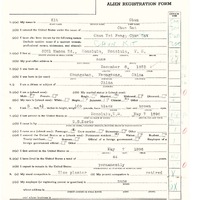 Alien Registration Form for Kit Chun (1940) Alien Registration Form for Kit Chun (1940) |
|
The Alien Registration Act of 1940 required all non-citizens entering and living within the U.S. to register their alien status with the government by completing an Alien Registration Form. The AR-2 form included a questionnaire and a requirement that fingerprints be taken at the time of registration. This act, also known as the Smith Act, was written to address concerns about subversive activities on the eve of American involvement in World War II.
|
| Amending Indian Appropriation Act of 1892 (1896) |
|
This report from the Committee of Public Lands asserted that dispossessed treaty lands and former military reservations should be closer in price per acre to lands distributed under the Homestead Act.
|
| An Act Relating to Woman Suffrage (1897) |
|
This act proposed to amend the Constitution of Washington State to grant women suffrage rights. While the proposed amendment failed in the general election held in 1898, it was eventually ratified in 1910. Washington was one of 15 states to grant women the right to vote prior to the adoption of the 19th Amendment in 1920.
|
| An Act to Authorize the Sale of Certain Lands to the State of Oklahoma (1953) |
|
This law authorized the state of Oklahoma to buy land once under the control of tribal nations, as the U.S. government resolved to terminate the special trustee relationship tribes held with the United States, further eroding tribal sovereignty.
|
| An Act to provide for designation by cities and towns of segregation districts for residence of white and colored persons (1912) |
|
Acts passed by the Virginia General Assembly reflected race-neutral language of the legal code after the Civil War. Application of these statutes resulted in entrenched Jim Crow segregation.
|
| An Act to Provide for the Care and Support of Insane Persons in the Indian Territory (1904) |
|
This act weaponized Western medical diagnoses against tribal citizens in Indian Territory for the purpose of incarceration and confinement. Nearly four hundred Native people, from fifty different nations, were confined to the Canton Asylum during its operation from 1902-1934.
|
| An Act to Terminate Certain Federal Restrictions upon Indians (1953) |
|
This act ended federal support for programs on Native reservations, as the U.S. government resolved to terminate the special trustee relationship tribes held with the United States, further eroding tribal sovereignty.
|
| Applegate v. Luke (1927) |
|
After the Phillips County Chancery Court struck down Arkansas' Alien Land Act of 1925 as unconstitutional, Attorney General H. W. Applegate appealed the case to the Arkansas Supreme Court. Justice T. H. Humphreys upheld the lower court's ruling, arguing that the alien land law violated Section 20 of the the Declaration of Rights in the State Constitution.
|
| Arkansas Alien Land Act (1925) |
|
This act was passed by the Arkansas General Assembly in 1925 to restrict the ability of aliens ineligible for citizenship to acquire, possess, enjoy, use, cultivate, occupy, and transfer real property, or any interest therein," unless specified in treaties.
|
| Asian Immigrants' Fight Against Discriminatory Alien Land Laws (2025) |
|
This module examines the history of anti-Asian/Japanese alien land laws in the 1920s United States, focusing on one lawsuit by Chinese immigrant Lum Jung Luke that brought down Arkansas' Alien Land Act.
|
| Balzac v. Porto Rico (1922) |
|
Balzac v. Porto Rico is one of a series of cases decided by the Supreme Court addressing the status of U.S. territories known as the Insular Cases. The court in Balzac ruled that residents of Puerto Rico were not guaranteed a trial by jury. In Dorr v. United States, the Supreme Court ruled the same way for residents of the Philippines.
|
| Brown v. Board of Education (1954) |
|
The Supreme Court found in Brown v. Board of Education that educational segregation violated the Equal Protection Clause of the Fourteenth Amendment. This landmark case overturned the precedent created by the decision in Plessy v. Ferguson, and ended the Jim Crow era.
|
| Buck v. Bell (1927) |
|
In this case, the Supreme Court legitimized eugenic sterilization laws. Justice Oliver Wendell Holmes Jr. ruled that a Virginia statute permitting the forced sterilization of institutionalized people found to be "afflicted with an hereditary form of insanity or imbecility" was within the power of the State under the Fourteenth Amendment and did not violate the Constitution. Regarding Carrie Buck and her family, Justice Holmes declared, "Three generations of imbeciles are enough."
|
| Burke Act (1906) |
|
The Burke Act amended Section 6 of the Dawes Act to explicitly add competency as a legal marker for allottees, tying settler-colonial judgements of social and cultural behavior to land holding.
|
| Cable Act (1922) |
|
The Cable Act was a federal law that repealed the Expatriation Act, restoring United States citizenship to American women married to foreigners. The act reflected early goals from newly-won women's suffrage.
|
| California Alien Land Law (1913) |
|
California's 1913 alien land law barred Japanese immigrants who were ineligible for citizenship from legally purchasing residential or agricultural property. The law was continued and expanded in 1920. California was one of many states to enact alien land laws during the era of Asian exclusion, when Asian immigrants were ineligible for citizenship.
|
| Chain Gang Blues (1925) |
|
Chain Gang Blues was a song recorded by blues singer Ma Rainey in 1925 that reflects the experience of Black Americans in the Jim Crow South. In the song, the protagonist has been sent on the chain gang for reasons that she thinks are unjust.
|
| Charter of the United Nations (1945) |
|
The Charter of the United Nations contains the rules and obligations its members must uphold, including the promotion of "universal respect for . . . human rights and fundamental freedoms for all without distinction as to race, sex, language, or religion." The U.S. is one of five permanent members of the United Nations Security Council.
|
| Civil Rights Act of 1957 |
|
The Civil Rights Act of 1957 created the Commission on Civil Rights and authorized the Attorney General to seek injunctions against voting interference.
|
| Civil Rights Act of 1964 |
|
The Civil Rights Act of 1964 ended segregation in public places and banned discrimination in employment. The act reflected over a century of political and legal activism.
|
| Civilian Exclusion Order No. 34 (1942) |
|
This broadside detailed U. S. Army orders to force all persons of Japanese ancestry, whether citizens or non-citizens, to depart Alameda County, California, and report to an assembly center where they would be sent to concentration camps. Fred Korematsu defied this exclusion order by remaining at his residence and was eventually convicted in federal court.
|
| Constitution And By-Laws of the Sac and Fox Tribe of Missouri (1937) |
|
As part of the Indian Reorganization Act of 1934, Native American tribes were encouraged to create tribal governments that mirrored the United States government. Many of the tribes' constitutions were essentially the same.
|
| Cooper Act (1902) |
|
Also known as the Philippine Organic Act, this act established the civil government of the Philippines following the Philippine–American War.
|
| Corrigan v. Buckley (1926) |
|
In this case, the Supreme Court upheld the constitutional validity of racially restrictive covenants, stating that "it is obvious that none of [the] amendments prohibited private individuals from entering into contracts respecting the control and disposition of their own property." Restrictive covenants were eventually struck down by the Supreme Court in Shelley v. Kraemer (1948).
|
| Curtis Act (1898) |
|
The Curtis Act shows federal land dispossession in Indian Territory through settler colonial judicial and administrative practices. The act dissolved regional tribal courts, voided tribal laws, and reorganized jurisdiction in Indian Territory.
|
| D.C. Divided: Segregation in the Nation's Capital (2025) |
|
This teaching module features a webinar discussing the racially restrictive covenants used by early 20th century developers and white citizens to prevent Black residents and other groups from buying or leasing property in Washington, D.C. This community conversation hosted by the Institute of Politics, Policy & History features a panel of historians, legal scholars, and descendants who reveal the history of the enduring impact of racial covenants in D.C. and how residents fought back against them.
|
| Dawes Act (1887) |
|
This classic document in Native American legal history formalized the process of federal land dispossession. Section 6 made claims to the adoption of civilized life as a necessary precursor to Indigenous participation in allotment.
|
| De Lima v. Bidwell (1901) |
|
De Lima v. Bidwell is one of a series of cases decided by the Supreme Court addressing the status of U.S. territories known as the Insular Cases. This case considered whether the newly acquired territory of Puerto Rico was a "foreign country" and to what extent shipping duties applied to imports from Puerto Rico and other U.S. territories. De Lima ruled that Puerto Rico was a part of the United States and duties should not be applied to imports. This case was decided on different grounds than that of Downes v. Bidwell, which ruled that unincorporated territories could be treated differently than states and incorporated territories.
|
| Dennis v. United States (1951) |
|
In this case, the Supreme Court affirmed the convictions of a group of Communist Party organizers, upholding the Smith Act (1940), which criminalized advocating for the overthrow of the U.S. government. The court again examined the Smith Act in Yates v. United States (1957) before it overturned the ruling in the Dennis case with Brandenburg v. Ohio (1969).
|
| Displaced Persons Act (1948) |
|
The first U.S. policy regarding refugees, the Displaced Persons Act of 1948 only allowed for European people displaced by World War II to enter the United States as refugees. Despite the 1948 United Nations Universal Declaration on Human Rights providing broad definitions for refugees, the United States continued to use narrow geographically or politically specific definitions for refugees until 1980.
|
| Dispossession: Congressional Acts and Allotment, 1887-1906 (2026) |
|
This teaching module examines the critical phase of Indigenous land dispossession that unfolded in Indian Territory (now Oklahoma) between 1887 and 1906. Prior to this period, tribal nations in Indian Territory operated independent forms of government, determined tribal citizenship and descent, and managed their own judiciary and commerce. Congressional acts detailed a methodical process for dissolving judicial, political, and economic forms of tribal sovereignty starting in 1887. Key documents show the suppression of familial kin structures, the undermining of tribal laws, courts, and governments, and the establishment of a guardianship regime. Lesser-known acts passed between 1893 until 1906 reveal the administrative underpinnings behind allotment, specifically for the Five Tribes.
|
| Dorr v. United States (1904) |
|
Dorr v. United States is one of a series of cases decided by the Supreme Court addressing the status of U.S. territories known as the Insular Cases. The court in Dorr ruled that residents of the Philippines were not entitled to a trial by jury. The case of Balzac v. Porto Rico decided the same in Puerto Rico.
|
| Dow v. United States (1915) |
|
In Dow v. United States, the Court of Appeals ruled that people from Southwest Asia could be considered white and were eligible for citizenship. This decision came seven years before the Supreme Court ruled that migrants from Japan and India were not white enough to be eligible for citizenship.
|
| Downes v. Bidwell (1901) |
|
Downes v. Bidwell is one of a series of cases decided by the Supreme Court addressing the status of U.S. territories known as the Insular Cases. This case considered whether the Constitution applied to territories, specifically Puerto Rico. It specifically considered the constitutionality of the Foraker Act which levied customs on exports from Puerto Rico. The Court ruled that the Constitution only fully applied to incorporated territories, while Puerto Rico is an unincorporated territory.
|
| Elective Franchise and Qualifications for Office (1902) |
|
This act passed by the Virginia General Assembly in 1902 contains literary and property ownership requirements for potential voters in an attempt to disenfranchise African Americans. Compare it to the 1887 act which placed few restrictions on voting. Application of statutes such as this one resulted in entrenched Jim Crow segregation.
|
| Ex Parte Mitsuye Endo (1944) |
|
In this case, the Supreme Court held that the federal government could not continue to hold citizens of Japanese ancestry who were "concededly loyal" to the United States, though the ruling did not find the actions of the War Relocation Authority unconstitutional as a whole. Mitsuye Endo was released.
|
| Executive Order 10450 - Security Requirements for Government Employment (1953) |
|
A part of the Lavender Scare, President Dwight D. Eisenhower's Executive Order 10450 banned members of the LGBTQ+ community from being employed by the federal government.
|
| Executive Order 10925 - Establishing the President's Committee on Equal Employment Opportunity (1961) |
|
This executive order by President John F. Kennedy directed government contractors to use affirmative action to ensure people of any "race, creed, color, or national origin" were given equal treatment and opportunity for employment. This executive order also established the President's Committee on Equal Employment Opportunity.
|
| Executive Order 11246 - Equal Employment Opportunity (1965) |
|
This executive order enacted by President Lyndon B. Johnson was repealed by a January 2025 executive order from Donald Trump. The original order was written to ensure equal opportunity in government employment and limit discrimination based on race. It required employers to furnish documentation of nondiscriminatory practices upon request.
|
| Executive Order 9066 - Authorizing the Secretary of War to Prescribe Military Areas (1942) |
|
This executive order by President Franklin D. Roosevelt was a federal law that forcefully removed persons deemed a national security threat to relocation centers in the western United States. While the act did not include racialized language, it was created with the intent to target Japanese Americans.
|
| Expatriation Act (1907) |
|
The Expatriation Act was a federal law that rescinded United States citizenship for American women that married foreigners. According to the law, "any American woman who marries a foreigner shall take the nationality of her husband." She was allowed to resume her American citizenship upon "termination of the marital relation."
|
| Fair Housing Act (1968) |
|
The Fair Housing Act was originally enacted as part of the Civil Rights Act of 1968. It prohibits discrimination by providers of housing based on race, color, religion, or national origin. In 1988, the act was amended to include disability and familial status.
|
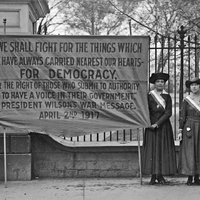 For Democracy (1917) For Democracy (1917) |
|
In this photo, three suffragists stand in front of the White House holding a banner with a quote from President Woodrow Wilson's address before Congress, calling for a declaration of war against Germany: "We shall fight for things which we have always carried nearest our hearts—for democracy, for the right of those who submit to authority to have a voice in their government."
One tactic adopted by suffragists was to use the president's own words to highlight the hypocrisy of fighting for democracy abroad while denying it at home. Today, we can see an additional layer of hypocrisy in the deep racial divide that permeated the women's suffrage movement and the ways in which restrictive voting laws prevented Black men from exercising their right to vote under the 15th Amendment.
|
| Foraker Act (1900) |
|
The Foraker Act established the civil government of Puerto Rico, transitioning it away from martial rule. The Foraker Act established Puerto Rico as an unincorporated territory, making it ineligible for statehood. This act did not allow residents of Puerto Rico to be United States Citizens.
|
| From Back Alley to the Border: Criminal Abortion in the 20th Century U.S. (2024) |
|
This teaching module looks at the history of criminal abortion in the 20th century, featuring a webinar with Alicia Gutierrez-Romine, author of the 2020 book, From Back Alley to the Border: Criminal Abortion in California, 1920-1969.
|
| George Quander versus the Law (1897-1908) |
|
George Quander was the nephew of Felix Quander. Like his uncle, George had run-ins with Fairfax County officials, culminating in 1908, when he was shot and killed by a deputy sheriff serving a warrant. The Alexandria Gazette is unsympathetic in its coverage of George Quander's encounters with the court, its officers, and the racist white citizens of Fairfax County.
|
| Gonzales v. Williams (1903) |
|
Gonzales v. Williams is one of a series of cases decided by the Supreme Court addressing the status of U.S. territories known as the Insular Cases. This case determined that while people from Puerto Rico were not citizens of the United States, they were also not "aliens." This case labelled those in unincorporated territories as U.S, nationals instead of citizens.
|
| Griswold v. Connecticut (1965) |
|
In Griswold v. Connecticut, the Supreme Court found that medical privacy was constitutionally protected regarding reproductive decisions. The Griswold decision helped set precedent for the decision in Roe v. Wade.
|
| Hawaii v. Mankichi (1903) |
|
Hawaii v. Mankichi is one of a series of cases decided by the Supreme Court addressing the status of U.S. territories known as the Insular Cases. This case considered the extent to which the Constitution should apply to Hawaii and how the new territory's previous legal codes could be folded into the laws of the Territory of Hawaii.
|
| Hernandez v. Texas (1954) |
|
Hernandez v. Texas showed racial discrimination in all-white juries, reflected in Juan Crow segragation.
|
| Hirabayashi v. United States (1943) |
|
In this case, the Supreme Court held that curfews against minority groups were constitutional at a time of war against the country that group's ancestors originated from. After the Executive Order 9066 was issued in the wake of the attack on Pearl Harbor, Japanese Americans were subject to curfews and other restrictions in addition to being removed to internment camps. Gordon Hirabayashi was convicted of violating the curfew. This was a companion case to Yasui v. United States, decided on the same day.
|
| Honorably Discharged Alien Soldiers (1932) |
|
This Idaho law allowed immigrants who served in the U.S. armed forces to petition for citizenship without the declaration of intent or proof of five years' residence requirements, as specified by the Alien Naturalization Act of 1918. This law indicates legal recognition and benefits extension to veterans in terms of citizenship, military service, and civil rights.
|
| Hoyt v. Florida (1961) |
|
In this case, the Supreme Court considered whether laws like that of Florida, which allowed women to be exempt from serving on juries unless they specifically registered to do so, were constitutional. Gwendolyn Hoyt alleged that because there were no women on her jury, she was not given a fair trial. The Court decided that because women were given an opportunity to register to be considered for jury duty, the law was constitutional.
|
| Hundley v. Gorewitz (1942) |
|
In this case, a federal court struck down a restrictive covenant in Washington, D.C., under the "change of neighborhood" doctrine which allowed a court to declare a restrictive covenant unenforceable if the neighborhood had changed to the point that the original purpose of the covenant had been defeated. In the Hundleys' case, NAACP lawyer Charles Hamilton Houston persuaded the court that the neighborhood was already becoming predominantly Black. These private agreements that prohibited the sale or rental of land to non-white individuals were intended to maintain residential segregation. Restrictive covenants were eventually struck down by the Supreme Court in Shelley v. Kraemer (1948).
|
| Hurd v. Hodge (1948) |
|
In this case, the Supreme Court ruled that judicial enforcement of restrictive covenants banning the purchase or occupation of property based on race by D.C. courts is prohibited by the Civil Rights Act of 1866. Hurd v. Hodge was decided alongside Shelley v. Kraemer, which held that the Equal Protection Clause of the Fourteenth Amendment prohibits such restrictive covenants.
|
| Illinois Women Participants in Suffrage Parade (1913) |
|
On March 3, 1913, the day before President Woodrow Wilson's first inauguration, as many as 10,000 women participated in the Woman Suffrage Procession down Pennsylvania Avenue. The parade was the first large-scale civil rights march in the nation's capital. The participation of African American women was a point of contention for racist members of the various delegations, however, Black women marched in the procession unsegregated.
The Chicago Daily Tribune reported on the parade, giving special attention to an incident where Black activist Ida B. Wells-Barnett was very nearly prohibited from marching with the rest of the Illinois delegate. Instead of giving in to attempts to segregate her, Wells-Barnett boldly marched alongside the white women of Illinois as planned. The next edition of the newspaper printed a picture of Wells-Barnett and her fellow marchers.
|
| Immigration Act of 1891 |
|
The Immigration Act of 1891 gave the Federal Government direct control over assessing and processing immigrants into the United States. It prohibited polygamists, people convicted of "crimes of moral turpitude," and people with certain diseases from entering the U.S. The act also created the Office of the Superintendent of Immigration within the Treasury Department to regulate immigration.
|
| Immigration Act of 1917 |
|
The 1917 Immigration Act was a federal law that created the Asiatic barred zone, prohibiting immigration from Asian nations.
|
| Immigration Act of 1924 |
|
Also known as the Johnson–Reed Act, this federal law stopped immigration from Asia and set strict quotas on immigration from Southern and Eastern Europe. This law slowed major immigration to the U.S. until the 1965 Hart-Celler Act.
|
| Immigration and Nationality Act of 1952 |
|
Also known as the McCarran–Walter Act, this act of Congress retained the national origins quotas for controlling immigration, but granted immigration quotas to all countries and removed racial restrictions for naturalization. The Act introduced immigration preferences for skilled and educated workers, still in place today.
|
| Immigration and Nationality Act of 1965 |
|
The Immigration and Nationality Act, also known as the Hart-Celler Act, amended the 1924 Immigration Act, to remove immigration quotas based on country of origin. This act started the categorization of refugees, but continued the U.S. pattern of defining refugees by geography or politics, and not adopting United Nations terminology.
|
| In re Halladjian et al. (1909) |
|
In this case, a Massachusetts circuit court ruled that people from West Asia were so intermixed with Europeans that the Armenian plaintiffs should be considered white and admitted to U.S. citizenship.
|
| In the Matter of the Application of Agnes Smith for a Writ of Habeas Corpus (1921) |
|
The habeas corpus petition of Agnes Smith shows legal challenges on the part of women in the early twentieth century from carceral confinement. After she was committed to an institute for "feeble-minded youth," Agnes' parents attempted to regain custody of her. The court denied the writ, claiming that Agnes was a "fit and proper subject" for the institution.
|
| In the Matter of the Application of Andrew J. Sawyer for Writ of Habeas Corpus for Chin Tu Ling, Lee Shun, and Look Fung (1898) |
|
In this case, three Chinese girls between the ages of 15 and 18 used habeas corpus to free themselves from the custody of the Mee Lee Wah Village Company responsible for developing the Chinese Village for the Trans-Mississippi and International Exposition in Omaha. The judge found that the girls were being kept for "immoral purposes" and were remanded to the custody of a missionary doctor who would make arrangements for their return to China. After this judgment, the company filed their own petition for a writ of habeas corpus in an attempt to re-establish custody of the girls, who, they argued, owed a contractual obligation to the corporation until the close of the exposition. In this second case, the judge released the girls into the custody of the Mee Lee Wah Village Company so that they could fulfill their contracts.
|
| In the Matter of the Application of Claus Hubbard for a Writ of Habeas Corpus (1898) |
|
In this case, a prominent member of Omaha's 3rd Ward was arrested for vagrancy. To challenge his wrongful arrest, Claus Hubbard petitioned for habeas corpus, arguing that he was targeted by police because of his activism in the community. Hubbard frequently provided legal advisement and bail to African Americans facing indiscriminate arrests. The court agreed, ordering his release and also admonishing the police for violating the constitutional liberties of citizens.
|
| In the Matter of the Application of Gussie Burns for Writ of Habeas Corpus (1920) |
|
In this case, Gussie Burns was arrested for vagrancy, found guilty, and sentenced to 30 days in the county jail. After her sentencing, she was subjected to a physical examination and reportedly found to have venereal disease. As a result, she was sent to the Omaha Women's Detention Home for treatment. After being confined to the home for four months, Gussie petitioned for a writ of habeas corpus, arguing that her 30 day sentence had long since passed, the disease she was alleged to have did not exist, and that officials would not release her until she consented to "an operation for the removal of certain tubes." A writ was granted, though the outcome of her case is unknown. Cases like Gussie's illustrate the legal sophistication of women in the face of attempts to subordinate them during the Progressive Era.
|
| In the Matter of the Petition of Ham Hung Wah by Tom Sing for Writ of Habeas Corpus (1911) |
|
The habeas corpus petition of Ham Hung Wah shows legal challenges related to immigration in the early twentieth century. In this case, the twelve-year-old native-born son of Chinese immigrant parents was arrested and detained as "an alien Chinese person seeking unlawfully to land in the United States" after returning to America from China where he had been visiting his grandparents. To support his son's petition, Ham Hung Wah's father also submitted an affidavit from prominent white members of society testifying to the family's trustworthiness, membership in the Presbyterian Church, and adoption of the "habits of western civilization." The petition was eventually dismissed at the request of Wah's attorney. His fate is unknown.
|
| In the Matter of the Petition of Kichitaro Kubota and Ise Kubota for a Writ of Habeas Corpus (1920) |
|
In this habeas case, a Japanese immigrant and his new wife were denied entry to the United States after visiting Japan. Kichitaro Kubota presented evidence of his employment and property-ownership to the court and condemned the prejudice that led to their exclusion. The judge found that Kubota and his wife were entitled to be admitted into the U.S. and ordered them released from detention.
|
| Indian Appropriations Act of 1893 |
|
This appropriations act shows funding for a range of federal projects on tribal lands in the late nineteenth century. Monies were allocated toward payroll for agents, interpreters, surveyors, and boarding school superintendents, as well as traveling and various expenses for same; treaty stipulations and material support on reservations and treaty lands; boarding schools; and distribution on interest of trust fund stocks. The act shows key federal interventions in the establishment of institutions, as well as the commission later entitled the Dawes Commission.
|
| Indian Appropriations Act of 1902 |
|
Referred to as the "Dead Indian Act," this congressional act shows how privilege was given to guardians with the power to sell allotted land of minor heirs of deceased tribal citizens. The act also established a new federal judicial district in Indian Territory.
|
| Indian Appropriations Act of 1904 |
|
This act allocated funds for a wide variety of expenditures on Native lands including boarding schools, asylums, payroll, transportation, warehouses, police, judges, and medical supplies, and called for the liquidation of tribal land not already allotted to tribal citizens. It also removed alienation restrictions for some allottees on a case-by-case basis.
|
| Indian Citizenship Act (1924) |
|
The Indian Citizenship Act granted automatic United States citizenship to all Native American people while allowing them to maintain their tribal citizenship.
|
| Indian Territory Citizenship Act (1901) |
|
This act amended section six of the Dawes Act to give United States citizenship to all Native Americans residing in Indian Territory.
|
| Interim Report on Employment of Homosexuals and Other Sex Perverts in Government (1950) |
|
Following World War II, there was a surge in growth of gay culture in cities. Young people were moving to cities in droves, and they used the anonymity they found in cities to practice their sexuality. The backlash against the increasingly prevalent gay culture was known as the Lavender Scare. Tied to the Red Scare, many homosexual people were fired from their roles working for the federal government. The Interim Report on Employment of Homosexuals and Other Sex Perverts in Government summarized the people they deemed unsuited to work for the government due to their sexuality. As a result, thousands of gay employees were fired or forced to resign from government roles, and other gay individuals never applied for fear of being outed.
|
| Iowa Civil Rights Act (1965) |
|
This Iowa law outlines the civil rights protections for areas like employment, housing, education, and public accommodations, prohibiting discrimination based on race, creed, religion, color, and national origin. Since its original passage in 1965, the Iowa Civil Rights Act has been expanded to include protections against sex (1970), age (1972), disability (1981), and gender identity and sexual orientation (2007) discrimination. In 2025, the state legislature removed gender identity from the list of protected classes, becoming the first state in the U.S. to do so.
|
| Jones Act (1920) |
|
The Jones Act established that all interstate shipping must be conducted on ships that are owned and operated by United States shipping. This act claims to protect national security, but it also makes shipping to U.S. territories and Hawaii more expensive than international shipping.
|
| Jones–Shafroth Act (1917) |
|
This act granted U.S. citizenship to anyone born in Puerto Rico on or after April 11, 1899, reformed the Puerto Rican government, and included a bill of rights that paralleled the rights and privileges available to U.S. citizens in the states and territories.
|
| Keyishian v. Board of Regents (1967) |
|
In the Supreme Court case of Keyishian v. Board of Regents, the Court considered whether a New York law limiting the public employment of "subversive persons" was a violation of the First Amendment. The Court in this case ruled that First Amendment restrictions must be narrow.
|
| Korematsu v. United States (1944) |
|
In this case, the Supreme Court ruled that war-time exclusion against Japanese-Americans was valid.
|
| Labor Management Relations Act (1947) |
|
Also known as the Taft-Hartley Labor Act, this act amended the National Labor Relations Act of 1935 (Wagner Act) to limit the power of labor unions following the post-war strike wave of 1945-1946.
|
| Latina/os and Criminal and Immigration Law Enforcement (2025) |
|
This teaching module discusses the history of criminal and immigration law enforcement of Latina/os in the U.S., featuring a webinar with Kevin R. Johnson, Professor of Law and of Chicana/o Studies at the University of California, Davis.
|
| Law Enforcement Assistance Act of 1965 |
|
This act authorized the U.S. Attorney General to make grants for the training and administration of state and local law enforcement in an attempt to modernize police practices.
|
| Legalizing Whiteness: What Asian American Legal History Tells Us About Citizenship in the Early 20th Century (2025) |
|
This teaching module explains how the Supreme Court determined Asian American legal standings in the early 20th century through the lens of and priority toward whiteness.
|
| Letter from Commissioner of Indian Affairs to Superintendent, Round Valley, California (1902) |
|
This letter from the Commissioner of Indian Affairs to the Superintendent of the Round Valley Reservation in California reveals the connections between appearance and progress towards civilization in the eyes of federal Indian policymakers during the Progressive Era. This federal document is an example of policies restricting Native American identity for the purpose of furthering assimilation. In it, racialized presumptions about civilization are tied to hair, Native practices of face painting, and clothing. The agent is encouraged to get his wards to wear their hair short, as it will "hasten their progress towards civilization." Hair is especially seen as an agent of regression for former boarding school students, who return to the reservation, let their hair grow long, and subsequently "adopts all the old habits and customs which his education in our industrial schools had tried to eradicate." Dancing and feasts are prohibited because of their effects on morality. The Commissioner suggests withholding employment and supplies from Native Americans who do not comply with these orders.
|
| Letter from Nellie M. Quander to Alice Paul (1913) |
|
Nellie M. Quander, president of the newly-incorporated Alpha Kappa Alpha sorority at Howard University, wrote a letter to women's suffrage activist Alice Paul inquiring about the upcoming Woman Suffrage Procession. After her first letter went unanswered, Quander wrote again to ask if the Howard University students would be welcome in the march, or if they would be met with "discrimination on account of race affiliation," highlighting the racial discrimination Black women faced in the suffrage movement. It is unclear whether Quander received a reply to her second letter or if any members of Alpha Kappa Alpha participated in the march. One account of the march noted the presence of a "group of twenty-five girls in caps and gowns" from Howard University.
|
| Letters of Application for Fee Patent (1915) |
|
Three applications sent to the Secretary of the Interior for admission to full American citizenship through the competency process. These applications summarized the main assets and qualities of the Native American individual that qualified them for U.S. citizenship. Some applications were written by the Native American applicant, but the majority were composed by a reservation agent. Together, these three applications reveal the changes brought upon Native American landholdings and personal identity as a result of the Allotment and Assimilation era. They emphasize how legal schemes, such as the competency commissions, upheld racialized legal benchmarks as indicators of a Native person's readiness for citizenship.
|
| Lone Wolf v. Hitchcock (1903) |
|
After Congress attempted to pass legislation that violated the Medicine Lodge Treaty of 1867, Kiowa chief Lone Wolf filed a complaint on behalf of the tribes who had signed the treaty. The Supreme Court sided with Congress and upheld the violation of the treaty.
|
| Lum Jung Luke and E. M. Allen v. C. E. Yingling and H. W. Applegate (1926) |
|
Lum Jung Luke and his business partner, E. M. Allen, applied for an injunction against Arkansas Attorney General H. W. Applegate and prosecutor C. E. Yingling, who had threatened to begin an escheat proceeding (the process of transferring assets to the state) against Lum due to his status as an alien ineligible for citizenship. Chancery Judge A. L. Hutchins ruled in Lum's favor, not only enjoining the attorney general, but also striking down the Alien Land Act of 1925 as "unconstitutional and void."
|
| Lum Jung Luke's Deed of Transfer (1926) |
|
This deed of transfer between Lum Jung Luke (spelled Luke Lum Jung) and the Harrison Lumber Company was filed while the Chancery Court decision on Arkansas' alien land law was still pending.
|
| Making A Sioux Indian Into An American Citizen (1916) |
|
In this newspaper article, Secretary of Interior Franklin Lane gives an account of a naturalization ritual that took place on the Yankton Reservation, South Dakota, in 1916. This article highlights the lived experience of naturalization processes for Native American individuals becoming U.S. citizens, revealing the involvement of other participants at the ceremony. This account highlights the complexities with receiving allotment for Native individuals and some of the effects citizenship had on legal and political rights. With a photograph of the event, this document provides a glimpse into the symbolic nature of the event, where the restructuring of Native identity encouraged in Allotment and Assimilation era policies is performed.
|
| Mann Act (1910) |
|
The Mann Act was a federal law that focused on interstate sex trafficking, specifically of white women. The act was responsible for the targeting of inter-racial couples by law enforcement.
|
| Mays v. Burgess (1945) |
|
In this case, the Court of Appeals for D.C. affirmed the lower court's ruling that restrictive covenants, agreements among property owners forbidding the sale of their properties to Black people, was legal. In a dissenting opinion, Judge Henry Edgerton argued, "It would seem to be unsound policy for a court . . . to enforce a privately adopted segregation plan which would be unconstitutional if it were adopted by a legislature." When Clara Mays attempted to appeal this decision, the Supreme Court declined to hear her case. Restrictive covenants were eventually struck down by the Supreme Court in Shelley v. Kraemer (1948).
|
| Mendez v. Westminster (1947) |
|
Menedez v. Westminster found educational segregation toward Latino students unconstitutional.
|