 New York Married Women's Property Act (1848) New York Married Women's Property Act (1848) |
|
This act marked a large change in women's legal rights at the time. Before the statute was passed, married women had no separate legal identity apart from their husband. Once married, their property and earnings became their husband's property and earnings. This statute gave women the right to control all the aspects of their own personal property without the control of their husband or their debts. This law helped women be recognized as separate legal individuals apart from their husbands and inspired other states to do the same, paving the way for improving women's civil rights and changing the idea of citizenship and equality under the law.
|
| Obergefell v. Hodges (2015) |
|
In the landmark decision in Obergefell v. Hodges, the Supreme Court found that same-sex marriage was protected under the equal protection clause of the 14th Amendment.
|
| Omaha Grapples with its Ugly Past (2019) |
|
This article looks at the legacy of the lynching of Will Brown, featuring interviews with prominent, Black Omaha community members Preston Love and Ernie Chambers, as well as University of Nebraska-Omaha Urban studies professor, Barbara Hewins-Maroney.
|
| Ozawa v. United States (1922) |
|
The Supreme Court found in Ozawa v. United States that Japanese immigrants were not eligible for naturalization, based on a contested category of whiteness. The case considered the meaning of "free white persons" from the 1906 Naturalization Act and whether factors like assimilability should be considered. While the court determined in Ozawa that the words "white person" were meant to indicate a person of the "caucasian race," the decision in U.S. v. Thind just months later stated that the word "caucasian" was meant to refer to the "common understanding" of race and not a scientific one.
|
| Patients to Be On An Equal Footing (1881) |
|
This Nebraska statute declared that all hospital patients would be cared for equally, no matter their economic or social standing. The statute also ensured equal treatment for people of different races and ethnicities. The significance of this post-Reconstruction law reflects the state of Nebraska's decision to further expand the protection of civil rights instituted on a federal level with the Reconstruction Amendments, setting a trend for the state to continue to do so in the future.
|
| Perez v. Sharp (1948) |
|
In this case, a 4-3 majority of the Supreme Court of California ruled that the state's ban on interracial marriage violated the 14th Amendment. It was the first of any state to strike down an anti-miscegenation law in the U.S, preceding Loving v. Virginia by almost 20 years.
|
| Plessy v. Ferguson (1896) |
|
In Plessy v. Ferguson, the Supreme Court found that racial discrimination did not violate constitutional equal protection. This case established the principle of "separate but equal" which was overturned in 1965 by the decision in Brown v. Board of Education.
|
| Plymouth, Massachusetts, Colonial Court Cases (1646-1675) |
|
These excerpts from the Records of the Colony of New Plymouth in New England document Native Peoples' engagement with the law after a 1641 code grants due process.
|
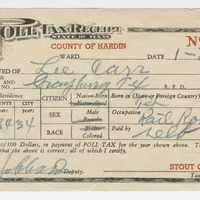 Poll Tax Receipt for Lee Carr (1955) Poll Tax Receipt for Lee Carr (1955) |
|
An image of a poll tax receipt from Texas. Poll taxes were a tool to prevent Black people and poor people from voting, since the poll tax was often a significant percentage of someone's weekly income.
|
| President Johnson's Commencement Address at Howard University: "To Fulfill These Rights" (1965) |
|
In this speech given to Howard University's 1965 graduating class, President Lyndon B. Johnson talks about the Civil Rights and Voting Rights Acts being passed as a result of the Civil Rights Movement and the long-lasting impacts of systemic racism.
|
| Prigg v. Pennsylvania (1842) |
|
The case of Prigg v. Pennsylvania evaluated the legality of Pennsylvania's personal liberty laws. Margaret Morgan moved from Maryland to Pennsylvania after being granted her freedom. When relatives of her previous enslaver wanted to reclaim her, they sent Edward Prigg to Pennsylvania to find her. Pennsylvania courts found Prigg guilty of violating the state's personal liberty laws, but the Supreme Court ruled that the federal fugitive slave laws overrule state laws.
|
| Proclamation 10948 - Enhancing National Security By Addressing Risks At Harvard University (2025) |
|
This presidential proclamation claims that because of an increase of criminal activity at Harvard University, and a failure of the University to comply with federal directives, international student visas will be revoked.
|
| Proclamation 4417 - An American Promise (1976) |
|
This proclamation issued by President Gerald Ford confirmed the termination of Executive Order 9066, which had authorized the internment of Japanese-Americans during World War II.
|
| Re: DEI Programs Are Lawful Under Federal Civil Rights Laws and Supreme Court Precedent (2025) |
|
This memorandum from law professors across the United States explains how diversity, equity, and inclusion initiatives are legally defensible, in spite of the January 21, 2025, Executive Order titled "Ending Illegal Discrimination and Restoring Merit-Based Opportunity."
|
| Re: February 14, 2025 Dear Colleague Letter issued by the United States Department of Education, Office of Civil Rights (2025) |
|
In this letter from the Montana University System, the Chief Legal Counsel responds to the Dear Colleague letter, describing its compliance with the guidance from the Dear Colleague Letter. It calls attention to Montana's work with tribal governments to increase the recruitment and retention of tribal students, noting that the Supreme Court has recognized distinctions based on tribal enrollment as political not racial classification.
|
| Rehabilitation Act (1973) |
|
This act regulated the Department of Labor and specifically sought to limit discrimination based on disabilities. It required affirmative action in federal employment and created and extended civil rights to people with disabilities. While not as maybe far-reaching as the Americans with Disabilities Act, this act was passed nearly 20 years earlier.
|
| Remembering a Dark Past, Renewing Resolve for the Future (2019) |
|
This article from the Omaha World Herald describes Omaha's official observance of the 100-year anniversary of the lynching of Will Brown. Omaha Mayor, Jean Stothert, spoke at the commemoration calling Will Brown's lynching one of the darkest days in our history.
|
| Report of the Woman's Rights Convention Held at Seneca Falls (1848) |
|
Generally credited as the first call for equal rights for women, this document is the result of the Seneca Falls Convention of 1848. It calls for suffrage rights for women, as well as equal rights in all aspects of society. The convention was organized by Elizabeth Cady Stanton and Lucretia Mott, both women were from abolitionist families, highlighting a sharp divide between women’s rights advocates before and after the Civil War.
|
| Roe v. Wade (1973) |
|
Roe v. Wade is the landmark Supreme Court decision that extended the right to privacy to the ability for women to obtain abortion care. The decision was overturned in the 2022 decision of Dobbs v. Jackson Women's Health Organization, returning legislation on abortion care to the states.
|
| Sedition Act (1798) |
|
This is one of four acts known collectively as the Alien and Sedition Acts. These acts were passed by a Federalist-controlled Congress applied restrictions to immigration and speech in the U.S. They were highly controversial and contributed to the Federalist defeat in the election of 1800. After 1802, only the Alien Enemies Act remained in force, and has continued to be invoked during times of war. The Sedition Act made it illegal to print "false, scandalous and malicious writing" against the U.S. government. It was used to suppress speech critical of the Federalist Party.
|
| Shelby County v. Holder (2013) |
|
This landmark Supreme Court decision overturned the federal pre-clearance section the Voting Rights Act of 1965 which required jurisdictions to seek approval from the Department of Justice or the U.S. District Court for D.C., before making changes to their voting laws. This decision limited the federal government's ability to protect voting rights for all citizens and has since allowed policies such as voter ID laws and the closing polling locations to limit voting rights for certain groups.
|
| Shelley v. Kraemer (1948) |
|
In this case, the Supreme Court ruled that the Equal Protection Clause of the Fourteenth Amendment prohibited the enforcement of restrictive covenants banning the purchase or occupation of property based on race. Shelley v. Kraemer was decided alongside Hurd v. Hodge, which held that the Civil Rights Act of 1866 prohibits judicial enforcement by D.C. courts of such restrictive covenants.
|
| Smith v. Directors of Independent School Dist. of Keokuk (1875) |
|
In this case, the Iowa Supreme Court affirmed a lower court's ruling that the Keokuk school district could not refuse to admit a Black student based on race. Legal precedent for this case as set in the 1868 ruling in Clark v. Board of School Directors.
|
| South Dakota Human Relations Act of 1972 |
|
This act prohibits unfair and discriminatory practices in employment, labor union membership, housing accommodations, property rights, education, public accommodations, and public services on the basis of race, color, creed, religion, sex, ancestry, and national origin. The act was amended in 1986 to include protections against discrimination based on disability. The Civil Rights Movement helped push for these changes throughout the United States.
|
| State of Iowa v. Katz (1949) |
|
In this case, the Iowa Supreme Court upheld a lower court's jury verdict that Katz Drug Store violated the civil rights of three Black patrons when workers refused to serve them at the store's soda fountain.
|
| State of Missouri v. Celia (1855) |
|
In this case, eighteen-year-old Celia was convicted of murdering her enslaver. The case considered whether Celia was guilty of murder or if she could be acquitted due to self-defense from sexual assault. The court ruled that Celia's enslaved status prevented her from being eligible to protect herself, and she was sentenced to death.
|
| State of Nebraska, ex rel. Daniel Freeman, v. John Scheve et al. (1902) |
|
In this case, Daniel Freeman, recognized as the first homesteader under the 1862 Homestead Act, made a public grievance over the use of the Bible in a public school near Beatrice. When the teacher refused to cease using the Bible, offering prayers, and singing hymns in her classroom, Freeman took his case to the school board, who defended the teacher. He then took his case to the courts. The lower court also sided with the teacher, and he appealed the case to the Nebraska Supreme Court. The higher court found that the actions of the teacher and the school board violated the provisions in Nebraska's constitution regarding the separation of church and state. The U.S. Supreme Court did not make a similar ruling until 1962 in Engel v. Vitale.
|
| Statute of Northampton, Chapter 3 (1328) |
|
This medieval English law has been brought up in Second Amendment debates in recent years. Chapter III of the statute regulated "riding or going armed in affray of the peace." Proponents of firearms regulations call attention to this law as an historical example of public carry restrictions, while opponents point out that "armed" in this context referred to the wearing of armor and associated weaponry, not the peaceful carrying of smaller weapons.
|
| Students for Fair Admission v. Harvard (2023) |
|
This Supreme Court case considered whether Harvard's admissions process violated Title VI of the Civil Rights Act. The Court decided that the race-based admissions system did not meet the strict scrutiny required to allow a race-based system, and held as unconstitutional the consideration of an applicant’s race as a factor in making an admissions decision that benefits diversity.
|
| Suffrage Paraders (1913) |
|
On March 3, 1913, the day before President Woodrow Wilson's first inauguration, as many as 10,000 women participated in the Woman Suffrage Procession down Pennsylvania Avenue. The parade was the first large-scale civil rights march in the nation's capital. The participation of African American women was a point of contention for racist members of the various delegations, however, Black women marched in the procession unsegregated. The official magazine of the National Association for the Advancement of Colored People, The Crisis, published an account of the parade and the Black women who participated in it.
|
| Sweatt v. Painter (1950) |
|
In this case, the Supreme Court held that separate Black law schools in Texas were not equal in quality to white-only law schools. Sweatt v. Painter set important precedent for the decision in Brown v. Board of Education four years later.
|
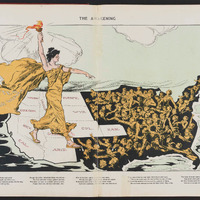 The Awakening (1915) The Awakening (1915) |
|
This political cartoon was the centerfold of a special suffrage issue of Puck Magazine. The cartoon depicts Lady Liberty marching eastward on a map of the United States following suffrage wins in the western states of Washington, Oregon, Nevada, California, Idaho, Utah, Arizona, Montana, Wyoming, Colorado, and Kansas. Women in the east reach toward the light of Liberty's torch of freedom. Below the image is a poem by Alice Duer Miller.
|
| The Black Code of the District of Columbia (1848) |
|
This compendium collects the laws governing the Black residents of Washington, D.C. These laws granted the municipal government of D.C. the authority to restrain both enslaved and freed people, including multiracial individuals who did not comply with this set of racialized laws. The District's Black codes regulated movement and activities for Black people living and working in D.C. and expressly prohibited both freedpeople and enslaved people from partaking in activities included in the First Amendment. Violation of these laws was punishable by whipping, imprisonment, and fines.
|
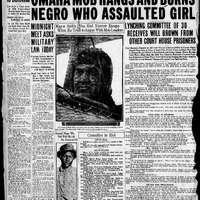 The Lynching of Will Brown (1919) The Lynching of Will Brown (1919) |
|
The day after the lynching of Will Brown, the Omaha Bee devoted the first two pages of its edition to the racial terror violence enacted by a mob of white Omahans. The articles on these pages provide different perspective of the race riot, from the crowds cheering at the destruction of government buildings, to the alleged assault victim's shock at the incident. The newspaper also featured a list of victims of the mob.
|
| The Treaty of 1866 and the Long Fight for Black Belonging in the Choctaw and Chickasaw Nations (2025) |
|
This module reframes histories of the Civil War, emancipation, and Reconstruction by analyzing how enslaved and freed Black people in the Choctaw and Chickasaw Nations struggled to actualize their freedoms amid contested tribal and federal jurisdictions. Ultimately, the module elucidates how Black enslaved and Freedpeople in the Chickasaw and Choctaw Nations developed unique methods of resistance and visions of freedom shaped by the legal paradigms forged in the Treaty of 1866.
|
| The Woman Suffrage Movement and Frederick Douglass (1908) |
|
In this speech given on the 60th Anniversary of the Seneca Falls Convention, Black women's rights advocate Mary Church Terrell reflects on the role of Frederick Douglass in the women's suffrage movement.
|
| Tinker v. Des Moines School District (1969) |
|
The Supreme Court's decision in this case recognized the First Amendment right to freedom of speech or expression in U.S. public schools.
|
| Title IX of the Education Amendments of 1972 |
|
Title IX is a federal law that prohibits sex-based discrimination in schools or education programs that receive funding from the federal government. Since the passage of this act, the number of female students participating in organized sports programs increased. Numerous court decisions have questioned the scope of Title IX over the years, and the U.S. Department of Education which oversees Title IX has continued to issue guidance on its protections against sexual harassment and sexual violence, as well as discrimination based on a student's gender identity.
|
| U.S. Freedman's Bank Records, Registers of Signatures of Depositors, New York (1870) |
|
Freedman's Bank records show both strivings toward stability as well as racialization and colorism post-emancipation due to the specific color-related information listed with deposits.
|
| Union Labor Injunctions (1903) |
|
This California act states that workers who agree to work together during a trade dispute between employees and employers are not eligible to be criminally charged for conspiracy. Courts cannot issue injunctions against a group of workers for organizing together if the actions they take as a group is an action a single person could do legally. This law was passed in 1903 to protect workers' right to organize and take collective action and to prevent employers from using conspiracy laws to crack down on union activity.
|
| United States v. Brignoni-Ponce (1975) |
|
In this case, the Supreme Court ruled that it was a violation of the Fourth Amendment for law enforcement to stop a vehicle solely on the basis of the driver appearing to be of Mexican descent. Appearance of ethnicity did not constitute reasonable suspicion for the stopping and interrogation of a vehicle and its passengers.
|
| United States v. Cruikshank (1876) |
|
This Supreme Court case arose in the aftermath of the Colfax Massacre of 1873, where a militia of white supremacists murdered as many as 150 Freedmen following the contested 1872 election for governor of Louisiana. Members of the militia were indicted under the Enforcement Act of 1870. The Supreme Court found the indictment insufficient and reversed the conviction of the white defendants, offering their interpretation of the function of the Constitution, including the First, Second, Fourteenth and Fifteenth Amendments. One major contribution of the case was the determination that the Bill of Rights did not limit the powers of individual actors or state governments.
|
| United States v. Thind (1923) |
|
The Supreme Court found in U.S. v. Thind that Indian immigrants were not eligible for naturalization, based on a contested category of whiteness. Contradicting their 1922 ruling in Ozawa naming caucasian identity as a requirement for naturalization, as a South Asian immigrant, Thind was deemed ineligible for citizenship because, despite being racially caucasian, he did not appear white.
|
| United States v. Windsor (2013) |
|
In this case, the Supreme Court overturned the 1996 Defense of Marriage Act. It examined the argument of a same-sex couple who were married in Canada and wanted the tax benefits of marriage after one partner died. While same-sex marriage was recognized by the State of New York, the Defense of Marriage Act prevented federal recognition of their marriage.
|
| United States, ex rel. Standing Bear, v. George Crook (1879) |
|
In this case, Judge Elmer S. Dundy ruled that "an Indian is a person within the meaning of the laws of the United States," and that they were entitled to the right of expatriation. Standing Bear and 29 other Ponca had left their reservation in Indian Territory without the permission of the federal government and returned to Nebraska. They were later arrested and petitioned for a writ of habeas corpus, which was granted. Judge Dundy's opinion led to the release of the Ponca petitioners.
|
| Vietnamese Fishermen's Association v. The Knights of the Klu Klux Klan (1982) |
|
A sign of progress in the fight for civil rights for Asian immigrants, the Vietnamese Fishermen's Association filed a class action lawsuit against the KKK and won. The KKK was burning the fishermen's boats and were found guilty of violating the Vietnamese fishermen's civil rights.
|
| Voting Rights Act (1965) |
|
The Voting Rights Act of 1965 prohibits racial discrimination in voting, enforcing the voting rights protected by the Fourteenth and Fifteenth Amendments. Its intent was to outlaw the discriminatory voting practices adopted by many southern states against African Americans. Its power was severely reduced by the 2013 Supreme Court Decision in Shelby County v. Holder and again by Louisiana v. Callais in 2026. Mere days after the decision in Callais, Tennessee passed a new redistricting map that will divide the only majority-Black district in the state. Several other southern states have also taken steps toward redistricting areas with a Black majority.
|
| Washington Law Against Discrimination in Employment (1949) |
|
Originally passed in 1949, the Law Against Discrimination in Employment prohibits employers from discriminating against employees because of race, creed, color, national origin, as well as age (1961), sex (1971), marital status (1973), disability (1973, 1993, 1997), sexual orientation (2006), honorably discharged veteran or military status (2007), and citizenship or immigration status (2020). The many changes made to this law since its post-war origin reflects the progression of the civil rights movements over the years.
|
| Webinar - Affirmative Action's Origins and Legacies (2023) |
|
In this webinar, UNL Law Faculty Eric Berger, Danielle Jefferis, and Catherine Wilson provide an in-depth look at affirmative action, delving into its origins and tracing its impact to the present day.
|
| Webinar - Before the Movement: The Hidden History of Black Civil Rights (2026) |
|
In this webinar, Professor Dylan C. Penningroth of the University of California, Berkeley, discusses his award-winning 2023 book, Before the Movement: The Hidden History of Black Civil Rights, examining how Black people used the law in their everyday lives prior to the civil rights movement.
|
| Webinar - D.C. Divided: Segregation in the Nation's Capital (2025) |
|
This webinar discusses the racially restrictive covenants used by early 20th century developers and white citizens to prevent Black residents and other groups from buying or leasing property in Washington, D.C. This community conversation hosted by the Institute of Politics, Policy & History features a panel of historians, legal scholars, and descendants who reveal the history of the enduring impact of racial covenants in D.C. and how residents fought back.
|
| Webinar - Equal Protection, Reconstruction, and the Meaning of the 14th Amendment (2023) |
|
In this webinar, Dr. Kate Masur of Northwestern University discusses the 14th Amendment and the implications of equal protection under the law with Dr. Sharlene Sinegal-DeCuir of Xavier University and Dr. William Thomas and his American Constitutional History class.
|
| Webinar - Latina/os and Criminal and Immigration Law Enforcement (2025) |
|
In this webinar, Professor Kevin R. Johnson of the University of California, Davis, discusses the history of criminal and immigration law enforcement of Latina/os in the U.S with Dr. Donna D. Anderson and her And Justice For All class.
|
| Webinar - The Many Interpretations of the Second Amendment, From The Early Republic to the Present (2026) |
|
In this webinar, Professor Saul Cornell of Fordham University discusses his research on the Second Amendment, race, and regulation with Dr. William G. Thomas III.
|
| Woman Suffrage in Territories (1883) |
|
This newspaper article discusses the women's suffrage act passed in Washington Territory. Washington was the third territory to grant women suffrage rights, although the Territorial Supreme Court later overturned the law.
|
| Wyoming Declaration of Rights (1889) |
|
The first article of the State of Wyoming's Constitution enumerates certain rights within the state. Wyoming Territory was the first government to grant women suffrage rights, and that right was preserved in the Declaration of Rights when organizing the state government.
|
| Yarborough v. Alvarado (2004) |
|
In this case, the Supreme Court overturned a Ninth Circuit Court of Appeals ruling that stated that youth and inexperience with law enforcement should be accounted for when evaluating custody. In the majority opinion, the Supreme Court held that previous rulings had rejected reliance on factors such as age and inexperience in custody analysis.
|
| Yasui v. United States (1943) |
|
In this case, the Supreme Court held that curfews against minority groups were constitutional at a time of war against the country that group's ancestors originated from. After the Executive Order 9066 was issued in the wake of the attack on Pearl Harbor, Japanese Americans were subject to curfews and other restrictions in addition to being removed to internment camps. Minoru Yasui was convicted of violating the curfew. This was a companion case to Hirabayashi v. United States, decided on the same day.
|
| Yates v. United States (1957) |
|
In this case, the Supreme Court limited the scope of the Smith Act by holding that radical and reactionary speech was protected under the First Amendment, drawing a distinction between advocacy of forcible overthrow as an abstract principle and an effort to instigate action to that end. Unlike the decision in the earlier Dennis v. United States (1951) case, the court reversed the convictions of the Communist Party leaders.
|