 14th Amendment to the United States Constitution (1868) 14th Amendment to the United States Constitution (1868) |
|
The Fourteenth Amendment gave citizenship to all persons born or naturalized in the United States. The writers intended it to support the Civil Rights Act of 1866, and it has since been used to support civil rights and justify the expansion of rights across marginalized groups. The equal protection clause is among the most litigated parts of the Constitution, meaning that many court cases are decided based on interpretations of the 14th Amendment. The amendment was passed by Congress June 13, 1866, and ratified July 9, 1868.
|
| 19th Amendment to the United States Constitution (1920) |
|
The Nineteenth Amendment granted women the right to vote by prohibiting the denial of suffrage based on sex. The amendment was passed by Congress June 4, 1919, and ratified August 18, 1920. The 19th Amendment effectively only guaranteed voting rights for white women. Women of color remained disenfranchised for years after. Poll taxes, literacy and property tests, violence and intimidation were all used to keep women from exercising their right to vote. It was not until the Voting Rights Act of 1965 that the 19th Amendment became a reality for all women.
|
| 24th Amendment to the United States Constitution (1964) |
|
The Twenty-Fourth Amendment prevents the use of poll taxes in elections. It was passed during the 1960s Civil Rights Movement along with the Voting Rights Act of 1965 to actualize voting rights for people of all races guaranteed by the 15th Amendment. The amendment was passed by Congress August 27, 1962, and ratified January 23, 1964.
|
| Administering Drugs with Intent to Produce Abortion (1882) |
|
This nineteenth century West Virginia abortion law punished providers for helping women access abortion care. Under this law, anyone found guilty of helping "produce abortion" was subject to three to ten years imprisonment.
|
| Affirmative Action's Origins and Legacies (2023) |
|
This teaching module provides an in-depth look at affirmative action, delving into its origins and tracing its impact to the present day, featuring a webinar with Nebraska Law faculty Catherine Wilson, Danielle Jefferis, and Eric Berger.
|
| American Indian Religious Freedom Act (1978) |
|
This act protected the right of Native Americans to practice their traditional religions and access to sacred sites, objects, and materials. The act was amended in 1994 to allow for the protected use of peyote as a sacrament in traditional religious ceremonies.
|
| An Act Further to Protect Personal Liberty (1843) |
|
This Massachusetts personal liberty law aimed to counteract the Fugitive Slave Act of 1793 by forbidding state-level judges and law enforcement officers from arresting or detaining any person "for the reason that he is claimed as a fugitive slave."
|
| An Act Respecting Slaves, Free Negroes, and Mulattoes (1847) |
|
This Missouri law is one of the Black Codes designed to ensure white supremacy prior to the Civil War, limiting literacy and assembly for enslaved people as well as preventing interstate travel for free Black people.
|
| An Act Temporarily Providing for Such Persons as Have Been to the Present Time Considered as Slaves (1865) |
|
This law, which did not universally abolish slavery in the Choctaw Nation, regulated the way in which persons who had been previously enslaved in the nation were allowed to remain with their former enslavers. It also legally barred any Black enslaved person who escaped from bondage in the Choctaw Nation from "returning for the purpose of residing in the Nation."
|
| An Act to Adopt the Freedmen of the Choctaw Nation (1883) |
|
This act enrolled Choctaw Freedpeople as citizens of the Choctaw Nation, seventeen years after their emancipation.
|
| An Act to Adopt the Negroes of the Chickasaw Nation (1873) |
|
This tribal law, which was adopted by the Chickasaw Nation on January 10, 1873, called for the adoption of Chickasaw Freedmen as citizens of the Chickasaw Nation. The law included three primary stipulations for the adoption of Chickasaw Freedmen as tribal citizens: first, that Chickasaw Freedmen be excluded from any financial interests in the $300,000 the tribe would receive and any other tribal invested funds or claims; second, that despite these exclusions from monetary benefits, Chickasaw Freedmen be considered fully subject to the "jurisdiction and laws" of the Chickasaw Nation; and third, that the law would go into effect after being approved "by the proper authority of the United States." The law would not be approved by the U.S. Congress until 1894.
|
| An Act to Continue in force and to Amend "An Act to Establish a Bureau for the Relief of Freedmen and Refugees,'' and for Other Purposes (1866) |
|
This act of Congress extended the Freedmen's Bureau until 1868. The Freedmen's Bureau was established during Reconstruction to manage the affairs of the formerly enslaved and refugees from the Civil War. President Andrew Johnson vetoed the bill, but the veto was overridden by Congress.
|
| An Act to Establish a Bureau for the Relief of Freedmen and Refugees (1865) |
|
This act of Congress created the Freedmen's Bureau in order to provide aid and support to the formerly-enslaved people across the South.
|
| An Act to Prevent Kidnapping (1820) |
|
This act is Pennsylvania's first personal liberty law. It was written to counteract the Fugitive Slave Act of 1793 and preserve the ability of free Black people to live in Pennsylvania. The act made kidnapping any Black person a felony punishable by large fines and lengthy imprisonment. It also fined any state official that took cognizance of the case of "any fugitive from labor."
|
| Arkansas Declaration of Rights (1874) |
|
This excerpt from the Declaration of Rights in the 1874 (and current) Arkansas State Constitution contains the language prohibiting the distinction between resident aliens and citizens in regard to property.
|
| Asian Immigrants' Fight Against Discriminatory Alien Land Laws (2025) |
|
This module examines the history of anti-Asian/Japanese alien land laws in the 1920s United States, focusing on one lawsuit by Chinese immigrant Lum Jung Luke that brought down Arkansas' Alien Land Act.
|
| Baker v. Nelson (1972) |
|
Baker v. Nelson was first same-sex marriage case to be reviewed by the Supreme Court. The Supreme Court dismissed the appeal from the Minnesota Supreme Court, stating that the case did not bring forward "a substantial federal question." This case reflects the lack of thought given to LGBTQ+ rights in 1972.
|
| Balzac v. Porto Rico (1922) |
|
Balzac v. Porto Rico is one of a series of cases decided by the Supreme Court addressing the status of U.S. territories known as the Insular Cases. The court in Balzac ruled that residents of Puerto Rico were not guaranteed a trial by jury. In Dorr v. United States, the Supreme Court ruled the same way for residents of the Philippines.
|
| Batson v. Kentucky (1986) |
|
The Supreme Court reinforced the precedent set in Strauder v. West Virginia and Swain v. Alabama by ruling that racial discrimination in selecting jurors deprives the defendant of their rights during the trial and denies the broader public faith in the fairness of our justice system.
|
| Bill of Rights (1791) |
|
The first 10 amendments to the Constitution guarantee certain personal rights and limit the power of the federal government. These amendments are continuously considered by the Supreme Court in their rulings.
|
| Bowers v. Hardwick (1986) |
|
Later overturned by Lawrence v. Texas, this Supreme Court case ruled that the 14th Amendment did not prevent states from prohibiting sexual relations between same-sex couples.
|
| Brandenburg v. Ohio (1969) |
|
In this case, the Supreme Court ruled that an Ohio law prohibiting public speech that advocates for "crime, sabotage, violence, or unlawful methods of terrorism as a means of accomplishing industrial or political reform" violated the First and Fourteenth Amendments. The court held that such speech could only be prohibited "where such advocacy is directed to inciting or producing imminent lawless action and is likely to incite or produce such action."
|
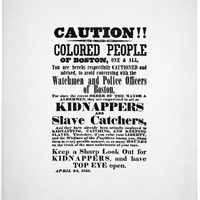 Broadside Reacting to the Fugitive Slave Act (1851) Broadside Reacting to the Fugitive Slave Act (1851) |
|
This broadside was distributed in Boston following the passage of the Fugitive Slave Act of 1850.
|
| Brown v. Board of Education (1954) |
|
The Supreme Court found in Brown v. Board of Education that educational segregation violated the Equal Protection Clause of the Fourteenth Amendment. This landmark case overturned the precedent created by the decision in Plessy v. Ferguson, and ended the Jim Crow era.
|
| California Proposition 6 (2024) |
|
A proposed amendment to the California that would have banned involuntary servitude as a punishment for a crime. This measure failed in the 2024 election, meaning the State of California remains one of 16 states that still allows forced labor. A similar ballot measure also failed in 2022.
|
| Chain Gang Blues (1925) |
|
Chain Gang Blues was a song recorded by blues singer Ma Rainey in 1925 that reflects the experience of Black Americans in the Jim Crow South. In the song, the protagonist has been sent on the chain gang for reasons that she thinks are unjust.
|
| Civil Liberties Act (1988) |
|
This act granted reparations to Japanese Americans who had been removed from their homes and interred in camps by the government during World War II. It also made restitution to Native Americans in Alaska who were interred by both the Japanese and Americans.
|
| Civil Rights Act of 1866 |
|
The Civil Rights Act of 1866 was the first federal law addressing civil rights. It gave everyone born in the United States, other than Native Americans, citizenship rights and equal rights under the law. President Andrew Johnson vetoed the bill and the House of Representatives overrode his veto. The Civil Rights Act was the precursor to the 14th Amendment.
|
| Civil Rights Act of 1875 |
|
The Civil Rights Act of 1875 is a Reconstruction Era law enacted to protect the civil rights of freed Black people. It explicitly protected the ability to use transportation and allowed Black people to serve on juries. The law was declared unconstitutional by the Supreme Court in 1883 when they ruled that the 14th Amendment only had the power to regulate states, not individuals.
|
| Civil Rights Act of 1964 |
|
The Civil Rights Act of 1964 ended segregation in public places and banned discrimination in employment. The act reflected over a century of political and legal activism.
|
| Civil Rights Cases (1883) |
|
These cases saw the Supreme Court push back on constitutional equal protection and the 1875 Civil Rights Act. The ruling held that the 13th Amendment "merely" abolished slavery and that the 14th Amendment did not apply to the racist acts of private individuals. The decision in these cases led to the increased segregation of Black people in all facets of public and private life.
|
| Civilian Exclusion Order No. 34 (1942) |
|
This broadside detailed U. S. Army orders to force all persons of Japanese ancestry, whether citizens or non-citizens, to depart Alameda County, California, and report to an assembly center where they would be sent to concentration camps. Fred Korematsu defied this exclusion order by remaining at his residence and was eventually convicted in federal court.
|
| Clark v. Board of School Directors (1868) |
|
In this case, the Iowa Supreme Court ruled that the segregation of students based on race was unconstitutional. It was the first and only 19th century court to overturn school segregation.
|
| Coger v. The North Western Union Packet Co. (1873) |
|
In this case, the Iowa Supreme Court held that a steamboat company's removal of a Black woman from its dining table violated her constitutional right of equality under Iowa's constitution, relying heavily on the Court's earlier decision in Clark v. Board of School Directors. This case came nearly 100 years before the U.S. Supreme Court decision in Heart of Atlanta Motel, Inc. v. United States that upheld Title II of the newly passed Civil Rights Act of 1964, which prohibited discrimination in public accommodations.
|
| Constitution of Oregon (1859) |
|
Oregon became a state with a Black exclusion law in its constitution. Drafted in 1857 by delegates at a territorial convention, several sections of the constitution reflect Oregon voters' goal of creating a white-only state.
|
| Corrigan v. Buckley (1926) |
|
In this case, the Supreme Court upheld the constitutional validity of racially restrictive covenants, stating that "it is obvious that none of [the] amendments prohibited private individuals from entering into contracts respecting the control and disposition of their own property." Restrictive covenants were eventually struck down by the Supreme Court in Shelley v. Kraemer (1948).
|
| D.C. Divided: Segregation in the Nation's Capital (2025) |
|
This teaching module features a webinar discussing the racially restrictive covenants used by early 20th century developers and white citizens to prevent Black residents and other groups from buying or leasing property in Washington, D.C. This community conversation hosted by the Institute of Politics, Policy & History features a panel of historians, legal scholars, and descendants who reveal the history of the enduring impact of racial covenants in D.C. and how residents fought back against them.
|
| Dear Colleague Letter (2025) |
|
This letter, sent to the departments of education in all 50 states, summarizes the Trump administration's position on diversity, equity, and inclusion (DEI). While the letter does not carry the force of law, it states that any institutions of higher education who do not comply with the administration's interpretation of existing nondiscrimination requirements may lose federal funding.
|
| Declaration of Independence (1776) |
|
The Declaration of Independence formally announced the separation of the 13 United States from the United Kingdom. The document lists the reasons members of the second Continental Congress believed they should no longer be under British colonial rule.
|
| Defense of Marriage Act (1996) |
|
The Defense of Marriage Act defined marriage federally as between a man and a woman, and allowed each state to recognize marriage based on its own definition. As a result, same-sex marriages granted under the laws of some states were not recognized by others.
|
| Dennis v. United States (1951) |
|
In this case, the Supreme Court affirmed the convictions of a group of Communist Party organizers, upholding the Smith Act (1940), which criminalized advocating for the overthrow of the U.S. government. The court again examined the Smith Act in Yates v. United States (1957) before it overturned the ruling in the Dennis case with Brandenburg v. Ohio (1969).
|
| Dorr v. United States (1904) |
|
Dorr v. United States is one of a series of cases decided by the Supreme Court addressing the status of U.S. territories known as the Insular Cases. The court in Dorr ruled that residents of the Philippines were not entitled to a trial by jury. The case of Balzac v. Porto Rico decided the same in Puerto Rico.
|
| Duro v. Reina (1990) |
|
This Supreme Court case looked at Native American tribal jurisdictions. The Court ruled that Native tribes did not have criminal jurisdiction over nonmembers.
|
| Duro-Fix (1991) |
|
This amendment to the Indian Civil Rights Act was designed to overturn the Supreme Court's ruling in Duro v. Reina. It reinstated the power of Native American tribes to exercise criminal misdemeanor jurisdiction over all Indians.
|
| Enforcement Act of 1870 |
|
The Enforcement Act of 1870 was enacted to enforce the 15th Amendment during Reconstruction. It explicitly prohibited the use of terror, force, or disguise to violate a voter's constitutional right. This law was intended to protect the voting rights of Black Americans and penalize state officials and violent groups like the Ku Klux Klan who interfered.
|
| Enforcement Act of 1871 |
|
The Enforcement Act of 1871 revised the Enforcement Act of 1870 to further protect Black Americans' right to vote and hold office. It added more severe punishments to those who violated the constitutional rights of Black Americans. This act specifically called for federal oversight of national elections and empowered federal judges and marshals to supervise local polling places.
|
| Equal Credit Opportunity Act (1974) |
|
This act prohibited discrimination in credit transactions and lending practices based on sex and marital status. It was amended in 1976 to include other characteristics such as race, ethnicity, age, religion, and use of any public assistance program. Before the law was enacted, lenders and the federal government frequently and explicitly discriminated against female loan applicants.
|
| Equal Protection, Reconstruction, and the Meaning of the 14th Amendment (2023) |
|
This teaching module discusses the 14th Amendment and the implications of equal protection under the law, featuring a webinar with Kate Masur, author of the 2021 book, Until Justice Be Done: America's First Civil Rights Movement, from the Revolution to Reconstruction.
|
| Equal Rights Amendment of 1972 |
|
The Equal Rights Amendment of 1972 was intended to guarantee equal rights for all U.S. citizens regardless of sex. It passed Congress in 1972, but only 35 of the requisite 38 states ratified the amendment before the deadline set by Congress. The Equal Rights amendment was written by suffragists Alice Paul and Crystal Eastman and first presented to Congress in 1923, shortly after the 19th Amendment granting women voting rights was ratified.
|
| Ex Parte Mitsuye Endo (1944) |
|
In this case, the Supreme Court held that the federal government could not continue to hold citizens of Japanese ancestry who were "concededly loyal" to the United States, though the ruling did not find the actions of the War Relocation Authority unconstitutional as a whole. Mitsuye Endo was released.
|
| Executive Order 10450 - Security Requirements for Government Employment (1953) |
|
A part of the Lavender Scare, President Dwight D. Eisenhower's Executive Order 10450 banned members of the LGBTQ+ community from being employed by the federal government.
|
| Executive Order 10925 - Establishing the President's Committee on Equal Employment Opportunity (1961) |
|
This executive order by President John F. Kennedy directed government contractors to use affirmative action to ensure people of any "race, creed, color, or national origin" were given equal treatment and opportunity for employment. This executive order also established the President's Committee on Equal Employment Opportunity.
|
| Executive Order 11246 - Equal Employment Opportunity (1965) |
|
This executive order enacted by President Lyndon B. Johnson was repealed by a January 2025 executive order from Donald Trump. The original order was written to ensure equal opportunity in government employment and limit discrimination based on race. It required employers to furnish documentation of nondiscriminatory practices upon request.
|
| Executive Order 11478 - Equal Employment Opportunity in the Federal Government (1969) |
|
This executive order from President Richard Nixon ensured the continuation of affirmative action and increased directives to limit discrimination in the workplace. Nixon added that this order intends to prevent discrimination based on sex as well as race.
|
| Executive Order 12138 - Creating a National Women's Business Enterprise Policy and Prescribing Arrangements for Developing, Coordinating and Implementing a National Program for Women's Business Enterprise (1979) |
|
This executive order from President Jimmy Carter established regulations to ensure women-owned businesses received support from the federal government and that women face less discrimination in the workplace.
|
| Executive Order 12432 - Minority Business Enterprise Development (1983) |
|
This executive order from President Ronald Reagan sought to protect minority business owners and provide regulations to prevent discrimination. This was one of a series of executive orders to ensure affirmative action issued by every president across the second half of the twentieth century.
|
| Executive Order 13672 - Further Amendments to Executive Order 11478, Equal Employment Opportunity in the Federal Government, and Executive Order 11246, Equal Employment Opportunity (2014) |
|
This executive order by President Barack Obama revised and amended Presidents Richard Nixon's and Lyndon B. Johnson's Executive Orders 11478 and 11246 to include protections against discrimination in the federal government based on sexual orientation or gender identity. President Donald Trump rescinded this order on January 21, 2025, with his own Executive Order 14173.
|
| Executive Order 13988 - Preventing and Combating Discrimination on the Basis of Gender Identity or Sexual Orientation (2021) |
|
In this executive order, President Joe Biden stated his administration's commitment to the idea that "all persons should receive equal treatment under the law, no matter their gender identity or sexual orientation." The order directed federal agencies to review all orders, regulations, guidance documents, policies, programs, or other agency actions to ensure they are consistent with this idea and to extend such protections if they are not. President Donald Trump rescinded this order on January 20, 2025, with his own Executive Order 14168.
|
| Executive Order 14021 - Guaranteeing an Educational Environment Free From Discrimination on the Basis of Sex, Including Sexual Orientation or Gender Identity (2021) |
|
In this executive order, President Joe Biden declared that under his administration, "all students should be guaranteed an educational environment free from discrimination on the basis of sex," including sexual harassment and sexual violence, as well as discrimination on the basis of sexual orientation or gender identity. The order directed federal agencies to review all regulations, orders, guidance documents, policies, and any other similar agency actions to ensure they are consistent with this order and to extend such protections if they are not. President Donald Trump rescinded this order on January 20, 2025, with his own Executive Order 14168.
|
| Executive Order 14151 - Ending Radical And Wasteful Government DEI Programs And Preferencing (2025) |
|
This executive order by President Donald Trump directs the Office of Management and Budget to terminate all mandates, policies, programs, preferences, and activities relating to diversity, equity, inclusion, and accessibility. It also requires federal agencies to report a list of all employees in DEI positions within 60 days. As a result, these employees were terminated.
|
| Executive Order 14173 - Ending Illegal Discrimination and Restoring Merit-Based Opportunity (2025) |
|
This executive order by President Donald Trump takes aim at diversity, equity, inclusion, and accessibility initiatives in private institutions, especially institutions of higher education receiving federal funding. It also revokes several longstanding executive orders related to equal employment opportunity and affirmative action.
|
| Executive Order 9066 - Authorizing the Secretary of War to Prescribe Military Areas (1942) |
|
This executive order by President Franklin D. Roosevelt was a federal law that forcefully removed persons deemed a national security threat to relocation centers in the western United States. While the act did not include racialized language, it was created with the intent to target Japanese Americans.
|
| Fair Housing Act (1968) |
|
The Fair Housing Act was originally enacted as part of the Civil Rights Act of 1968. It prohibits discrimination by providers of housing based on race, color, religion, or national origin. In 1988, the act was amended to include disability and familial status.
|
| Fisher v. University of Texas (2016) |
|
This Supreme Court case upheld the admissions policies of the University of Texas using the strict scrutiny criteria established by the 2013 Fisher v. University of Texas decision. It was later overturned by the decision in Harvard and UNC v. Students for Fair Admission.
|
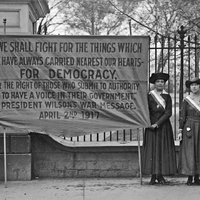 For Democracy (1917) For Democracy (1917) |
|
In this photo, three suffragists stand in front of the White House holding a banner with a quote from President Woodrow Wilson's address before Congress, calling for a declaration of war against Germany: "We shall fight for things which we have always carried nearest our hearts—for democracy, for the right of those who submit to authority to have a voice in their government."
One tactic adopted by suffragists was to use the president's own words to highlight the hypocrisy of fighting for democracy abroad while denying it at home. Today, we can see an additional layer of hypocrisy in the deep racial divide that permeated the women's suffrage movement and the ways in which restrictive voting laws prevented Black men from exercising their right to vote under the 15th Amendment.
|
| Garcetti v. Ceballos (2006) |
|
This Supreme Court case considered the amount of free speech a public employee can make in the course of their duties. The Court ruled that the First Amendment does not apply to public employees when they speak as part of their job; the First Amendment only applies when they speak as a private citizen.
|
| Gratz v. Bollinger (2003) |
|
In the case of Gratz v. Bollinger, the Supreme Court considered the University of Michigan's undergraduate admissions policy and found that race was too significant a factor in admissions decisions.
|
| Griswold v. Connecticut (1965) |
|
In Griswold v. Connecticut, the Supreme Court found that medical privacy was constitutionally protected regarding reproductive decisions. The Griswold decision helped set precedent for the decision in Roe v. Wade.
|
| Hernandez v. Texas (1954) |
|
Hernandez v. Texas showed racial discrimination in all-white juries, reflected in Juan Crow segragation.
|
| Hirabayashi v. United States (1943) |
|
In this case, the Supreme Court held that curfews against minority groups were constitutional at a time of war against the country that group's ancestors originated from. After the Executive Order 9066 was issued in the wake of the attack on Pearl Harbor, Japanese Americans were subject to curfews and other restrictions in addition to being removed to internment camps. Gordon Hirabayashi was convicted of violating the curfew. This was a companion case to Yasui v. United States, decided on the same day.
|
| Honorably Discharged Alien Soldiers (1932) |
|
This Idaho law allowed immigrants who served in the U.S. armed forces to petition for citizenship without the declaration of intent or proof of five years' residence requirements, as specified by the Alien Naturalization Act of 1918. This law indicates legal recognition and benefits extension to veterans in terms of citizenship, military service, and civil rights.
|
| Hoyt v. Florida (1961) |
|
In this case, the Supreme Court considered whether laws like that of Florida, which allowed women to be exempt from serving on juries unless they specifically registered to do so, were constitutional. Gwendolyn Hoyt alleged that because there were no women on her jury, she was not given a fair trial. The Court decided that because women were given an opportunity to register to be considered for jury duty, the law was constitutional.
|
| Hundley v. Gorewitz (1942) |
|
In this case, a federal court struck down a restrictive covenant in Washington, D.C., under the "change of neighborhood" doctrine which allowed a court to declare a restrictive covenant unenforceable if the neighborhood had changed to the point that the original purpose of the covenant had been defeated. In the Hundleys' case, NAACP lawyer Charles Hamilton Houston persuaded the court that the neighborhood was already becoming predominantly Black. These private agreements that prohibited the sale or rental of land to non-white individuals were intended to maintain residential segregation. Restrictive covenants were eventually struck down by the Supreme Court in Shelley v. Kraemer (1948).
|
| Hurd v. Hodge (1948) |
|
In this case, the Supreme Court ruled that judicial enforcement of restrictive covenants banning the purchase or occupation of property based on race by D.C. courts is prohibited by the Civil Rights Act of 1866. Hurd v. Hodge was decided alongside Shelley v. Kraemer, which held that the Equal Protection Clause of the Fourteenth Amendment prohibits such restrictive covenants.
|
| Illinois Women Participants in Suffrage Parade (1913) |
|
On March 3, 1913, the day before President Woodrow Wilson's first inauguration, as many as 10,000 women participated in the Woman Suffrage Procession down Pennsylvania Avenue. The parade was the first large-scale civil rights march in the nation's capital. The participation of African American women was a point of contention for racist members of the various delegations, however, Black women marched in the procession unsegregated.
The Chicago Daily Tribune reported on the parade, giving special attention to an incident where Black activist Ida B. Wells-Barnett was very nearly prohibited from marching with the rest of the Illinois delegate. Instead of giving in to attempts to segregate her, Wells-Barnett boldly marched alongside the white women of Illinois as planned. The next edition of the newspaper printed a picture of Wells-Barnett and her fellow marchers.
|
| In the Matter of the Application of Standing Bear et al. for a Writ of Habeas Corpus (1879) |
|
Standing Bear's writ of habeas corpus showed implications for citizenship, land dispossession, and human rights.
|
| Indian Civil Rights Act (1968) |
|
The Indian Civil Rights Act ensured that constitutional rights were extended to Native Americans while also ensuring tribal sovereignty.
|
| Interim Report on Employment of Homosexuals and Other Sex Perverts in Government (1950) |
|
Following World War II, there was a surge in growth of gay culture in cities. Young people were moving to cities in droves, and they used the anonymity they found in cities to practice their sexuality. The backlash against the increasingly prevalent gay culture was known as the Lavender Scare. Tied to the Red Scare, many homosexual people were fired from their roles working for the federal government. The Interim Report on Employment of Homosexuals and Other Sex Perverts in Government summarized the people they deemed unsuited to work for the government due to their sexuality. As a result, thousands of gay employees were fired or forced to resign from government roles, and other gay individuals never applied for fear of being outed.
|
| Iowa Civil Rights Act (1965) |
|
This Iowa law outlines the civil rights protections for areas like employment, housing, education, and public accommodations, prohibiting discrimination based on race, creed, religion, color, and national origin. Since its original passage in 1965, the Iowa Civil Rights Act has been expanded to include protections against sex (1970), age (1972), disability (1981), and gender identity and sexual orientation (2007) discrimination. In 2025, the state legislature removed gender identity from the list of protected classes, becoming the first state in the U.S. to do so.
|
| John Heo v. Robert H. Milroy (1880) |
|
In this habeas suit, John Heo was arrested by an Indian agent after he refused to reside on the reservation with his wife and children. Heo argued that he had severed his tribal relations, as had his parents, and that they never lived on a reservation or accepted government annuities. Despite "constantly living with the whites engaged in the pursuits of civilized life" and having "at no time lived with any tribe of Indians" or "acknowledged himself a member of any Indian tribe," the judge ruled in favor of the Indian agent, and Heo remained in custody.
|
| Keyishian v. Board of Regents (1967) |
|
In the Supreme Court case of Keyishian v. Board of Regents, the Court considered whether a New York law limiting the public employment of "subversive persons" was a violation of the First Amendment. The Court in this case ruled that First Amendment restrictions must be narrow.
|
| Kinney v. the Commonwealth (1878) |
|
In this case, the Supreme Court of Appeals in Virginia upheld the state's laws prohibiting interracial marriage. When interracial marriages became legal in Washington, D.C., Andrew Kinney, a Black man, and Mahala Miller, a white woman, traveled from the home they shared with their two children in Augusta County, Virginia, to be married. Upon their return, Kinney was indicted in the county court for "lewdly associating and cohabiting" with his wife and fined $500. Kinney appealed his case to the Circuit Court and again to the Supreme Court of Appeals. The court affirmed both lower courts rulings, stating that "if the parties desire to maintain the relations of man and wife, they must change their domicile and go to some state or country where the laws recognize the validity of such marriages."
|
| Korematsu v. United States (1944) |
|
In this case, the Supreme Court ruled that war-time exclusion against Japanese-Americans was valid.
|
| Korematsu v. United States (1984) |
|
In this case, Korematsu challenged his 1942 conviction by filing a writ of coram nobis, which asserted that his original conviction was so flawed as to represent a grave injustice and should be reversed. The judge granted the writ, thereby voiding Korematsu's conviction.
|
| Latina/os and Criminal and Immigration Law Enforcement (2025) |
|
This teaching module discusses the history of criminal and immigration law enforcement of Latina/os in the U.S., featuring a webinar with Kevin R. Johnson, Professor of Law and of Chicana/o Studies at the University of California, Davis.
|
| Lawrence v. Texas (2003) |
|
This Supreme Court case struck down a Texas law that criminalized sexual relations between people of the same sex. Lawrence v. Texas ruled that all sexual relations between consenting adults is legal.
|
| Letter from Nellie M. Quander to Alice Paul (1913) |
|
Nellie M. Quander, president of the newly-incorporated Alpha Kappa Alpha sorority at Howard University, wrote a letter to women's suffrage activist Alice Paul inquiring about the upcoming Woman Suffrage Procession. After her first letter went unanswered, Quander wrote again to ask if the Howard University students would be welcome in the march, or if they would be met with "discrimination on account of race affiliation," highlighting the racial discrimination Black women faced in the suffrage movement. It is unclear whether Quander received a reply to her second letter or if any members of Alpha Kappa Alpha participated in the march. One account of the march noted the presence of a "group of twenty-five girls in caps and gowns" from Howard University.
|
| List of Freedmen who have been Murdered in the state of Texas since the close of the Rebellion (1866) |
|
These records document the extreme extent of retributive, white supremacist violence committed against the population of freedmen and women upon emancipation in Texas. This compilation contains graphic language and descriptions.
|
| Loving v. Virginia (1967) |
|
In this landmark civil rights case, the Supreme Court ruled that laws banning interracial marriage were unconstitutional for violating the Equal Protection and Due Process clauses of the Fourteenth Amendment.
|
| Magna Carta (1215) |
|
The foundation for governments of former British colonies, the Magna Carta held the king accountable to the barons, and later, the people. It was born out of a misuse of resources and abuse of power on the part of the King of England.
|
| Marriage in Washington (1998) |
|
In this statute, the state of Washington declared marriage as a union solely between a male and female who are at least 18 years of age and who are not currently married. Additionally, any same sex marriage that occurred outside of Washington would not be recognized in the state. This codified the opinion in Singer v. Hara (1974) which denied the marriage of John Singer and Paul Barwick based on the "impossibility of reproduction rather than from an invidious discrimination "on account of sex."' This legal code was influenced by the federal Defense of Marriage Act (1996).
|
| Massachusetts Personal Liberty Act (1855) |
|
Passed in reaction to the Fugitive Slave Act of 1850, the Massachusetts Personal Liberty Act was among laws passed by Northern states in an attempt to protect Black residents from unwarranted arrest.
|
| Mays v. Burgess (1945) |
|
In this case, the Court of Appeals for D.C. affirmed the lower court's ruling that restrictive covenants, agreements among property owners forbidding the sale of their properties to Black people, was legal. In a dissenting opinion, Judge Henry Edgerton argued, "It would seem to be unsound policy for a court . . . to enforce a privately adopted segregation plan which would be unconstitutional if it were adopted by a legislature." When Clara Mays attempted to appeal this decision, the Supreme Court declined to hear her case. Restrictive covenants were eventually struck down by the Supreme Court in Shelley v. Kraemer (1948).
|
| Miranda v. Arizona (1966) |
|
In this case, the Supreme Court ruled that criminal suspects must be advised of their constitutional rights before being interrogated. Now known as Miranda Rights, a Miranda Warning is given to suspects in police custody advising them informing them of their Fifth Amendment right against compelled self-incrimination and their Sixth Amendment right to counsel.
|
| Muller v. Oregon (1908) |
|
In this case, the Supreme Court ruled that an Oregon statute restricting the number of hours women were permitted to work in a factory or laundry was not unconstitutional, as limitations placed upon contractual powers fall within the police power of the State. According to the court, "the fact that woman's "physical structure and the performance of maternal functions place her at a disadvantage which justifies a difference in legislation in regard to some of the burdens which rest upon her."
|
| NAACP v. Allen (1972) |
|
In this case, the court ruled that the Department of Public Safety of Alabama needed to follow affirmative action principles to reduce discrimination.
|
| Nebraska Alien Land Law (1921) |
|
This law barred noncitizens (aliens) from owning land in the state of Nebraska by putting a five-year limitation on holding all leases, titles, or comparable documents. It was a direct attack on Japanese immigrants with businesses or farms as a result of growing anti-Asian sentiment. Family members of aliens who had acquired land prior to 1889 were only allowed to hold the land for ten years. Any businesses working within the state, not just those originating from it, were required to have a board of directors or trustees of which a majority were citizens.
|
| Nebraska Civil Rights Initiative (2008) |
|
This amendment to the Nebraska Constitution banned the use of affirmative action in the "operation of public employment, public education, or public contracting." It was initiated as a ballot measure that was approved in 2008.
|
| Nebraska Civil Rights Law (1885) |
|
This law states that every person in the state of Nebraska should be granted equal ability to enjoy public spaces. Those who deny someone their ability to enjoy a public space will be charged with a misdemeanor and fined between $25 and $100.
|
| Nebraska Equal Pay Act (1969) |
|
The Nebraska Equal Pay Act prohibits paying a member of one sex lower than a member of another sex for jobs with comparable requirements. During World War II, women took over in predominately male positions due to drafts and the lack of male workers. This act helped in maintaining women's status as men began to return to the workforce in the post-war years. If any provisions are violated, the employer is held liable to pay back all unpaid wages. Furthermore, the Equal Opportunities Commission is given the power to bring any legal action necessary to collect the missing wages.
|